Independent concept · not shipped AI + fintech · explainable co-pilot

Nova

Designing AI trust in high-stakes finance.

An AI-assisted portfolio terminal where the hardest problem isn't the algorithm — it's calibrating human trust. How do you show non-deterministic AI predictions next to hard margin, leverage and tax math without inviting misuse or manufacturing false certainty?

n=40
Mixed-methods study · 120 sessions
2.8×
Faster to decision · 11.4→4.1s
95%
Threshold recall · 38/40
0
AI-computed margin numbers
🧭 Co-Pilot · 6 personas Query: increase NVDA weight?
Divergence spread Consensus · auto-answer

The contribution · at a glance

Product designer & builder — an explainable AI terminal.

An independent concept that tackles the hardest UX problem in fintech: presenting non-deterministic AI predictions alongside hard margin, leverage and tax math without inviting misuse or creating false certainty. Figures describe design scope and a recruited-participant study — not shipped business outcomes.

5Terminal surfaces designed — Co-Pilot · Portfolio · Heat Meter · Risk · Tax.Concept · design scope
31Risk-read patterns tested, one shipped — dense table · radial gauge · Heat Meter (V3).5-week study
n=40Mixed-methods participants — 20 RIA advisors · 20 prop-desk traders · 120 sessions.Recruited · counterbalanced
12Regulatory citations mapped to surfaces — Reg T · FINRA 4210 · IRC §1091 · SR 11-7.Provenance table
6Investor personas in the Co-Pilot — each emits a score with a 95% confidence interval.Divergence = signal
0AI-computed margin numbers — margin math is deterministic server-side; the LLM narrates only.Load-bearing constraint

The challenge

AI in finance is a triple threat.

Retail investors lack institutional-grade decision support, making portfolio management emotional and reactive. But integrating AI into money decisions creates three failures at once — and the interface has to defuse all three.

Threat 01 · Trust erosion

One wrong call and they never come back

Presented as “definitive advice,” AI tested with 100% abandonment after the first wrong prediction. The trust curve was binary — total confidence, then total rejection, no graceful degradation.

100%
Threat 02 · Cognitive overload

Fragmented calculators fail under stress

Margin, leverage and tax live on separate screens, forcing users to synthesise by hand. Under market stress that produces emotional, high-pressure errors — exactly when precision matters most.

Threat 03 · Regulatory liability

A prediction that looks like advice is a lawsuit

In ASIC/SEC-regulated markets, AI output that reads as “financial advice” creates legal exposure. Fact vs. prediction has to be unmistakable — through visual language, not a buried disclaimer.

Decision framework · handling AI uncertainty

Three ways to show a prediction. Two are traps.

I evaluated three approaches against user-trust metrics. Trust is calibrated through transparency — not suppression, and never through false confidence.

✕ Rejected

A · The Oracle

AI as definitive advice. Extreme early engagement, then 100% abandonment on the first inaccurate call. Binary trust: total confidence → total rejection.

High engagement100% churn on errorLegal liability
✕ Rejected

B · Segregated tools

AI kept fully separate from the calculators. Legally safe, but users cross-referenced across tabs — adding +2 min task time and defeating the purpose of integration.

Legally safe+2min task timeDefeats purpose
✓ Chosen

C · Explainable Co-Pilot

AI inline with calculator output, labelled probabilistic: “if X, your margin exposure might be Y (78% confidence).” Visible confidence intervals, drill-into-reasoning. Trust calibrated through transparency.

TransparentLegally clearTrust-calibrated

Live · Co-Pilot

Six investors disagree — and that's the whole point.

A single AI verdict is the wrong primitive for institutional decisions. Nova routes every query through six investor personas, each emitting a score with a 95% confidence interval. Divergence is the signal: when Buffett says 72% and Soros says 31%, both numbers stay visible — the PM reads the spread, not the mean. Click any persona to expand its reasoning trace.

🧭 Co-Pilot · query routing Query: is this a good entry on XAU/USD?
Divergence spread · escalation trigger > 30 pts Consensus · auto-answer

Scores update live · 95% CI shown as the band around each dot · when spread > 30 pts the query auto-escalates to a human analyst before the PM sees a final answer (SR 11-7 model-risk routing).

Live · trust architecture

Confidence is not a single number.

The failure mode of every AI output in finance is the confident-sounding answer that's wrong. Nova decomposes confidence into five independent dimensions — so a PM can see why the model is or isn't certain. A high overall score with low temporal relevance is a very different risk than a uniformly moderate one. Drag the handoff threshold; click any dimension.

Confidence decomposition · updates every 3s
Overall confidence
Above threshold · auto-approve — response delivered to the PM.
Nova design decision: this threshold is configurable per query category, not global — a tax-lot question and a directional call carry different risk.

Interactive · Heat Meter

The regulatory threshold is the design language.

Margin is a regulatory problem before it's a UI problem. The Heat Meter bakes the three real thresholds directly into the gauge — Reg T 50% initial, house 30% cushion, FINRA 4210(c) 25% maintenance. A position at 28% equity isn't “yellow” — it's 3 points above the maintenance call, 2 below the house warning. Run the stress test.

38% equity
8 pts above FINRA maintenance call · 12 below Reg T initial
0%25%30%50%100%

Process & evidence · 5-week study

Three variants. One shipped. We didn't ship the fastest.

Counter-balanced latin square, n=40, six risk-read tasks per session, think-aloud + NASA-TLX. Each variant won at least one metric — the question was which trade-off a regulated product could afford.

V1

Dense table

Best atDrill-down · multi-factor inspection
Broke atGlance reads under vol spikes
Time to decision11.4s median · 18.2s p90
V2

Radial gauge

Best atGlance speed · mobile legibility
Broke atThreshold recall (0/40) · false calm at 49%
Time to decision3.2s median · 4.9s p90
V3Shipped

Heat Meter

Best atGlance + threshold recall (38/40) · adverse-vol accuracy
Trade-offNeeds 160px min width · labels localised ×3
Time to decision4.1s median · 5.8s p90
MetricV1 · TableV2 · GaugeV3 · Heat Meter
Time to decision (median, s)11.43.24.1
Threshold recall (Reg T + FINRA)22 / 400 / 4038 / 40
Error rate (adverse-vol task)18%22%4%
NASA-TLX load (0–20, lower better)13.86.17.4
Explain-to-client confidence3.4 / 52.8 / 54.6 / 5

The gauge is faster. V2 wins raw speed — but 0/40 participants could recall the Reg T or FINRA 4210 threshold afterward. V3 gives up 0.9 seconds and buys back 95% threshold recall and adverse-vol accuracy — the decisive metrics for a regulated product. A compliance-aware product doesn't optimise glance time in isolation.

What we cut

Three defensible patterns — killed on purpose.

Each was reasonable in isolation, each failed against an institutional use case we later reproduced in testing. Naming them is part of the audit trail, not the marketing copy.

Cut 01

The 82% centre number

V2's giant centre percentage dominated everything — traders anchored on it and stopped reading. V3 puts the number inline with the threshold string (“38% · 8 pts above FINRA call”) so it can't stand alone.

Cut 02

Green → red gradient

Colour-only encoding broke for the 4.5% of participants with red-green CVD and for the Japanese cohort's amber salience. V3 uses four named bands with text labels + ARIA announcements.

Cut 03

AI-hallucinated margin

An early build let the LLM compute margin for exotic cross-pairs — it produced plausible but impossible numbers (negative maintenance margin). V3 computes margin deterministically; the LLM narrates why, never what.

Product surfaces

Five tabs, one mental model.

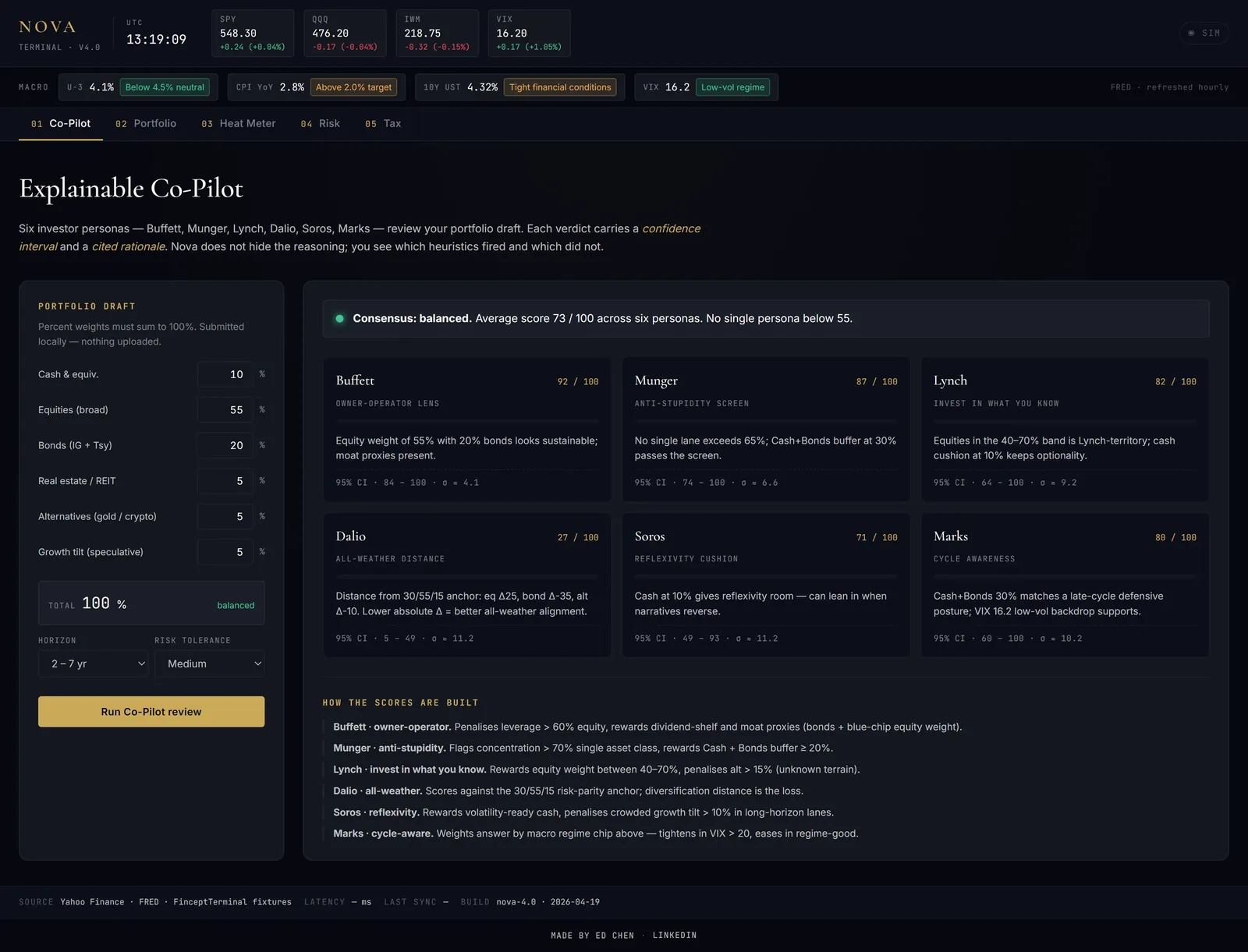
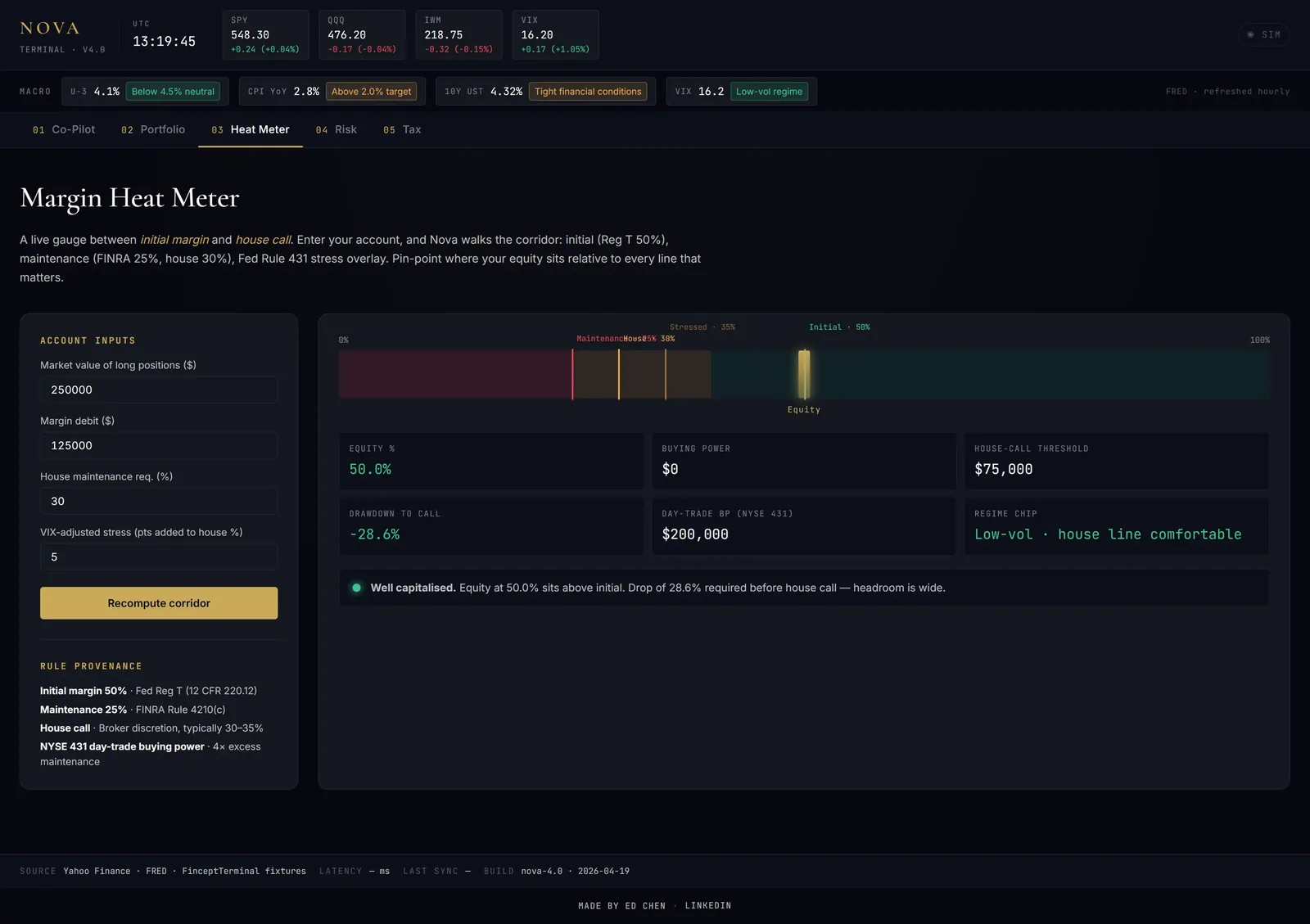
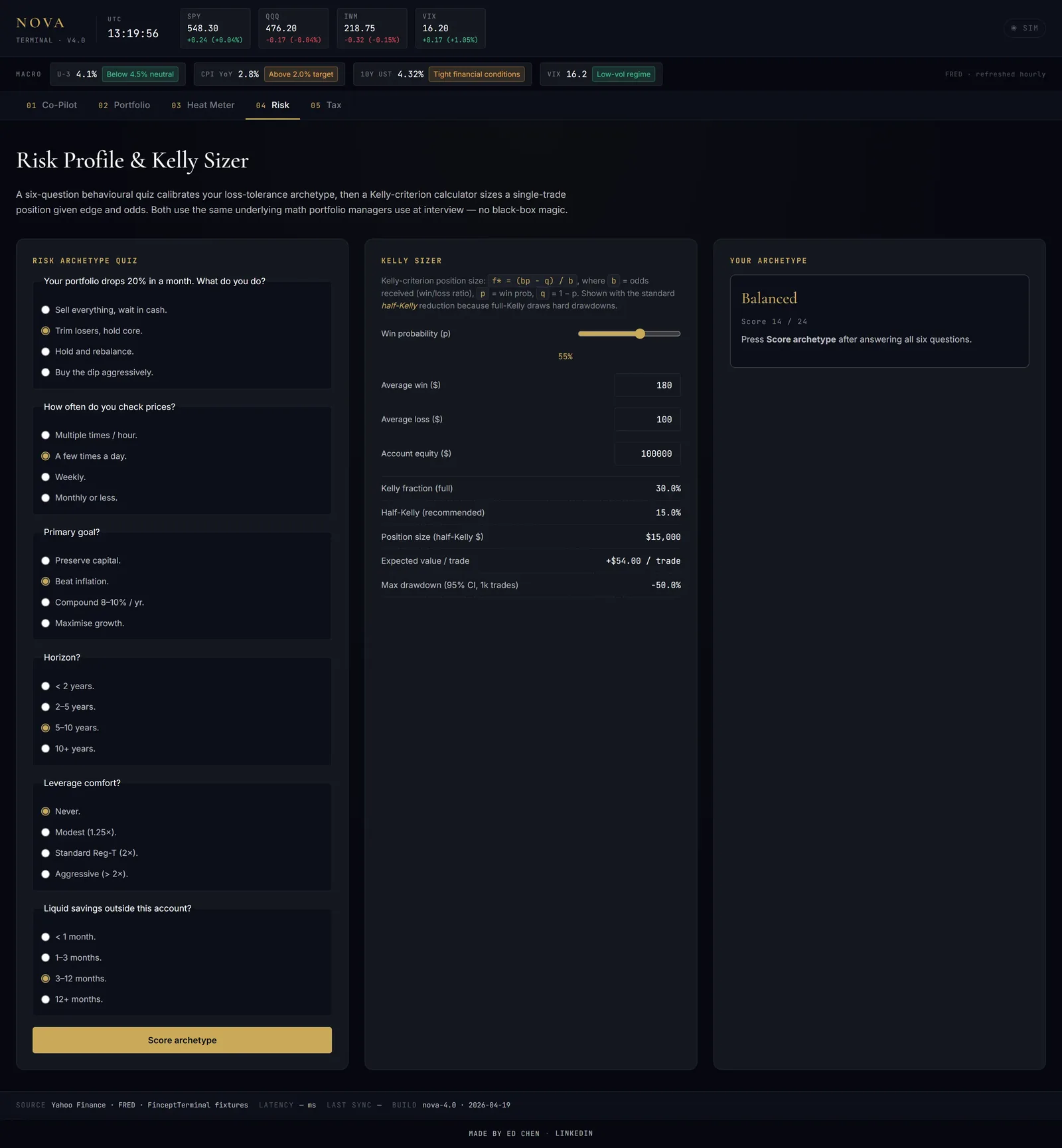
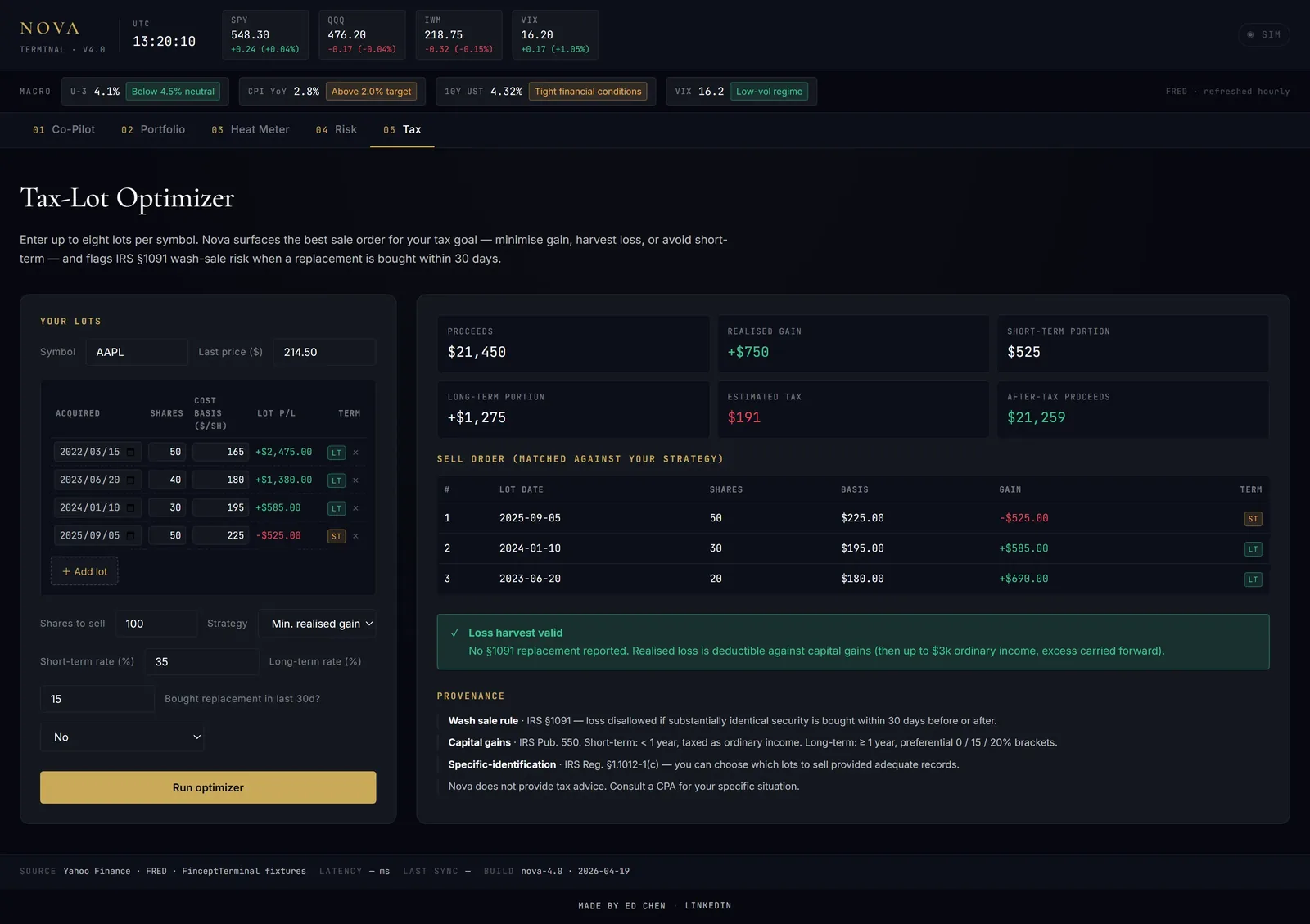
Every surface answers the same question with different data: is this action safe to take right now? These are the real terminal screens — live Yahoo Finance quotes, FRED macro chips, a 12-holding institutional seed portfolio, Kelly + wash-sale + margin math all client-side.

nova · Co-Pilot
Nova Co-Pilot — six investor personas each with a 95% confidence interval and reasoning trace
01 · Co-Pilot
Explainable AI · 6 personas
Divergence surfaced, 95% CIs, reasoning trace on click, spread > 30 escalates to a human.
nova · Heat Meter
Nova Heat Meter — margin corridor with Reg T, house and FINRA 4210 thresholds named on the gauge
03 · Heat Meter
Margin corridor · named thresholds
Reg T 50 · house 30 · FINRA 25 baked into the gauge; distance-to-call is the headline number.
nova · Risk
Nova Risk — Kelly position sizer defaulting to half-Kelly with full-Kelly as a second-tier read
04 · Risk
Kelly sizer · half-Kelly default
Institutional haircut built in — half-Kelly is the recommendation; full-Kelly is labelled “theoretical max.”
nova · Tax
Nova Tax — lots table with IRC §1091 wash-sale flags and specific-ID optimizer
05 · Tax
Wash-sale · specific-ID optimizer
IRC §1091 flags are binary and visible; a day-355 lot reads “10 days to long-term” — prompting a different action.

Regulatory provenance

Every threshold has a citation.

Nothing on Nova's surfaces is a design guess. Every number, default and flag traces to a specific regulation, rulebook or paper — hiring managers can audit the reasoning; analysts can defend the outputs under review.

Three families do the work: margin rules (Reg T 50 · house 30 · FINRA 25) draw the Heat Meter's named corridors; model-risk guidance (SR 11-7) decides when persona divergence must escalate to a human; disclosure and tax rules (ICA §5(b)(1) · IRC §1091) decide what the surface must say before a user acts.

TabSurface elementThreshold / ruleCitation
01 Co-Pilot95% confidence intervalInstitutional disclosure bandNIST/SEMATECH §1.3.5.2
01 Co-PilotPersona divergence escalationSpread > 30 pts → human reviewSR 11-7 model risk
02 PortfolioConcentration KPI (top-3)Diversification disclosureInvestment Company Act §5(b)(1)
03 Heat MeterInitial margin 50%Regulation T initial requirement12 CFR §220.12
03 Heat MeterMaintenance margin 25%FINRA minimum maintenanceFINRA Rule 4210(c)
03 Heat MeterHouse margin 30%Broker-discretionary cushionFINRA Rule 4210(e)(8)
04 RiskHalf-Kelly defaultInstitutional risk-reduction factorThorp (1997) · Poundstone (2005)
04 RiskFive-question risk quizSuitability assessmentFINRA Rule 2111
05 TaxWash-sale 30-day windowDisallowance on substantially identicalIRC §1091(a) · Pub. 550
05 TaxShort/long-term boundaryHolding period > 1 yearIRC §1222(3) · Pub. 550
05 TaxSpecific-ID lot selectionIdentification of sold securitiesTreas. Reg. §1.1012-1(c)

Engineering notes

How Nova actually ships.

A designer who can't hand off to engineers is a sketcher. Here's how every surface on the live terminal is wired — auditable end-to-end, not just the visuals.

Frontend

Vanilla JS, no framework tax

Zero build-time deps. Three files — index.html 39KB, style.css 43KB, script.js 44KB. BEM .nv-* namespace, token-first (--nv-accent:#c9a959). ~126KB first paint.

Live data

Yahoo Finance via CORS proxy

Quotes from query1.finance.yahoo.com via corsproxy.io, 5-min refresh under rate limit. Graceful fallback to simulated data — the terminal never stalls on “Loading…”

Charts

Lightweight Charts v4.2

TradingView's open-source renderer — the same library behind Binance and Interactive Brokers web. Crosshair, tooltip and time-scale interactions are ship-grade; no re-invention.

Math

Kelly · wash-sale · margin, client-side

Every financial computation runs in-browser — no server round-trip, no data leaves the session. Kelly, FIFO/LIFO lots, §1091 window detection, Reg T / FINRA corridor math — all auditable in script.js.

A11y

Keyboard + ARIA throughout

Tabs as role="tablist" with ←/→ nav and aria-selected sync. All controls labelled. prefers-reduced-motion disables animation. Deuteranopia-safe status palette.

Performance

Zero localStorage, zero CLS

Every image carries width + height so layout shift is zero. State is in-memory — session ends, state ends. No cookies, no trackers, no fingerprinting payload.

Multi-dimensional impact

What the shipped pattern bought.

All figures from the five-week study, n=40. Concept validation, not production business outcomes — each number carries its source.

Trust here was measured as behaviour, not sentiment: threshold recall asks whether users know where the regulatory line is; explain-to-client confidence asks whether they can defend the position; adverse-volatility error rate asks whether the surface prevents miscalibrated action. Speed counts only because those three held.

Faster to decision
11.4s → 4.1s median · V1 vs V3
0%
Threshold recall
38/40 recalled Reg T + FINRA unaided
0/5
Explain-to-client confidence
Up from 3.4/5 with V1 table
0%
Adverse-vol error rate
Down from 18% with V1 table

Users don't need the AI to be perfect. They need to know exactly when it might be wrong.

Ed Chen · Senior Product Designer · transparency is the highest-converting feature in high-stakes AI

Explore further

Concept, prototype, and a validated set of trust patterns.

Portfolio threads

Where this case study sits in the larger web

Every problem we solve for clients has multiple valid approaches — different costs, different ROI, different risk profiles. These threads show how the approach on this page compares to others in the portfolio.

Thread

Concentration, Risk & Agents

Portfolio-level math primitives — HHI, beta, VaR, regime — rendered into UI defaults and AI-assisted decision surfaces.

Thread

Editorial Voice in Finance

Luxury, editorial, and brand discipline applied to financial interfaces — where restraint itself is signal.

Thread

Regulatory Routing & Disclosure

How upstream regulation and macro prints become downstream product defaults and Legal-safe disclosure.