Argos
Cross-Asset Financial Crimes Compliance Platform
One platform covering banking transactions, securities surveillance, and real estate compliance — designed for the full AML investigation lifecycle from transaction monitoring through SAR filing. Every design decision starts from the same premise: compliance tools should reduce cognitive load under time pressure, not add to it.
Product designer — Argos (cross-asset AML/CFT surveillance concept)
A financial-crimes surveillance surface across banking, securities and real estate — designed around the investigator’s workflow and the regulator’s evidentiary standard.
Concept design study — figures are design scope (screens, workflows, user roles, the regulatory frameworks designed against), not shipped outcomes.
Prefer YouTube? Watch it there ↗
Financial Crimes Has Three Asset Classes.
Most Compliance Tools Only Cover One.
The defining insight from my research: AML compliance is not a single-domain problem. The same beneficial owner can move money through a bank account, trade securities through a brokerage, and purchase real estate through a shell company — and today's compliance tools treat each as a separate universe. Argos asks: what if an investigator could see all three simultaneously?
A cross-asset AML/CFT surveillance concept that treats the same beneficial owner as one investigation across bank + brokerage + real estate, rather than three separate alerting universes. 40 screens, 4 workflows, 4 user roles, anchored on BSA + FinCEN + FATF + 6AMLD.
- 40 screens across alert triage, investigation, network graph, and SAR filing workflows
- 4 distinct workflows + 4 user roles modelled (investigator, supervisor, compliance officer, auditor) with role-specific data scoping
- Cross-asset framing: bank account + brokerage + real estate beneficial-owner linkage as a single investigation, not three
- Regulatory anchors named by section: BSA 31 CFR § 1010.230, FinCEN CDD, FATF Recommendations 10 + 16, EU 6AMLD
Self-initiated concept, 2024–2025, original IP, zero client overlap — not a production deployment. Grounded in ACY’s 150-component compliance system and Christie’s UHNW due-diligence work, with domain-expert review from Ben Brown, CPA, CFE.
The full case study · ~30 min read
The research, the four users, the cross-asset killer feature, the regulatory framework — read in full, or stop at the summary above.
The Four UsersInformation architectureThe cross-asset killer featureSAR filing workflowRegulatory frameworkResearch & methodology2026 AI threat landscape
| Method | Source / Sample | Key Insight That Shaped Design |
|---|---|---|
| Domain Expert Consultation | Ben Brown, CPA, CFE (Chartered Financial Examiner) — 3 structured interview sessions covering investigation workflows, SAR filing, and rule engine logic | Investigators spend 70% of their time gathering context, not analysing it. The workspace must pre-assemble the investigation narrative — transaction timeline, entity relationships, prior SARs — before the investigator opens a case. |
| Production Experience | Nearly five years at ACY Securities: 150+ regulatory components, 40+ jurisdictions, $2B+ daily settlement (ACY Securities public reporting, 2024); Christie's: UHNW property transactions $5M–$80M | Compliance isn't a feature — it's the architecture. Every screen, every data field, every workflow step must be auditable. The front-door compliance work (KYC, regulatory disclosures) I built at ACY informs the back-office investigation UX of Argos. |
| Competitor Audit | NICE Actimize (enterprise legacy), Lucinity (modern Icelandic), Unit21 (API-first), Hummingbird (fintech-focused) — public documentation and product demos | No competitor covers all three asset classes (banking + securities + real estate) in a single investigation engine. Actimize is closest but operates as separate modules with no cross-asset correlation. This is the product gap Argos occupies. |
| Regulatory Review | BSA/AML (Bank Secrecy Act), FinCEN SAR filing requirements, FATF Mutual Evaluation recommendations, EU 6th Anti-Money Laundering Directive | SAR filing has a 30-day deadline (extendable once). This time pressure shapes everything — the alert queue must be fast, the investigation workspace must consolidate every evidence surface in one view, and the SAR form must be pre-populated from investigation findings. |
| Design Hypothesis | Derived from all above; not validated in production | The highest-leverage design intervention is the investigator workspace — where 22-hour investigations happen. If the tool can pre-assemble context, surface cross-asset connections, and auto-draft SAR narratives, the investigator's job shifts from data gathering to judgment. |
Four Roles. One Investigation Engine.
Financial crimes compliance is a team sport. Each role has different time pressures, decision authority, and information needs. Argos gives each role a purpose-built view while sharing the same underlying case data — because an L1 analyst's dismissal becomes an L2 investigator's escalation becomes a BSA officer's regulatory filing.
L1 Analyst
- Dismiss obvious false positives in under 2 minutes per alert
- Escalate suspicious patterns to L2 with sufficient context
- Process 80–120 alerts per shift without fatigue-induced errors
- Trust the risk score to prioritise the queue correctly
L2 Investigator
- Build a complete investigation narrative from escalated alerts
- Connect disparate data points across banking, securities, and real estate
- Document findings with regulatory-grade evidence chains
- Decide: dismiss with rationale, or recommend SAR filing
Compliance Manager
- Monitor team workload and case distribution across investigators
- Ensure SAR filing deadlines are met across all active cases
- Identify bottlenecks before they become regulatory violations
- Review and approve SAR filings before submission to FinCEN
BSA Officer
- Maintain the institution's BSA/AML compliance program
- Review high-risk SAR filings before FinCEN submission
- Ensure rule engine calibration reflects current regulatory guidance
- Report to the board on compliance program effectiveness
Three Problems Worth Solving
The False Positive Crisis
a figure widely repeated in vendor material — 85–95% of alerts generated by legacy transaction monitoring systems are false
positives. That means an L1 analyst dismisses 85–95 out of every 100 alerts —
and must stay sharp enough to catch the 5–15 that matter. The design challenge:
how do you make dismissal effortless without making real threats dismissible?
The answer is risk-scored queueing (highest risk first, then age), keyboard-driven
triage (d = dismiss, e = escalate, → = next), and pre-computed rule explanations
that let the analyst see why the alert fired before deciding.
Cross-Asset Correlation
A beneficial owner purchases a $12M property through a shell company in a GTO
jurisdiction, while a linked entity trades large-cap equities through a brokerage
account, and a third entity wires funds through a correspondent banking relationship.
Today, these are three separate investigations in three separate systems.
The challenge: how do you design an entity resolution interface that makes these
connections visible, explorable, and documentable — without overwhelming the
investigator with false entity matches?
AI Trust in a Regulated Environment
AI can accelerate investigations — suggesting connections, drafting SAR narratives,
scoring confidence on entity matches. But compliance is a regulated domain: every
decision must be explainable, every recommendation auditable, every automated
action logged.
The challenge: how do you design an AI co-pilot that investigators trust enough to
use but don't trust enough to defer to blindly? The answer: sidebar augmentation
(not embedded automation), confidence scores on every suggestion, and a visible
reasoning chain the investigator can accept, modify, or reject.
Financial Crimes Is Not a Trading Platform.
They Solve Opposite Problems.
Most of my production experience is in trading platforms (ACY Securities, Finlogix, LogixTrader). Before designing Argos, I had to explicitly map where those patterns apply — and where they would actively harm the compliance investigation experience.
| Dimension | Trading Platform (ACY / LogixTrader) | Compliance Investigation (Argos) |
|---|---|---|
| Primary emotion | Urgency, speed, competitive edge | Thoroughness, accuracy, regulatory confidence |
| Data density | Maximum — expert users want 120+ concurrent metrics | High but structured — investigators need context, not raw feeds |
| User intent | Execute — open app to trade | Investigate — open app to build a case narrative |
| Session length | Long, frequent (active traders check every few minutes) | Long, deep (4–8 hour investigation sessions per case) |
| Time pressure | Milliseconds matter — latency = lost money | Days matter — 30-day SAR deadline, but thoroughness over speed |
| Success metric | Task completion speed (order execution: 8.2s → 2.9s) | Investigation quality (SAR accuracy, false positive reduction, audit readiness) |
| AI role | Algorithmic trading — speed and automation valued | Augmentation only — every AI suggestion must be explainable and auditable |
| What transfers | Keyboard-driven interfaces, data density management, real-time data architecture, information hierarchy design | |
What transfers from trading platform work: keyboard-driven UI (triage shortcuts mirror trading hotkeys), data density management, real-time data architecture, cross-functional regulatory collaboration. What doesn't transfer: speed-over-accuracy mental models, automation-first AI, or the assumption that users want to act fast rather than act right.
Three Asset Classes. One Investigation Engine.
Argos is built as a shared core (70%) + asset-specific modules (30%). The alert queue, case management, SAR filing, and team operations are shared. Each asset class brings its own data models, detection rules, and regulatory requirements. The cross-asset correlation engine connects entities across all three.
Banking & Payments
Transaction monitoring, AML sanctions screening, customer due diligence. Nearly five years of compliance infrastructure at ACY Securities — 150+ regulatory components, 40+ jurisdictions, $2B+ daily settlement volume (ACY public reporting, 2024). This is the foundation: wire transfers, correspondent banking, CTR thresholds, structuring detection.
Liquid Assets & Securities
Order book reconstruction, trading pattern analysis, market abuse detection. Informed by LogixTrader, Finlogix, and ACY's securities trading infrastructure. Pattern detection: layering, spoofing, wash trading, pump-and-dump schemes. High-frequency data ingestion with sub-second latency requirements.
UHNW Property Oversight
Property risk scoring, beneficial ownership tracing, GTO jurisdictional compliance. Drawn directly from Christie's production work on $5M–$80M asset transactions and cross-border ownership structures. Shell company detection, sanctioned entity screening, FinCEN Geographic Targeting Order monitoring.
Explore the Argos App
All four workflows are fully interactive. Built in React with shadcn/ui, Tailwind, and 30+ feature components — open the prototype to navigate between the command center, alert triage, investigator workspace, and SAR filing flows.
From User Flows to Component Library
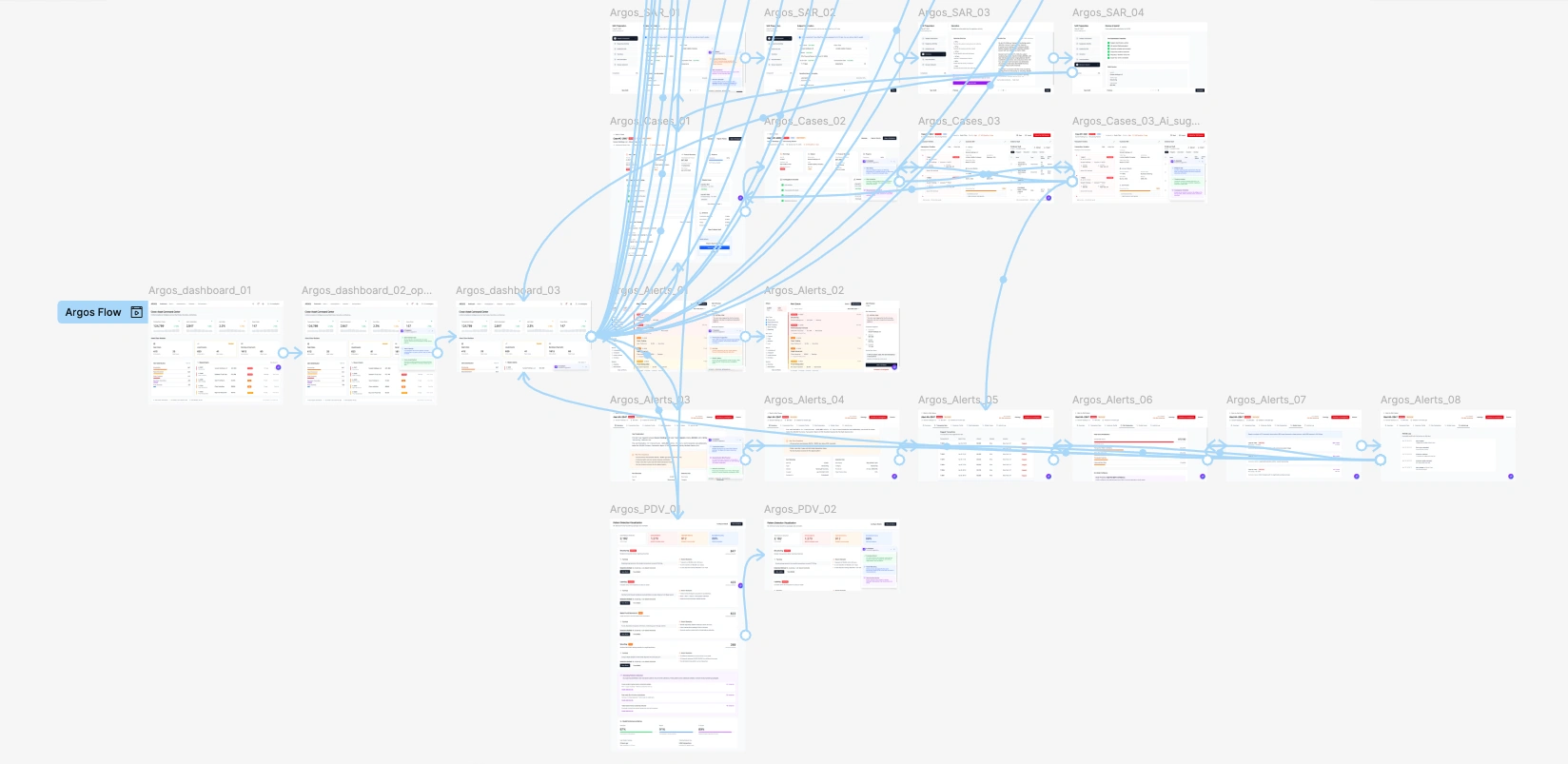
Before any screens, the full investigation lifecycle was mapped as a user flow — from alert generation through triage, investigation, and SAR filing. The component library spans 120+ compliance-specific patterns, built to handle the data density and regulatory requirements of financial crimes investigation.
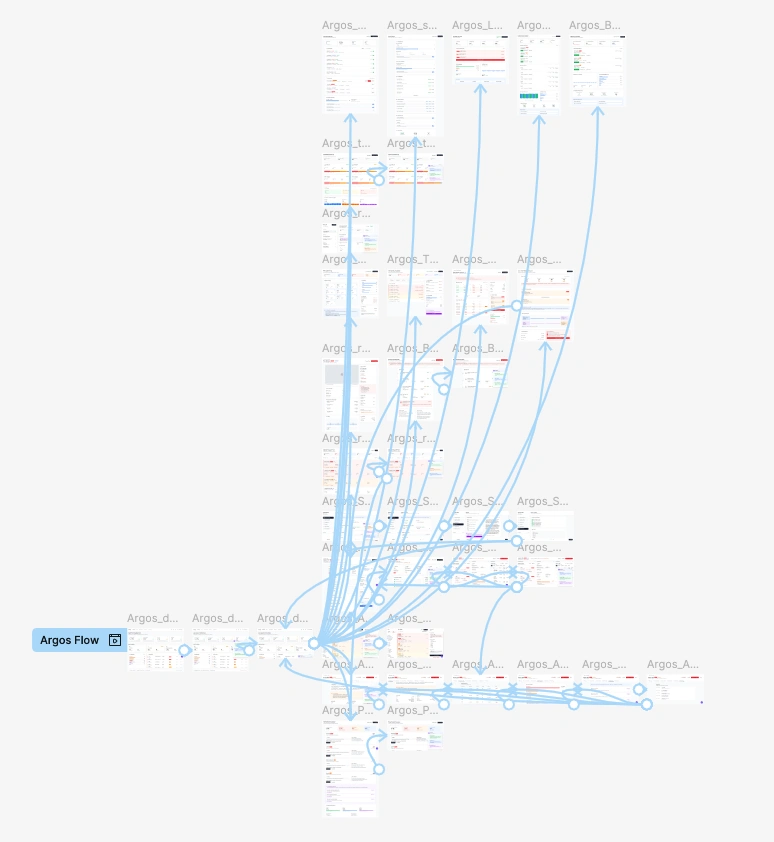
User Flow: Alert Generation → Triage → Investigation → SAR Filing
Component Library: 120+ Compliance-Specific Patterns
The Operational Nerve Center — Morning Standup in One Screen
The Command Center is designed for compliance operations leadership: morning standups, shift handoffs, and real-time situational awareness. At a glance: today's alert volume, team workload distribution, risk concentration across asset classes, SAR filing pipeline, and system health. The design principle: a compliance director should know the state of the operation within 30 seconds of opening this screen.
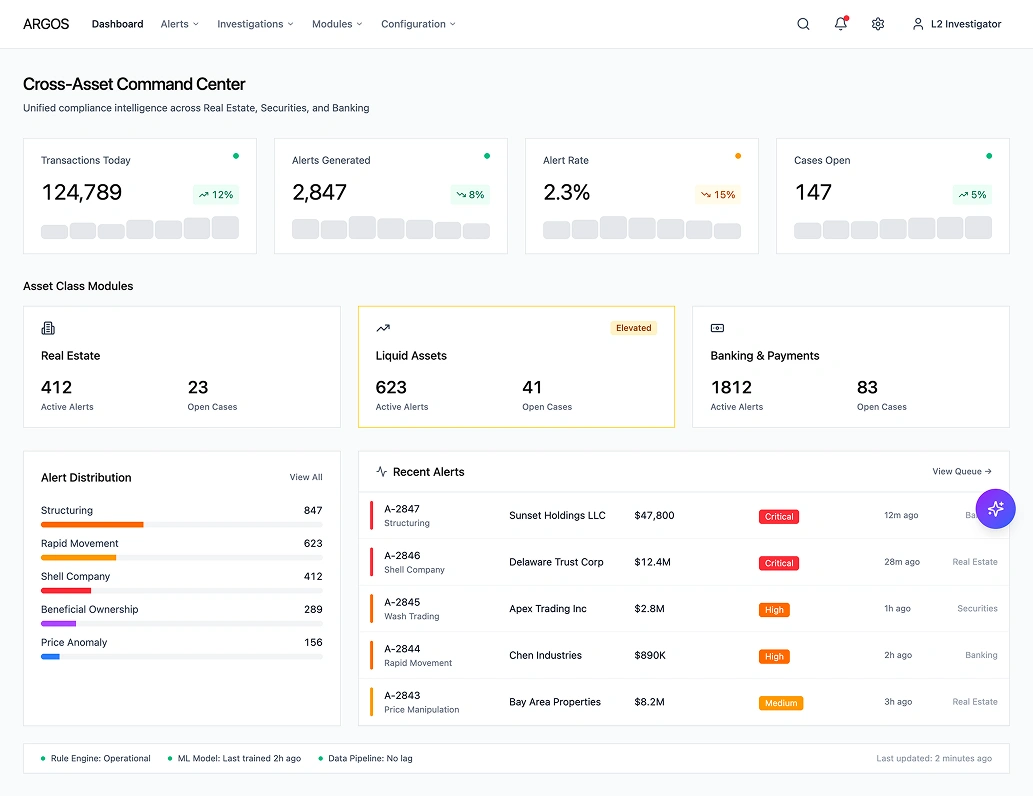
Command Center — Operational Overview with Cross-Module Risk Distribution
12 KPI Cards, Each Clickable
Alert volume, queue depth, SARs in review, team utilisation, filing deadlines, rule engine health — each card is a drill-down entry point. The compliance director sees the pulse; clicking reveals the granular data underneath.
Three-Module Risk Distribution
Banking, securities, and real estate risk are shown side-by-side. If 80% of high-risk alerts are coming from the real estate module, the director can reallocate investigator bandwidth before it becomes a bottleneck.
Team Workload as a First-Class Metric
Investigator utilisation isn't hidden in an HR system — it's on the main dashboard. If one investigator has 15 active cases and another has 3, the imbalance is visible before it affects filing deadlines.
AI Co-Pilot Panel for Bulk Operations
The AI sidebar surfaces operational recommendations: "3 cases approaching 30-day deadline — recommend reassignment" or "Rule 47 has generated 200+ false positives this week — consider threshold adjustment." Suggestions, not decisions.
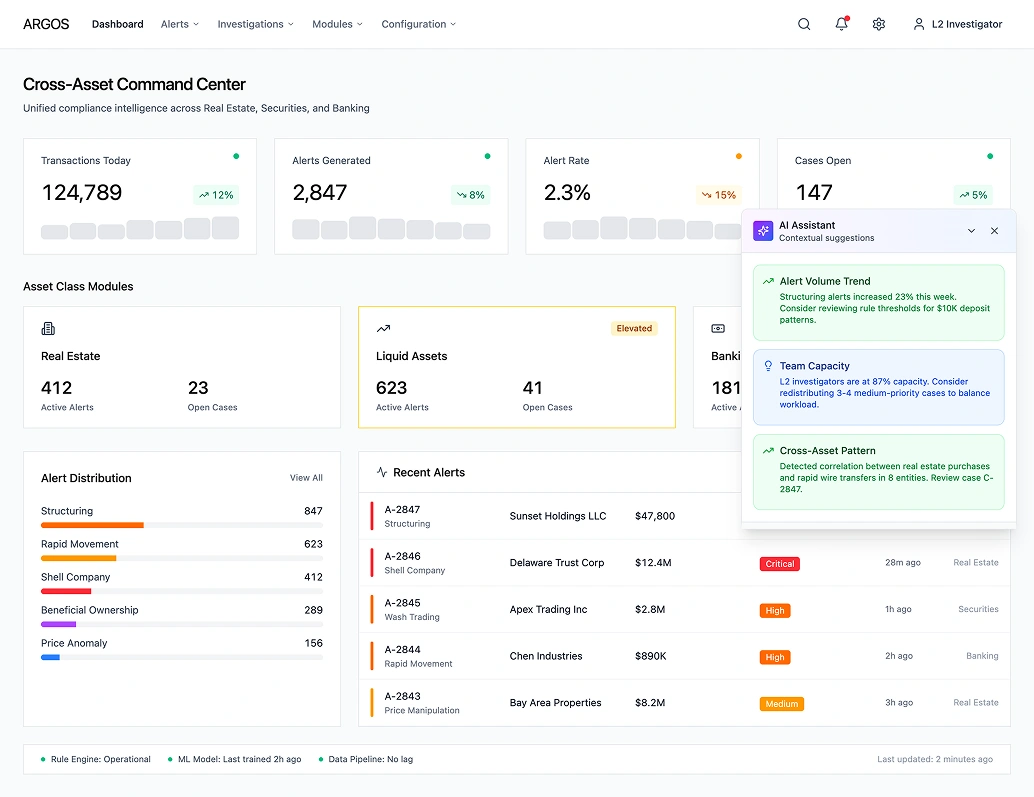
AI Co-Pilot Panel — Operational Recommendations and Bulk Actions
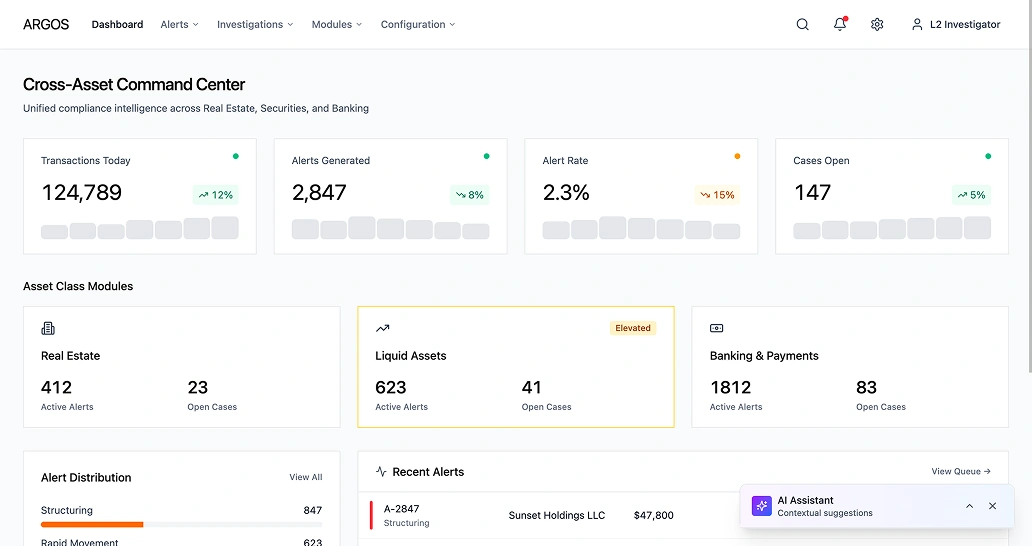
Alternative Dashboard Layout — Optimised for Command Room Displays
85% of Alerts Are False Positives. Design for That Reality.
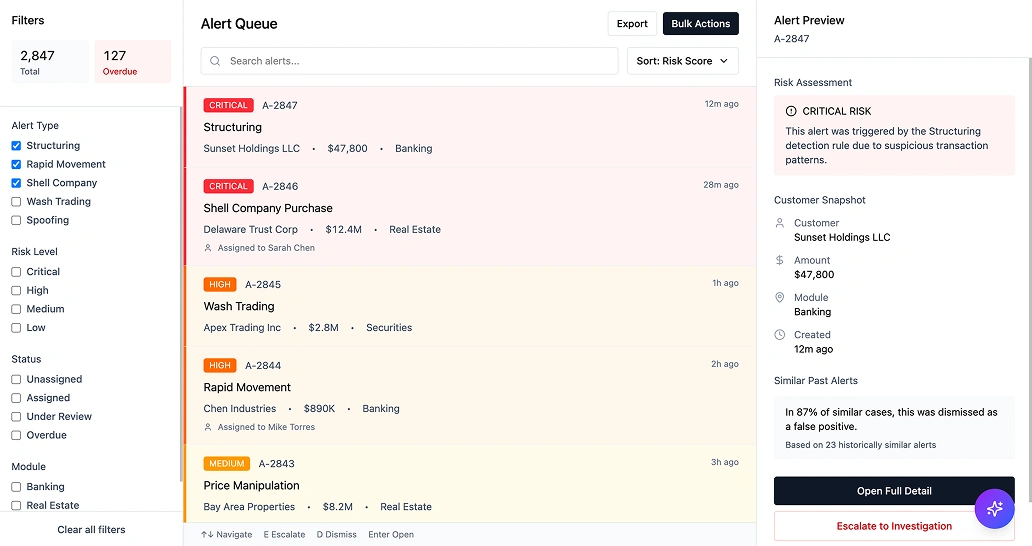
The alert triage queue is where the speed of false positive dismissal becomes the competitive edge. Argos prioritises risk-scored queueing, one-second rule engine evaluation, and keyboard-driven triage. This is where 85% of alerts are filtered out — it must be frictionless for the obvious dismissals and thorough for the genuine threats. The L1 analyst's keyboard shortcuts (d = dismiss, e = escalate, → = next) compress 8-hour investigation days into 3.
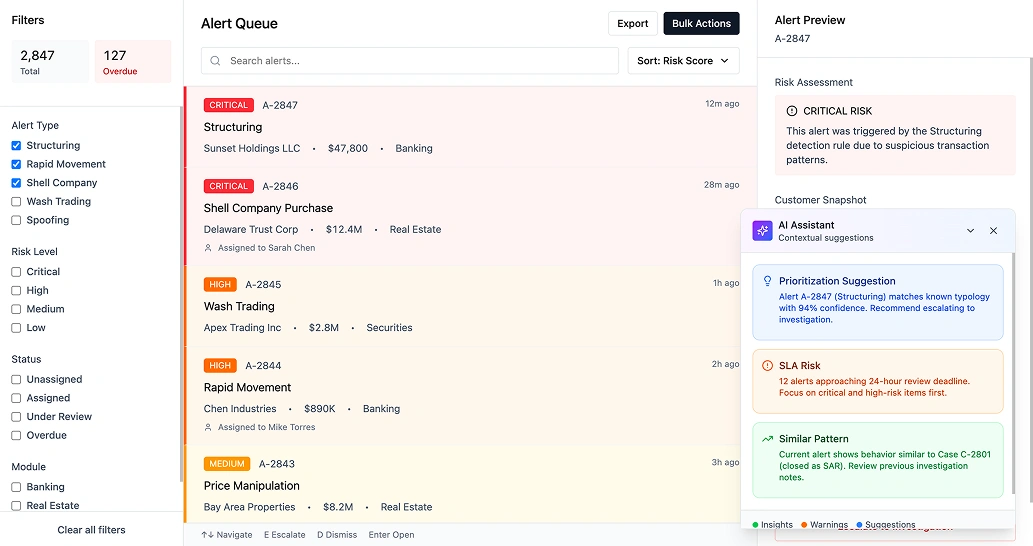
Alert Queue — Risk-Scored Priority with Keyboard-Driven Triage
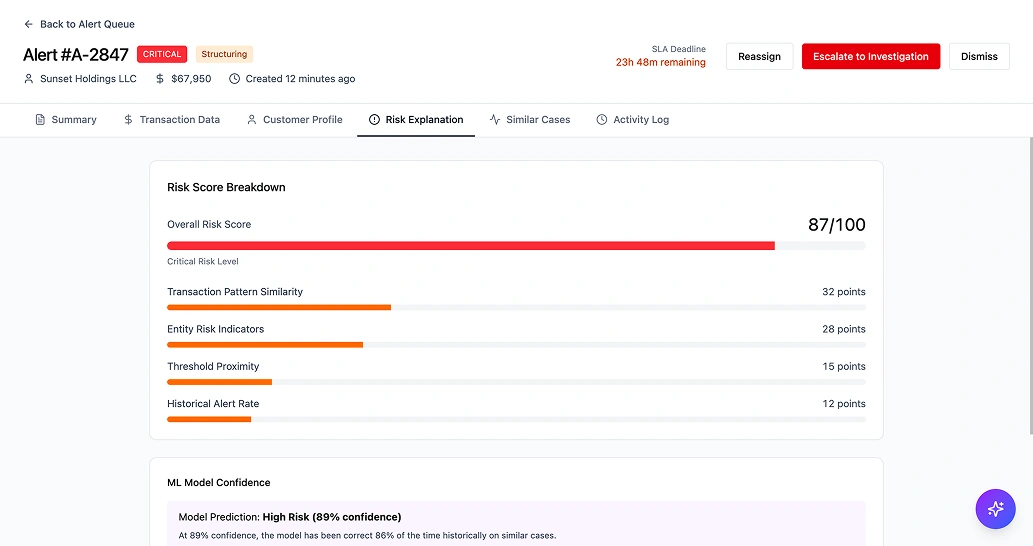
Risk Score Drives Queue Order
High-risk PEP alerts surface above medium-risk structuring patterns. Secondary sort by age prevents starvation of older medium-risk cases. The analyst's attention goes to the things that matter first.
Keyboard-First Interaction Model
d = dismiss, e = escalate, → = next alert, ← = previous. Trading floor culture demands speed — this triage interface borrows that mental model. Mouse-optional for the entire workflow.
Rule Explanation Before Decision
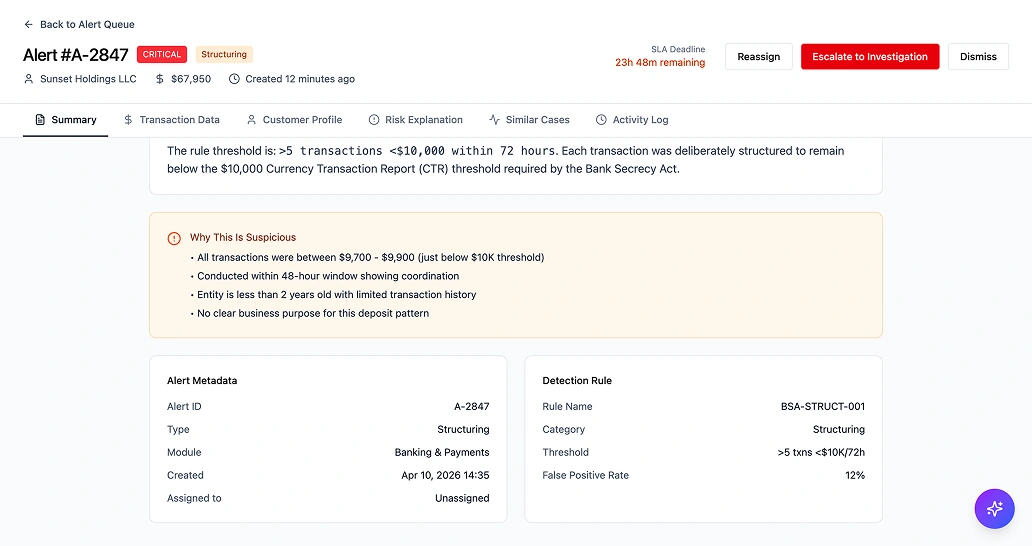
Every alert shows which rule fired and why. "Structuring: 4 cash deposits of $9,800 within 48 hours" — the analyst sees the pattern, not just the flag. This context is what makes a 2-minute dismissal defensible in audit.
Batch Operations for Rule Corrections
When a rule generates 200 false positives, dismissing them one-by-one is not viable. Batch dismiss with a shared rationale saves hours and creates a clean audit trail for the rule adjustment that follows.
Alert Detail — Rule Explanation and Transaction Context
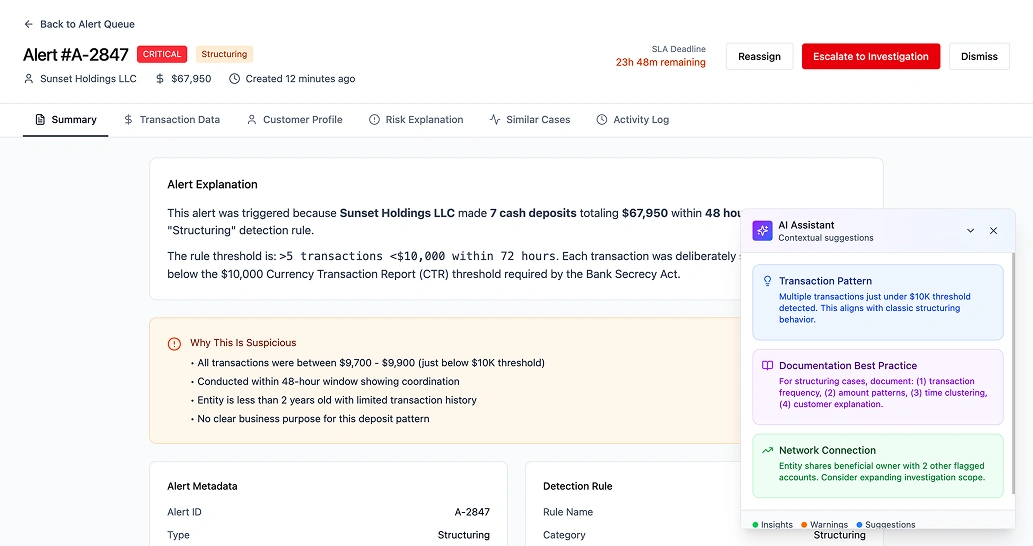
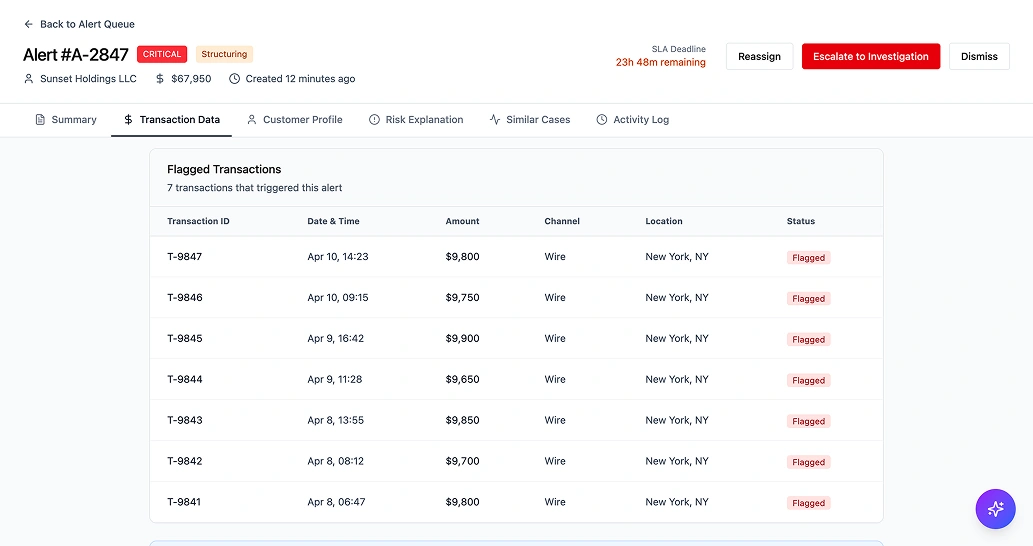
Transactional Details — Wire Transfer Pattern Analysis
Escalation Flow — L1 → L2 Handoff with Full Context
Batch Dismiss — Shared Rationale for Rule-Generated False Positives
Advanced Filtering — Jurisdiction, Rule Type, Risk Level
Sorting Controls — Risk, Age, Investigator Availability
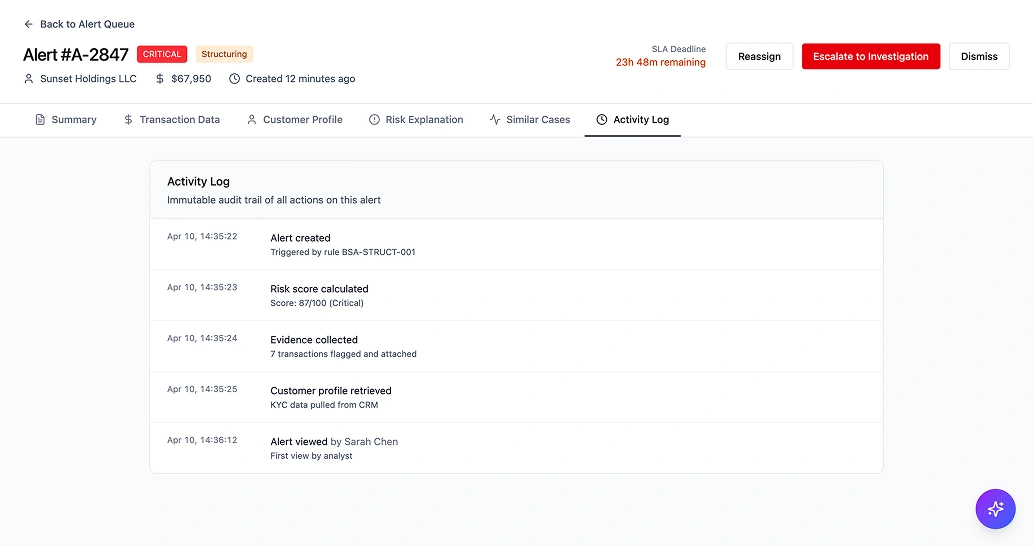
L1 Analyst Personal Dashboard — Shift Performance and Queue Metrics
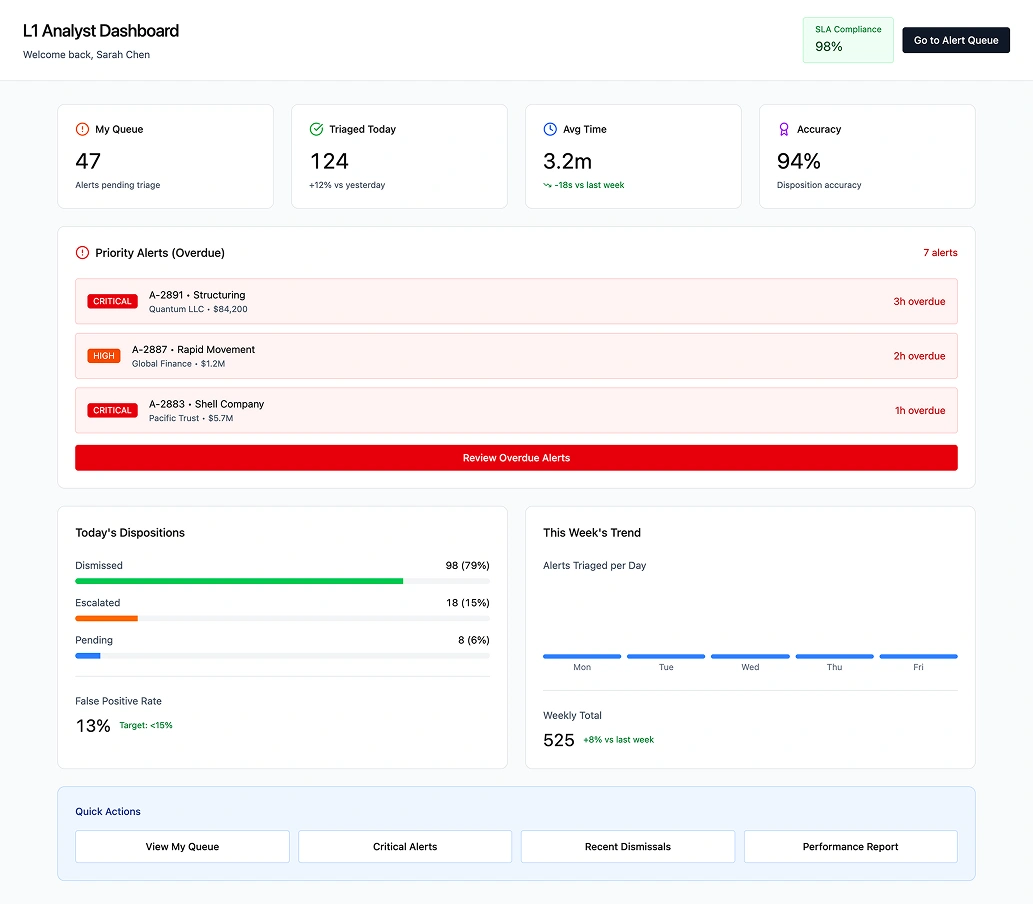
L1 Analyst Workspace — Personal Queue, Performance Metrics, Rule-Level Insights
22 Hours of Investigation. One Screen to Rule Them All.
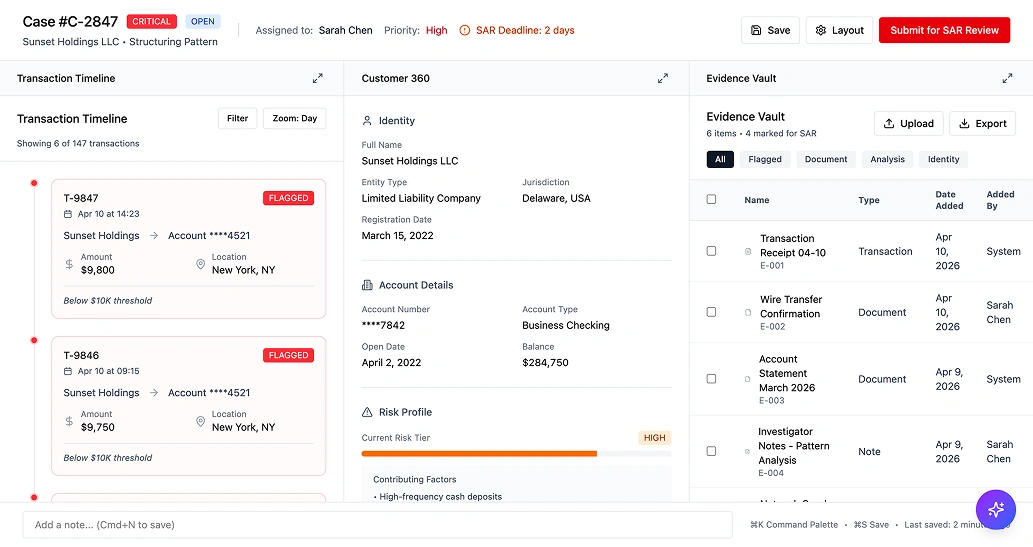
The investigator workspace is the hero of Argos — where 22-hour investigations happen. It's designed for deep dives: connecting disparate data points across banking, securities, and real estate; building narrative chains from transaction timelines; and documenting findings under the 30-day SAR deadline pressure. The AI Co-Pilot provides real-time suggestions for missing leads while maintaining full explainability and confidence calibration — because in compliance, "the AI said so" is not a valid rationale.
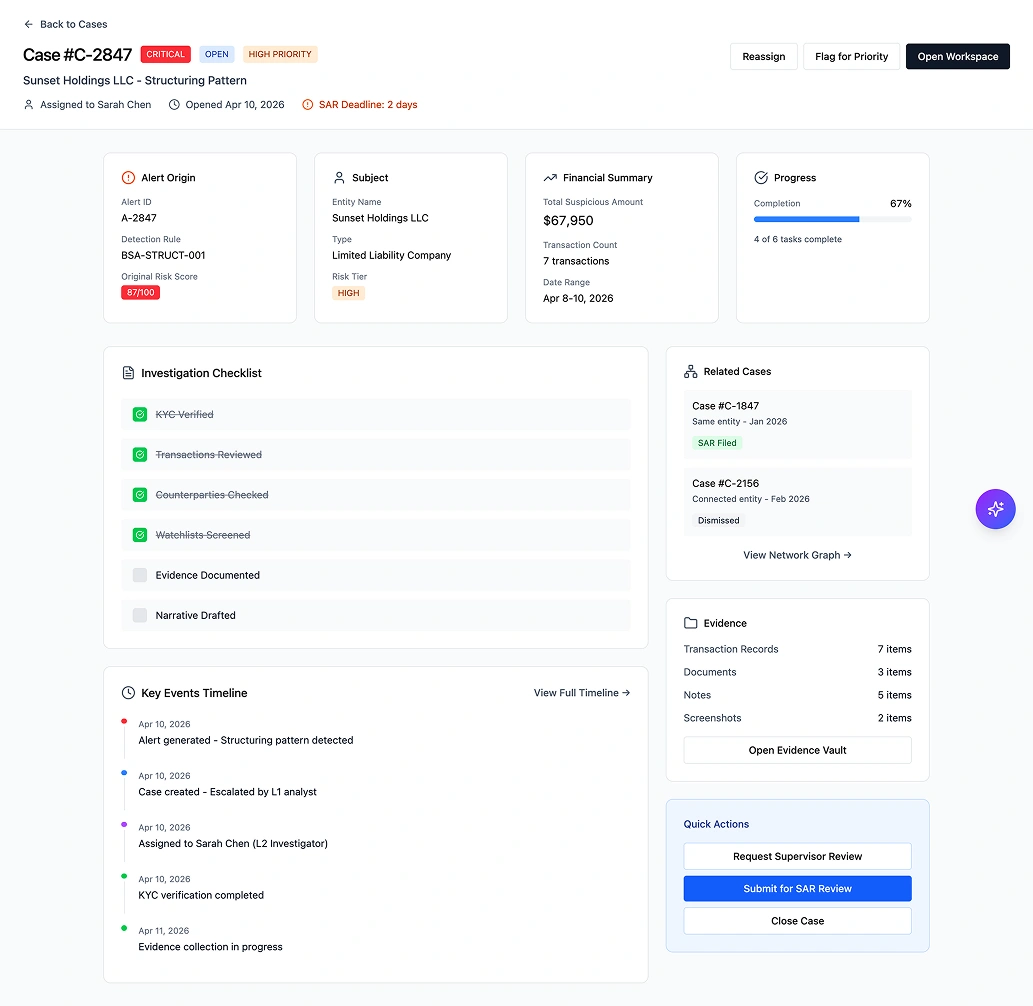
Case Detail — Investigation Timeline, Document Explorer, Evidence Chain
Pre-Assembled Investigation Context
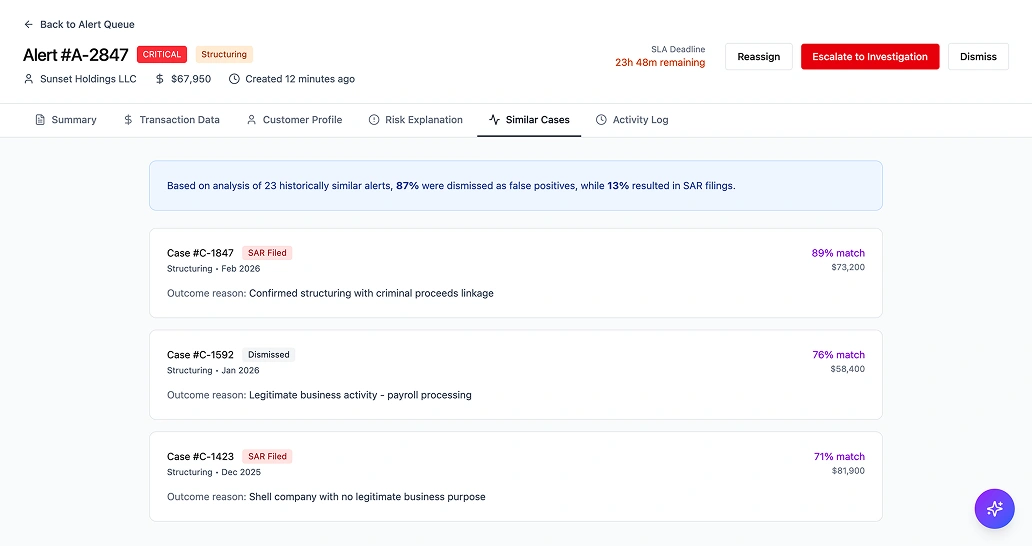
When the investigator opens a case, the context is already there: the original alert, the customer profile, the transaction history, prior SARs filed on this entity, and related cases across all three asset classes. The investigator's job starts at analysis, not data gathering.
AI Co-Pilot — Suggestions, Not Decisions
Every AI suggestion shows: confidence score (0–100%), data sources used, reasoning chain, and alternative interpretations. The investigator can accept, modify, or reject. All AI interactions are logged and auditable for regulatory review.
Narrative-Driven Investigation UI
Trading dashboards show numbers; compliance needs stories. The case management interface is built around a narrative timeline — "On Jan 15, Entity A wired $2.3M to Entity B, which purchased a property in a GTO jurisdiction 3 days later." This is how SARs are written, so this is how investigations should be structured.
Evidence Linking Across Asset Classes
A single investigation can reference banking transactions, securities trades, and real estate records. The workspace lets the investigator link evidence from any module into the case file — building the cross-asset narrative that no single-domain tool can produce.
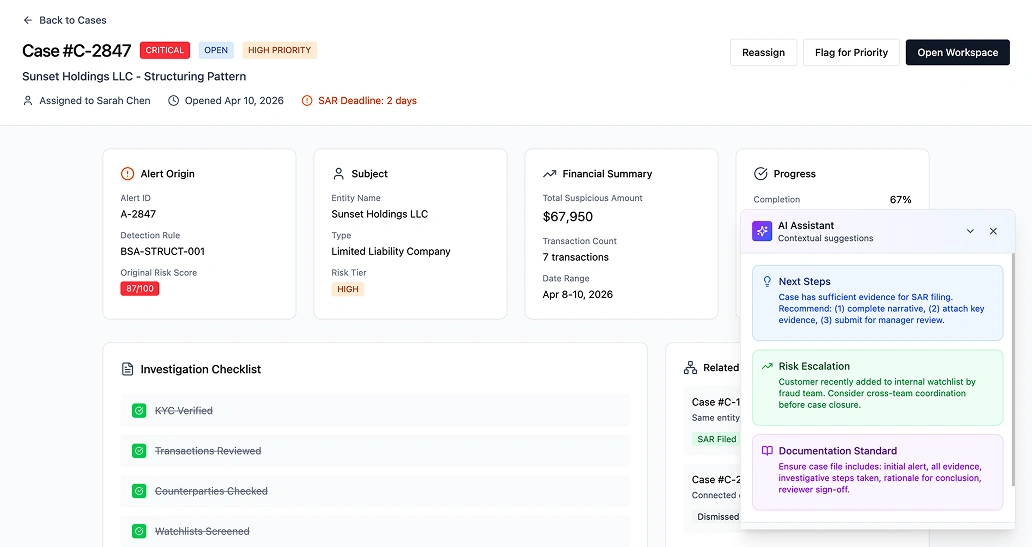
Evidence Collection — Linking Transactions, Documents, and Entity Records
In-Case Network Analysis — Entity Relationship Visualisation
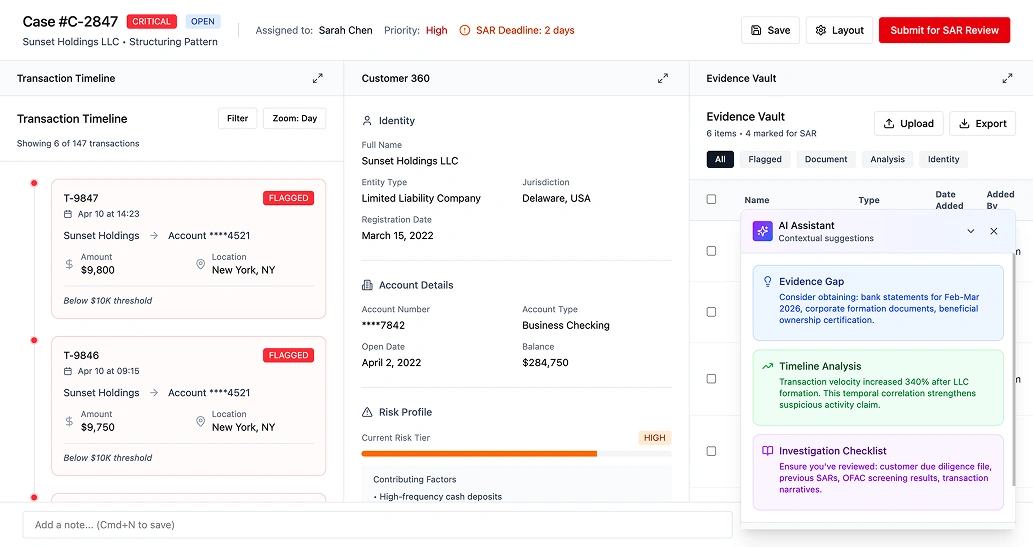
AI Co-Pilot — Suggested Connections, Missing Leads, Confidence Scores (78% Match Confidence Shown)
Key Design Decision: AI as Sidebar, Not Embedded
The AI Co-Pilot lives in a collapsible sidebar, not embedded in the investigation flow. This is deliberate: the investigator maintains full control of the narrative. AI suggestions appear alongside the work, not inside it. The investigator can pull a suggestion into the case file with one click — or ignore it entirely. Both actions are logged. This architecture means every investigation is human-driven with AI augmentation, never AI-driven with human approval. That distinction matters to regulators.
The Killer Feature: See the Same Person Across Three Asset Classes
Automated beneficial ownership tracing and cross-asset correlation. A real estate transaction, a securities account, and a banking relationship are connected by the same Ultimate Beneficial Owner (UBO). Argos joins these dots in real time — and makes the connections explorable, documentable, and linkable to active investigations.
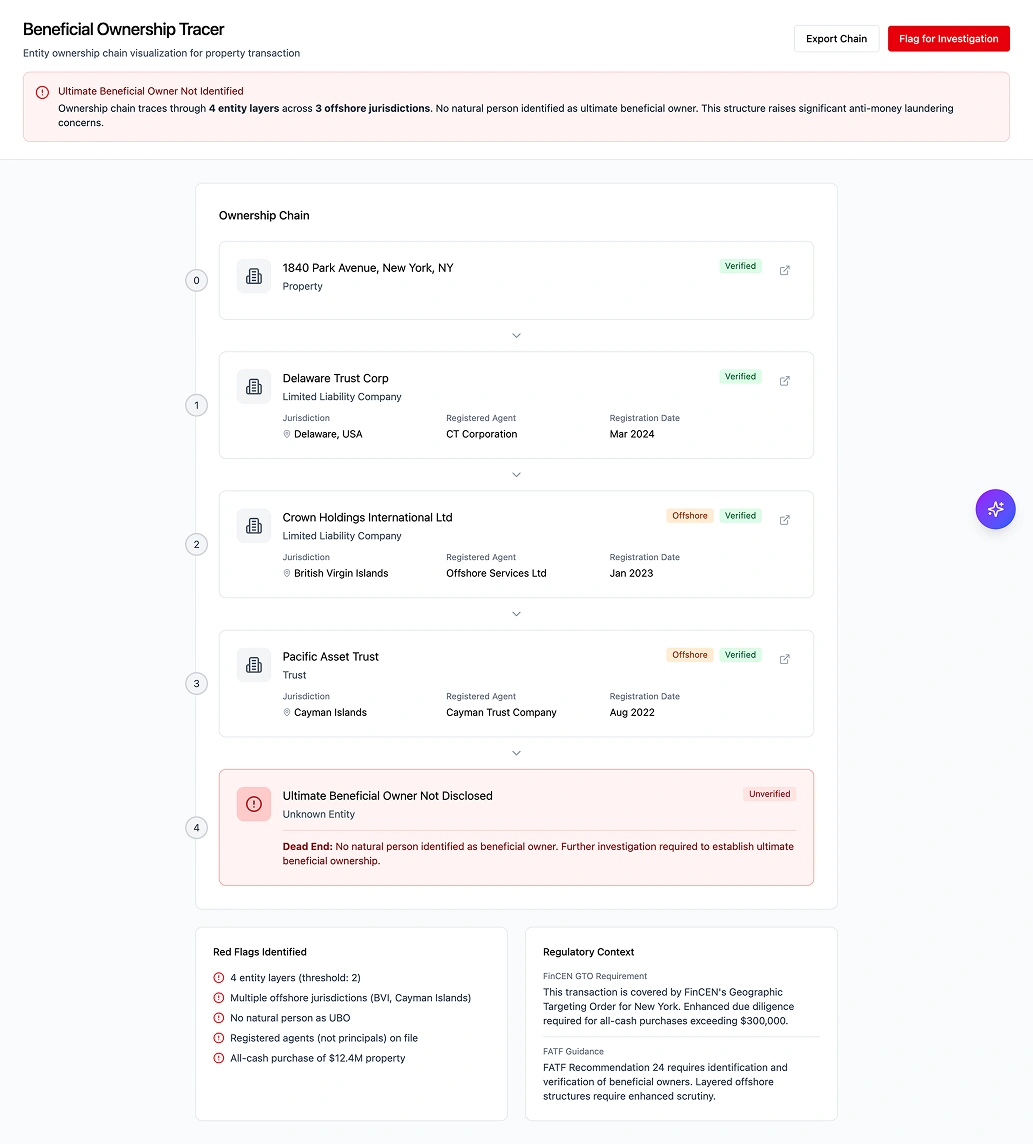
Beneficial Ownership Tracer — Entity Resolution with Ownership Chains
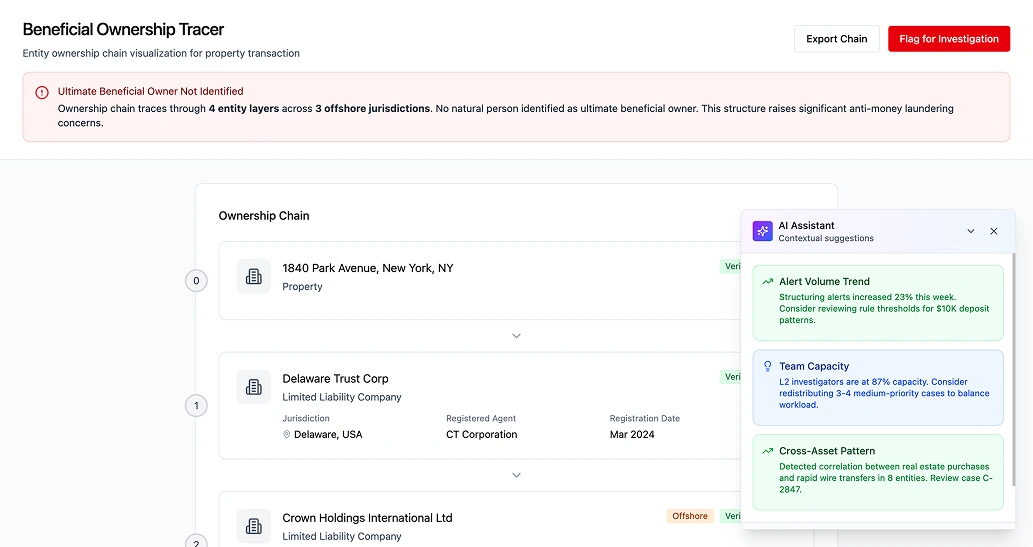
Network Expansion — Following Ownership Chains Through Shell Companies
Entity Graph, Not Just Entity List
Ownership structures are visual, not tabular. The investigator can see that Entity A owns 60% of Entity B, which owns 40% of Entity C — and that Entity C purchased a $12M property in Miami. The graph makes layered ownership structures immediately comprehensible.
Jurisdictional Risk Overlay
Each entity node shows its jurisdiction and associated risk level. A Cayman Islands holding company connected to a Panama trust connected to a US property purchase — the jurisdictional pattern is visible before the investigator reads a single document.
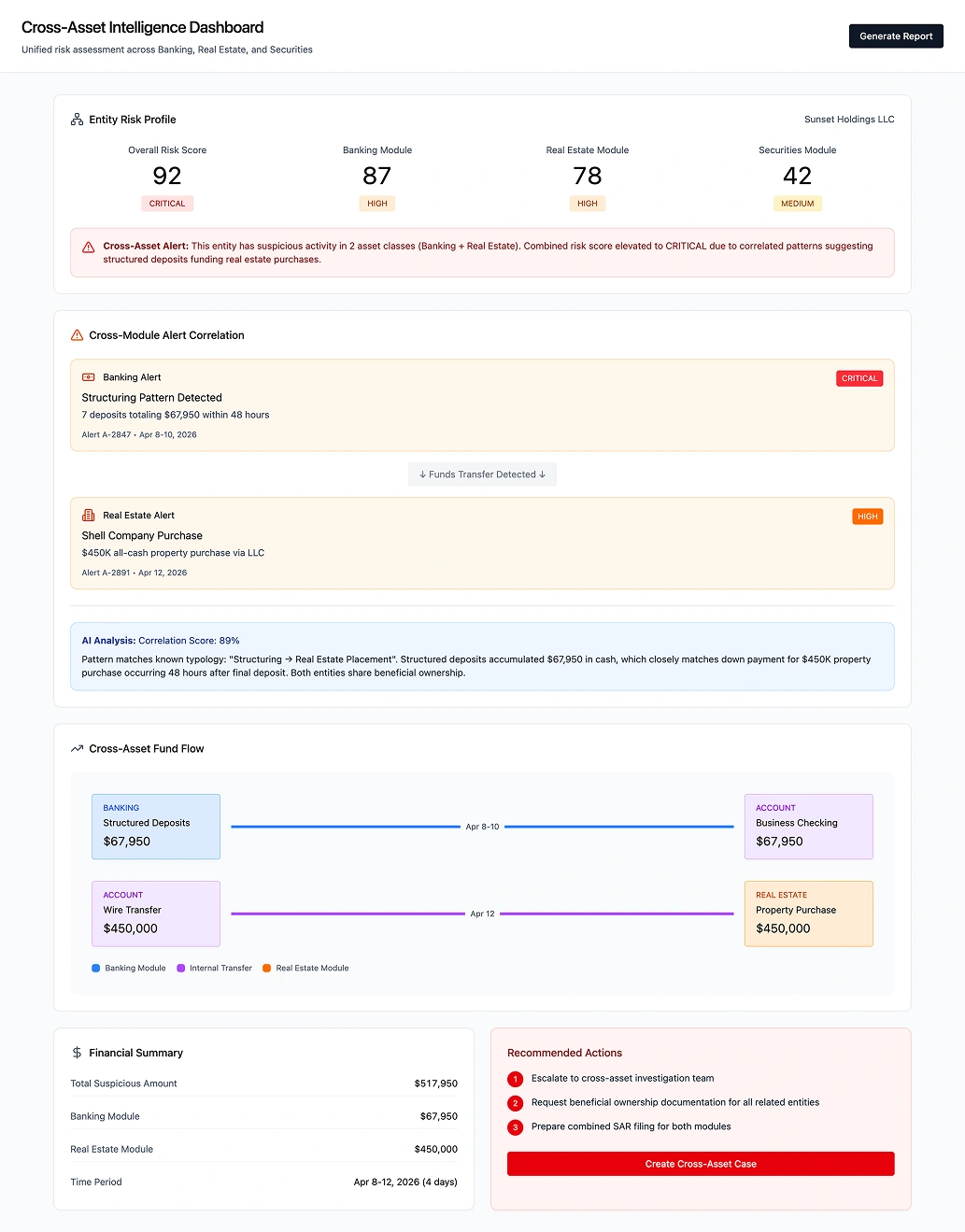
CAID (Cross-Asset Intelligence Dashboard) — Unified Customer View Across All Three Modules
One Customer, Three Asset Classes, One Screen
The CAID shows banking activity (wire transfers, account balances), securities activity (trading patterns, portfolio positions), and real estate activity (property ownership, transaction history) for a single entity. This is the view that doesn't exist in any competitor product — and the view that cross-asset investigations require.
Risk Signals Aggregated, Not Siloed
A customer with low risk in banking, medium risk in securities, and high risk in real estate has a different risk profile than any single module would suggest. The CAID aggregates risk signals across all three domains into one cross-domain verdict that reflects the actual threat.
$80M Properties Deserve More Than a Checkbox
Christie's UHNW experience informs this module: risk scoring for properties $5M+, sanctioned entity detection, beneficial ownership compliance, and Geographic Targeting Order (GTO) jurisdictional overlay. Every property transaction, every entity structure, every wire is cross-checked against sanctions lists, PEP databases, and adverse media.
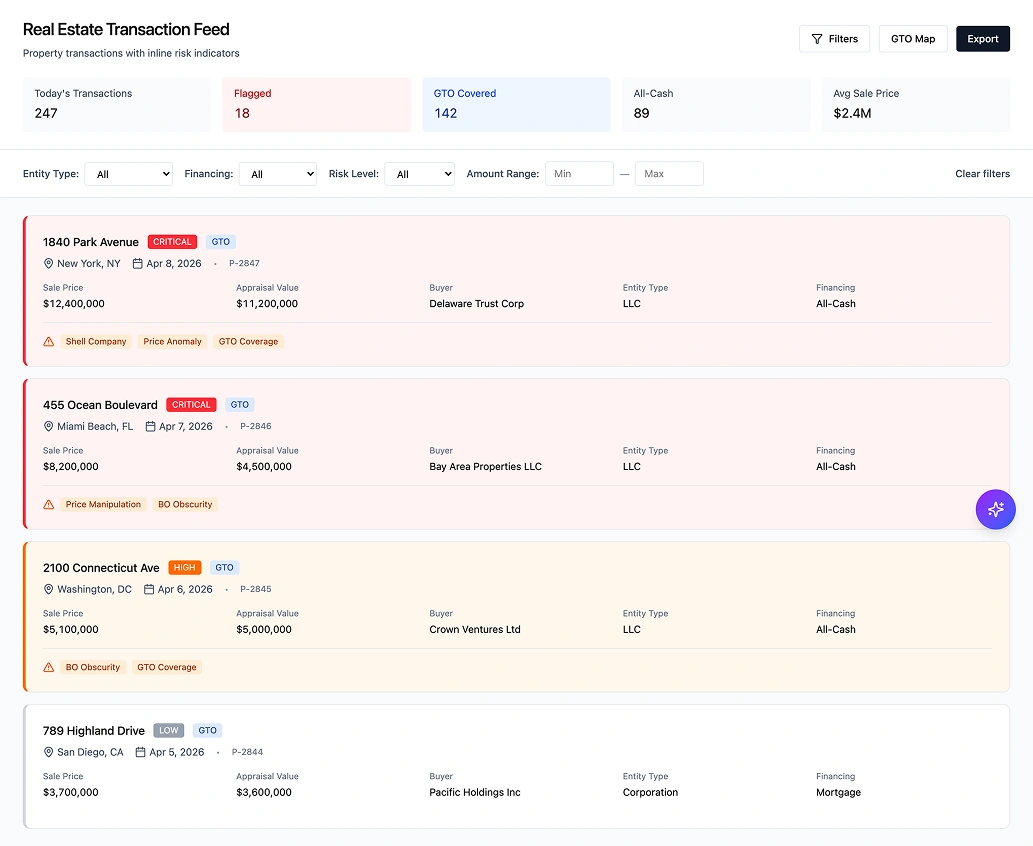
Property Risk Assessment — Value, Ownership Structure, Risk Indicators
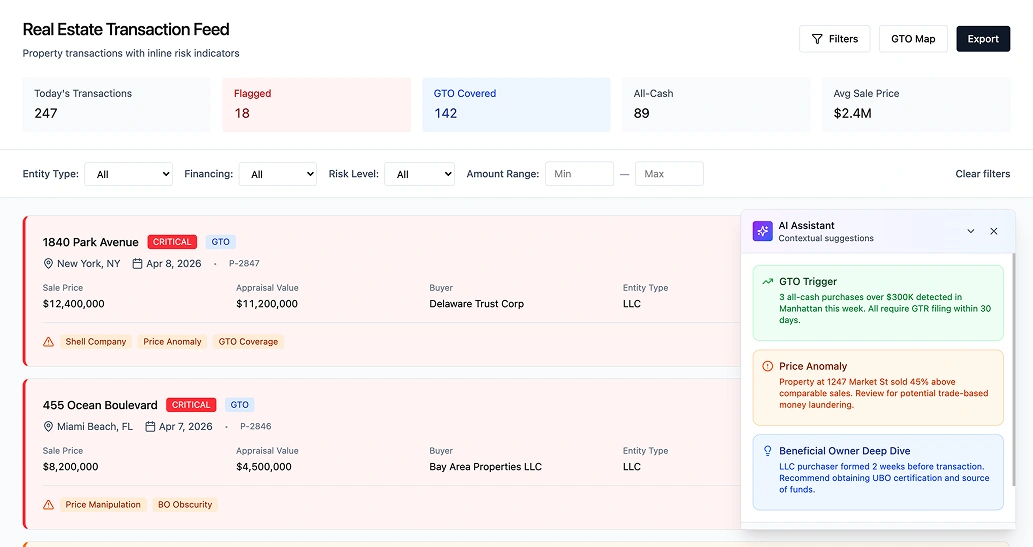
Beneficial Ownership Verification — Multi-Layer Entity Structure
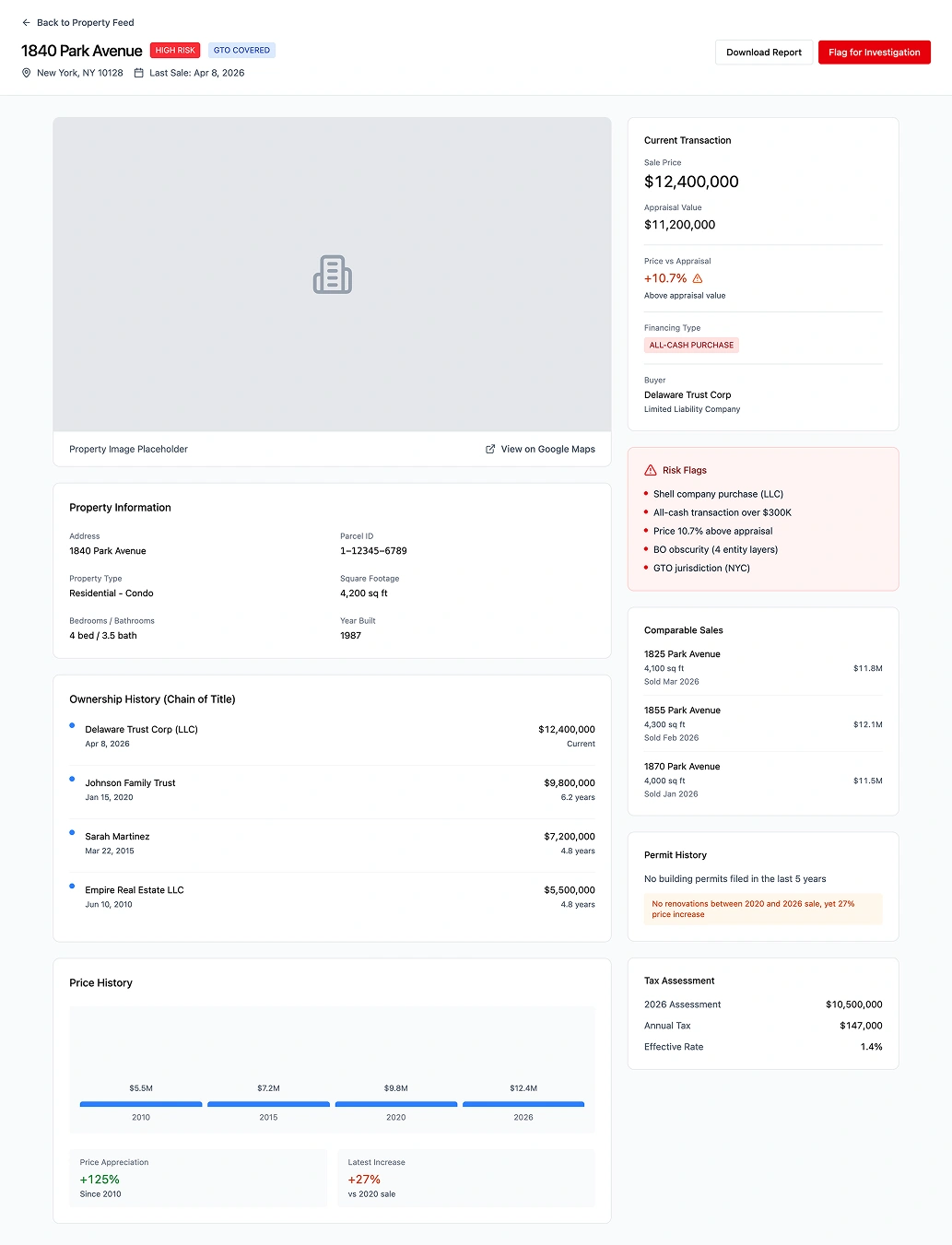
Fund Source Tracking — Wire Origins, Intermediary Banks
Property Risk Scoring
Every property above $5M is automatically scored based on: purchase price relative to market value, buyer entity structure complexity, jurisdiction risk, fund source transparency, and PEP/sanctions match probability. The score determines investigation priority.
GTO Jurisdictional Overlay
FinCEN Geographic Targeting Orders require all-cash real estate transactions above thresholds in certain jurisdictions to report beneficial ownership. The GTO module automatically flags transactions in covered areas and triggers the required reporting workflow.
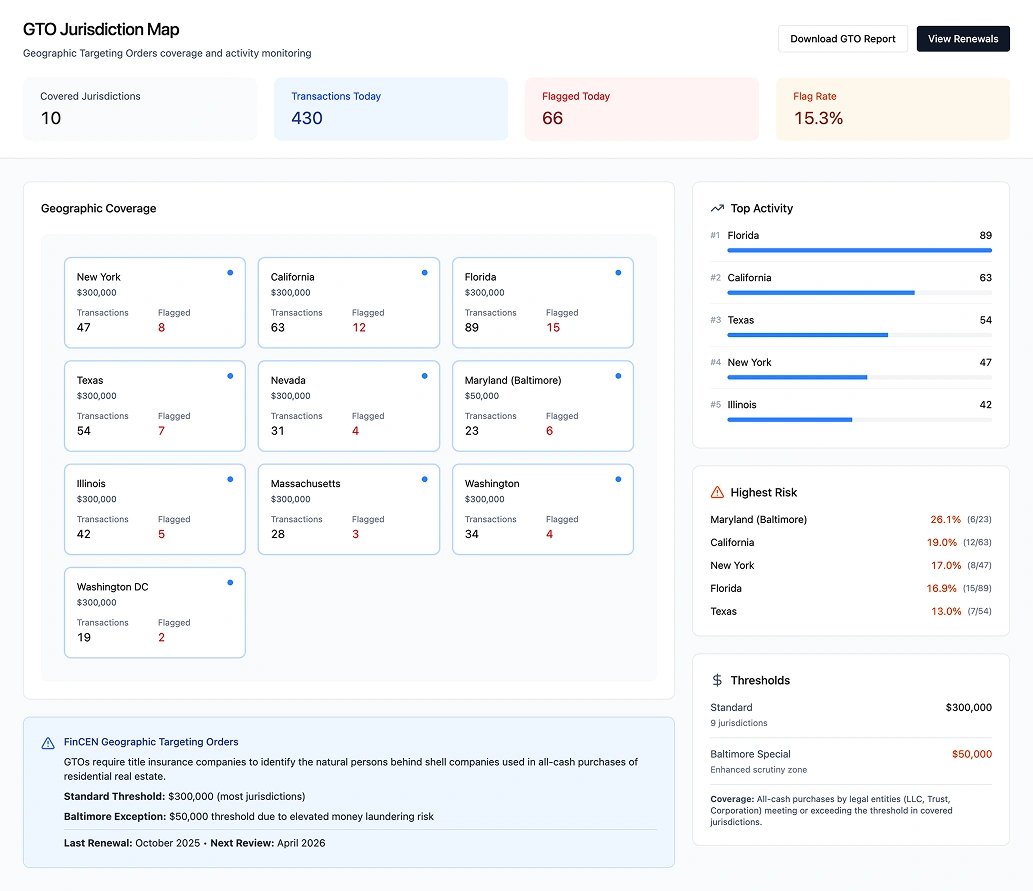
GTO Monitoring — Jurisdictional Risk Map with Active Coverage Areas
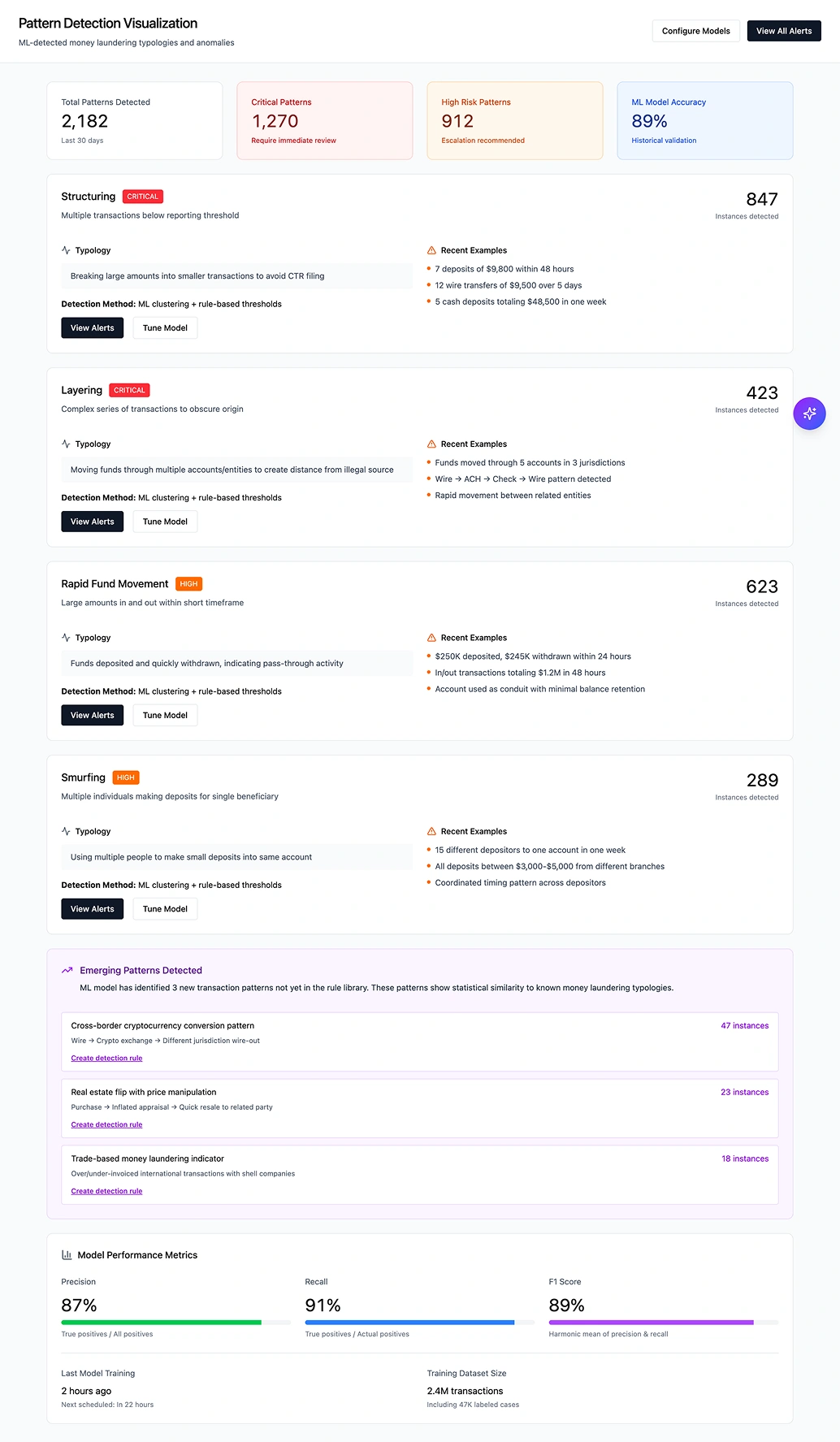
Property Dossier — Unified Property File with Compliance Status
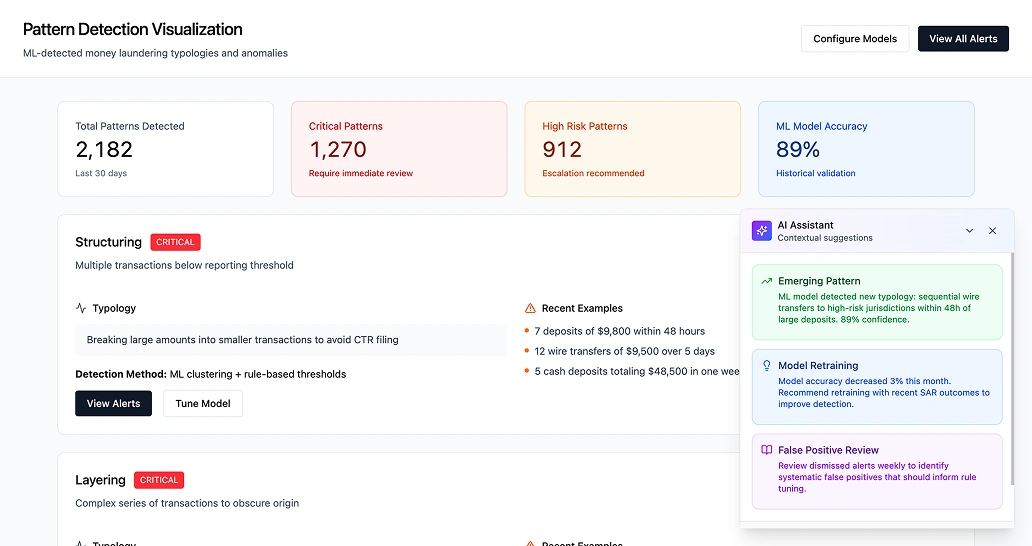
Property Dossier Detail — Documents, Timeline, Ownership History, Regulatory Filings
Order Book Reconstruction Meets Market Abuse Detection
Trade surveillance and order book reconstruction, designed with nearly five years of ACY trading infrastructure plus lessons from LogixTrader and Finlogix. Pattern detection covers layering, spoofing, wash trading, and pump-and-dump schemes — with sub-second latency for high-frequency data ingestion.
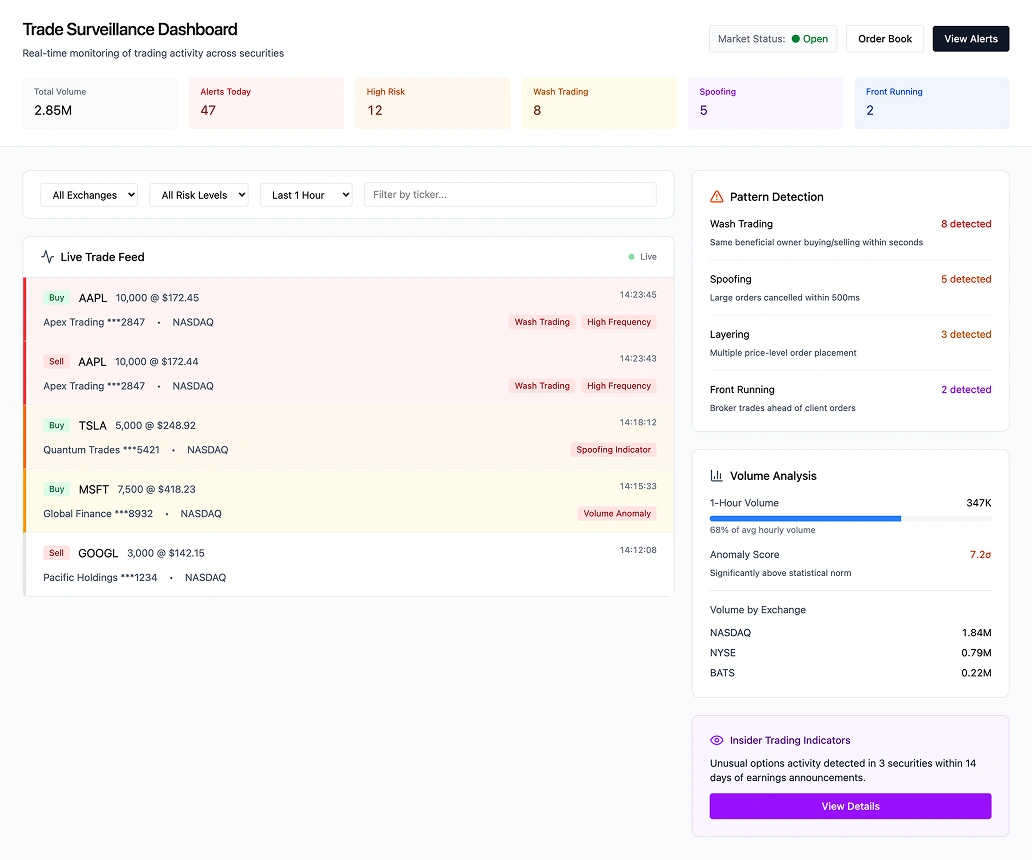
TSD (Trade Surveillance Dashboard) — Real-Time Order and Execution Flows
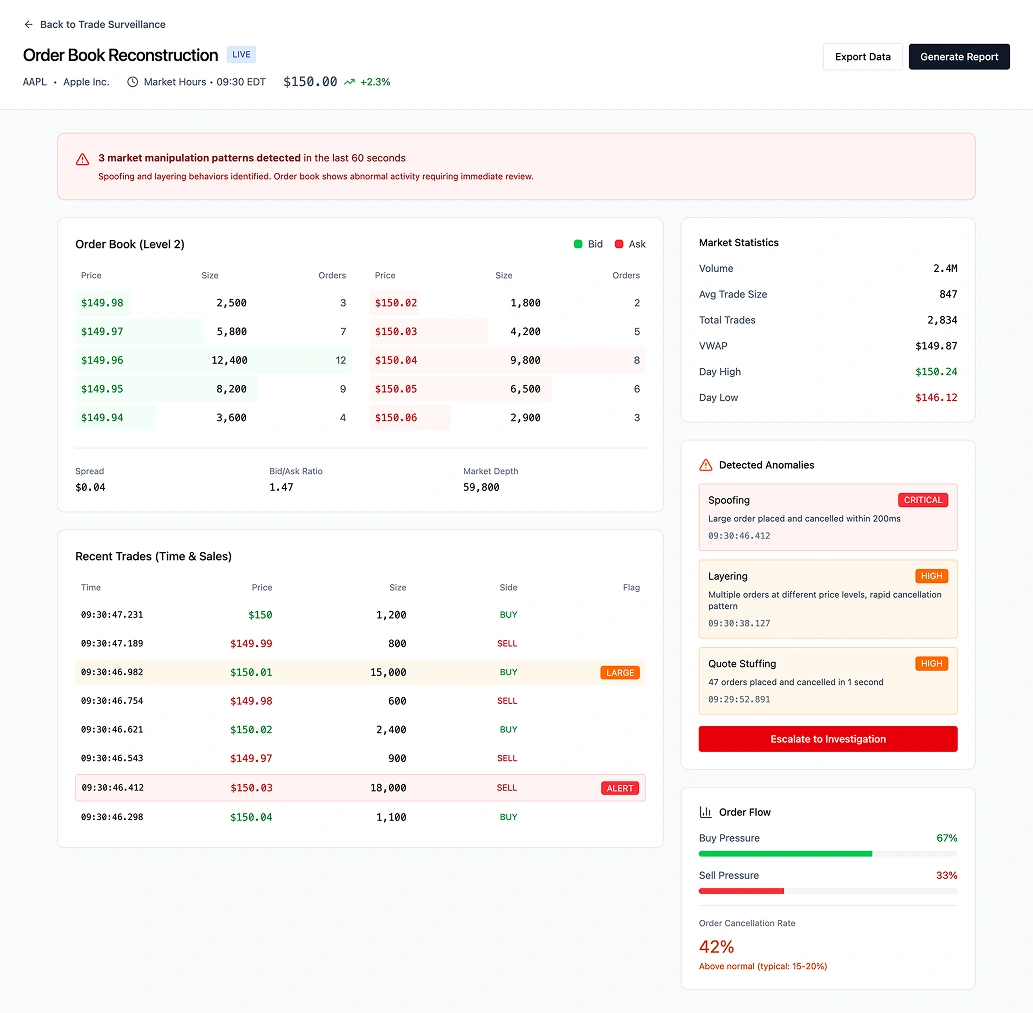
OBR (Order Book Reconstruction) — Replay of Suspicious Trading Activity
What Transfers from Trading Platform Work
The TSD interface borrows directly from LogixTrader's order flow visualisation — the same real-time candlestick + volume patterns that traders use to read markets are what compliance analysts use to spot manipulation. The data is the same; the intent of the viewer is different.
Temporal Replay as Investigation Tool
The OBR lets investigators replay order book state at any timestamp — seeing exactly what the order book looked like when a suspicious order was placed. This is the evidence that proves layering and spoofing: "at 14:32:07, Entity X placed 47 orders that were cancelled within 200ms."
From Investigation to Regulatory Document — Without Starting Over
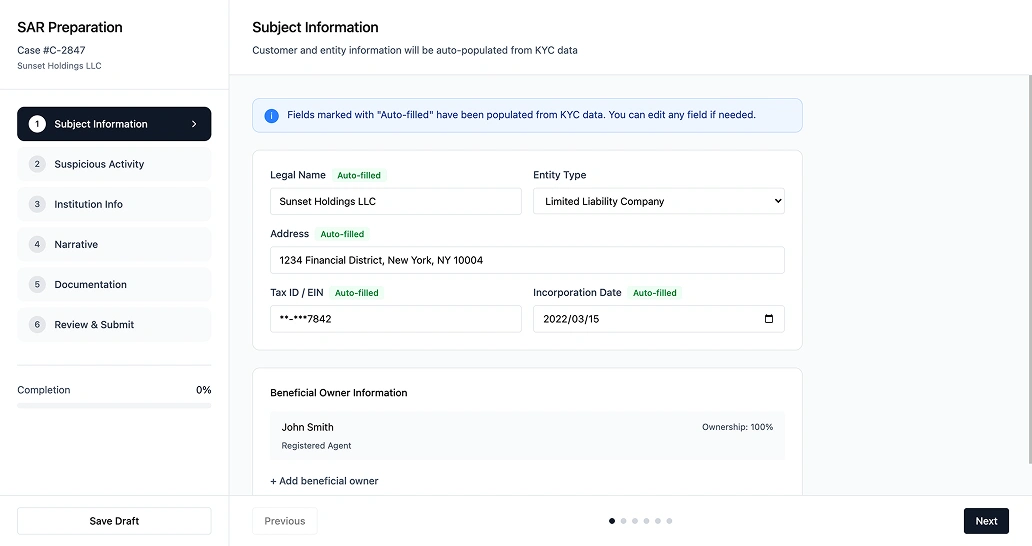
SAR (Suspicious Activity Report) filing is where investigations become regulatory documents. FinCEN deadlines are brutal: 30 days from alert to filing, extendable once. Argos automates narrative building from investigation findings, cross-references entity data, and routes through compliance review → legal approval with full audit trail. Typical SAR preparation: 22 hours. Target with Argos: 11 hours (legal review still human-in-the-loop).
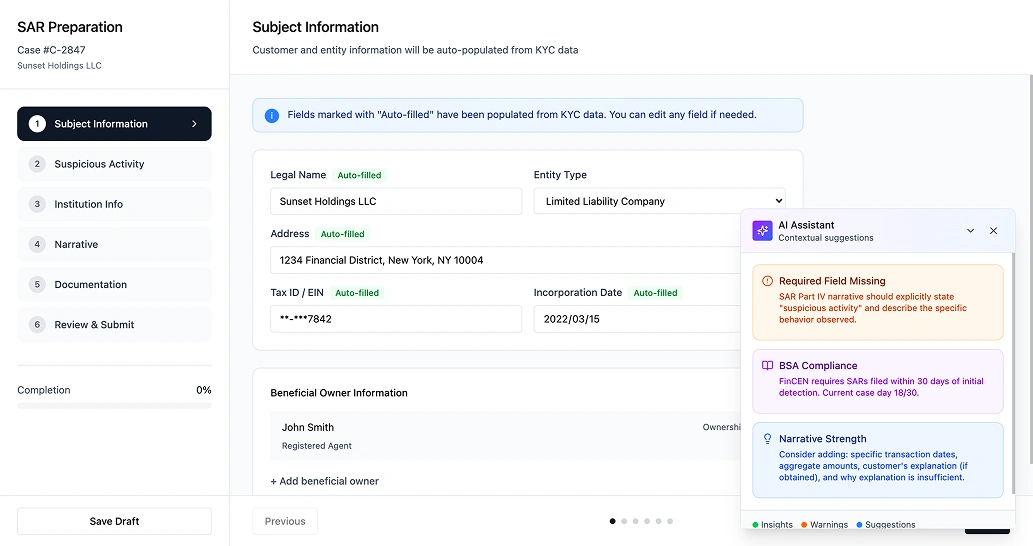
SAR Form — Institution and Transaction Fields Pre-Populated from Investigation
Auto-Populated from Investigation Timeline
Customer details, transaction summaries, and risk indicators are pulled directly from the case file. The investigator reviews and edits — they don't re-enter data they've already documented during the investigation.
30-Day Countdown as Design Constraint
The filing deadline is not buried in a settings panel — it's a visible countdown on every SAR in progress. Auto-escalation triggers at 25 days, 20 days, and 15 days, routing to compliance manager attention before the deadline becomes a regulatory violation.
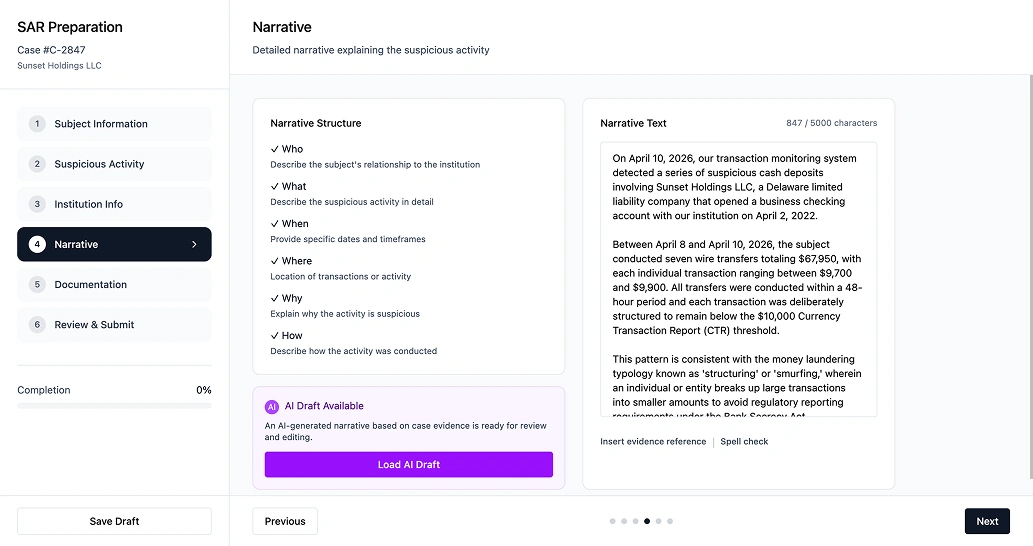
Narrative Builder — Structured, Not Free-Form
SAR narratives follow a specific FinCEN structure. The builder provides section templates (Who, What, When, Where, Why, How) with suggested content from the investigation. The investigator writes in their own words, supported by the structure.
Multi-Stage Approval Workflow
Investigator → Compliance Manager review → Legal review → BSA Officer sign-off → FinCEN submission. Each stage has its own checklist and the ability to send back with comments. Full audit trail at every step.
Narrative Builder — Structured SAR Narrative with AI-Suggested Content
Cross-Asset Fields — Linking Related Transactions Across All Three Modules
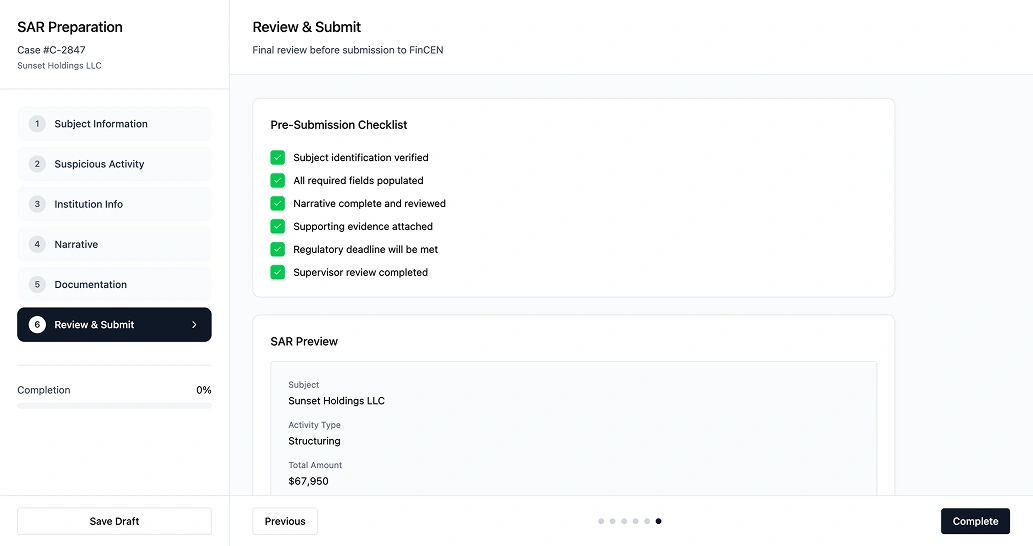
Final Review — Multi-Stage Approval Routing to Legal and BSA Officer Sign-Off
Compliance Teams Shouldn't Wait for Engineers
The Argos rule engine is configured through a visual builder: condition logic, thresholds, alert routing, and action triggers. Changes deploy in minutes, not sprints. Every rule revision is versioned and logged for audit — because when a regulator asks "why did you change Rule 47 on March 15?", the answer needs to be documented, not reconstructed.
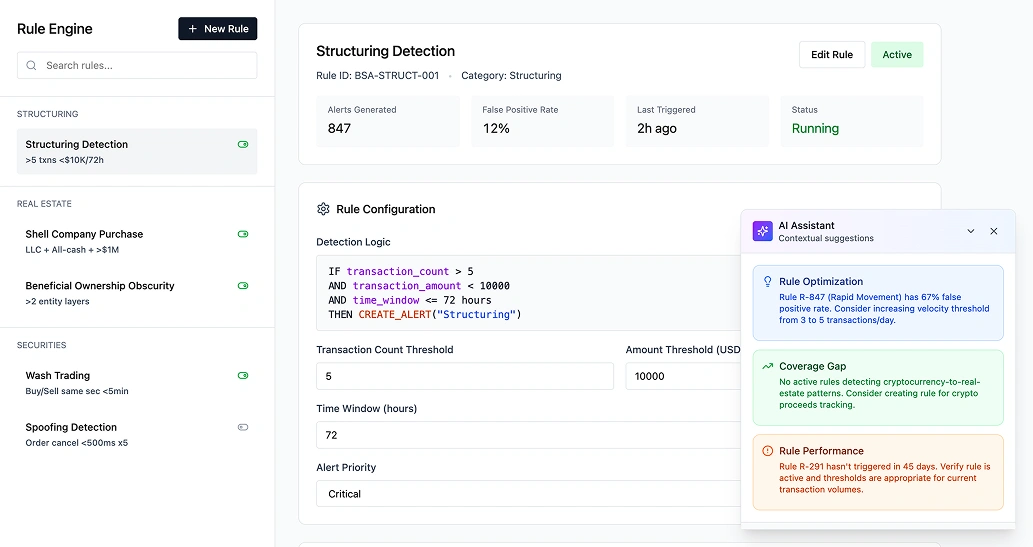
Rule Builder — No-Code Logic Composition with Version History
Visual Logic Composition
Rules are built from condition blocks: "IF transaction amount > $10,000 AND customer risk score > 7 AND jurisdiction = GTO-covered THEN generate alert with risk level HIGH." No SQL, no engineering ticket, no 2-week wait.
Impact Preview Before Deployment
Before a rule change goes live, the system shows: "This change would have generated 47 additional alerts last month" or "This change would have eliminated 200 false positives." Data-driven rule tuning, not guesswork.
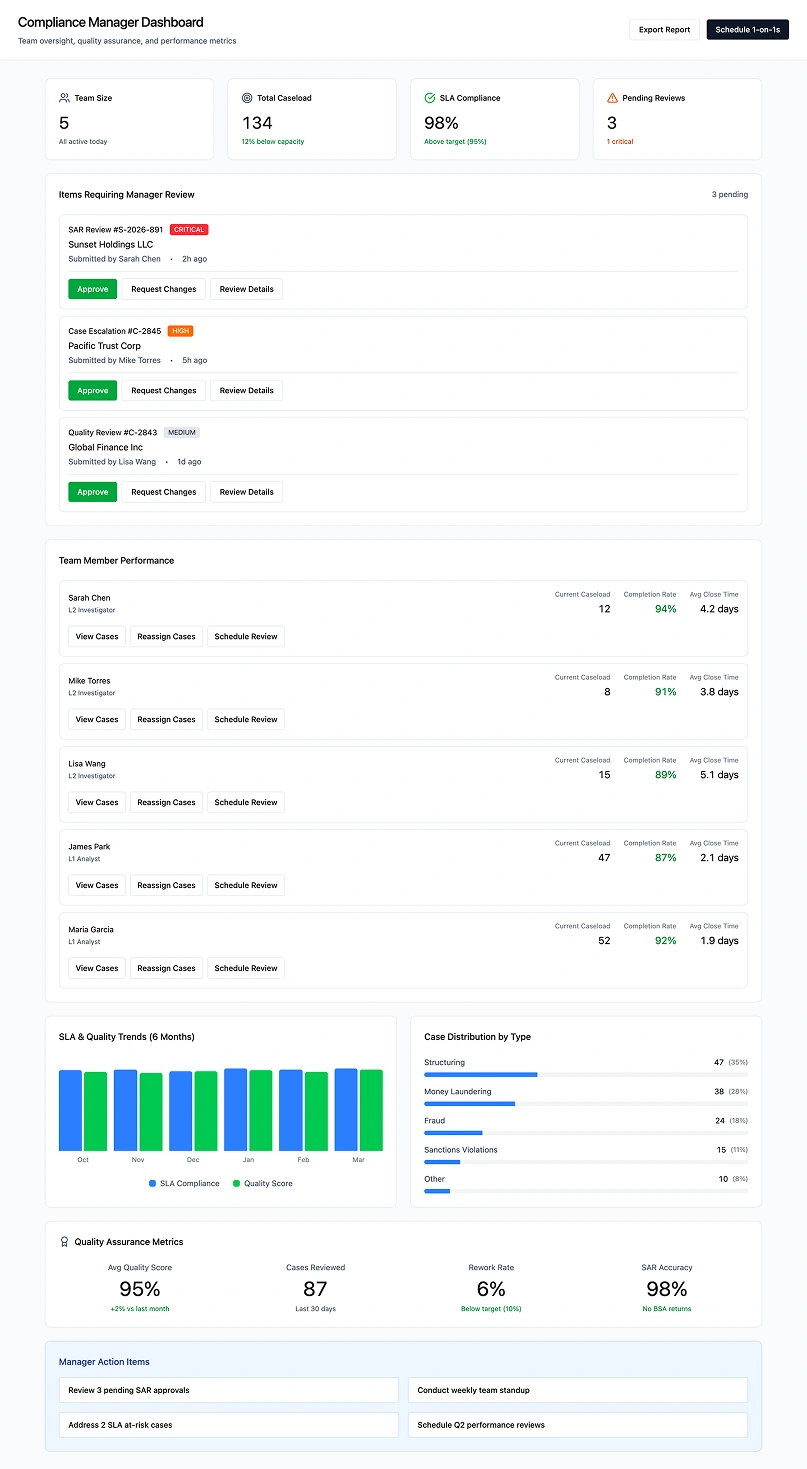
Four Roles, Four Views, One Compliance Program
Each role gets a purpose-built dashboard: L1 analysts see their queue and shift performance; investigators see their active cases and deadlines; compliance managers see team workload and filing pipeline; BSA officers see program-level KPIs and regulatory deadlines.
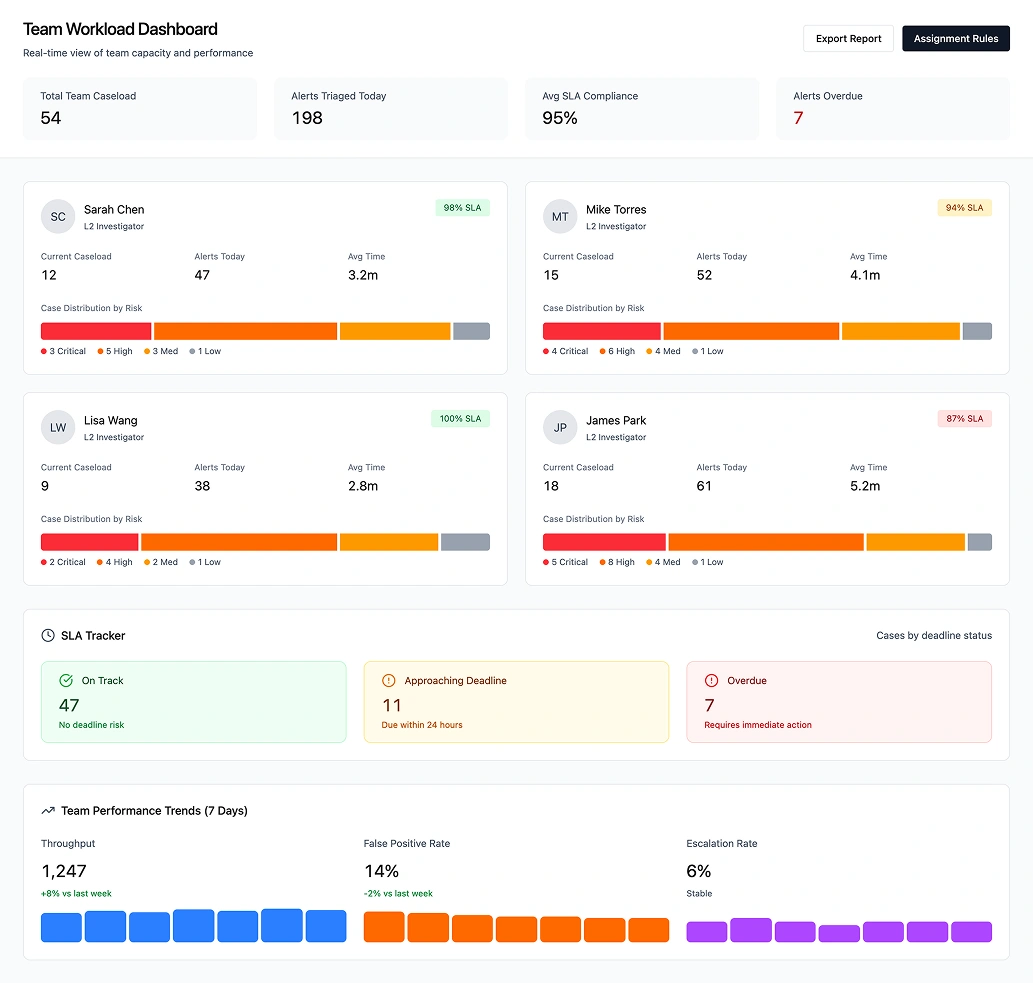
Team Lead Dashboard — Investigator Workload and Case Distribution
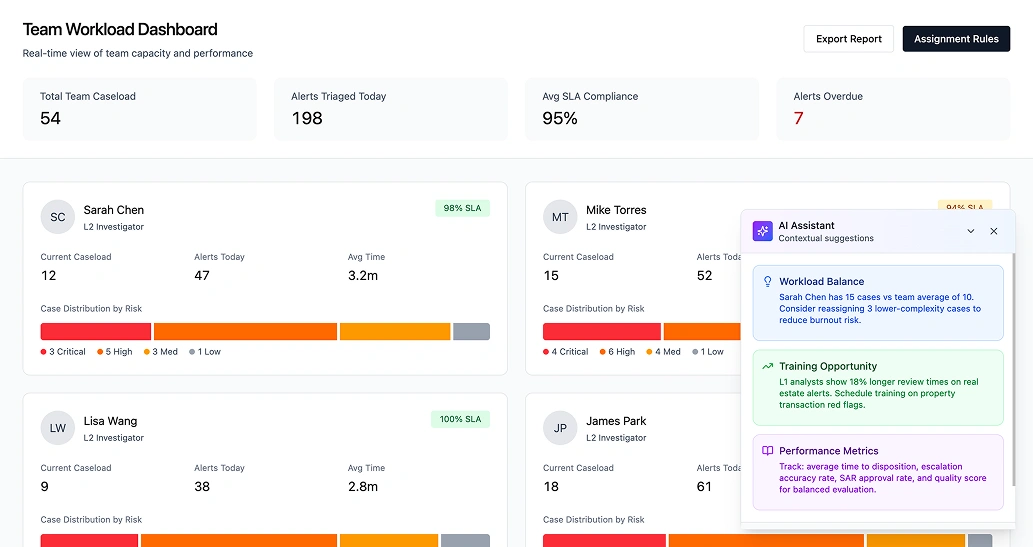
AI Workload Balancing — Recommended Case Reassignments
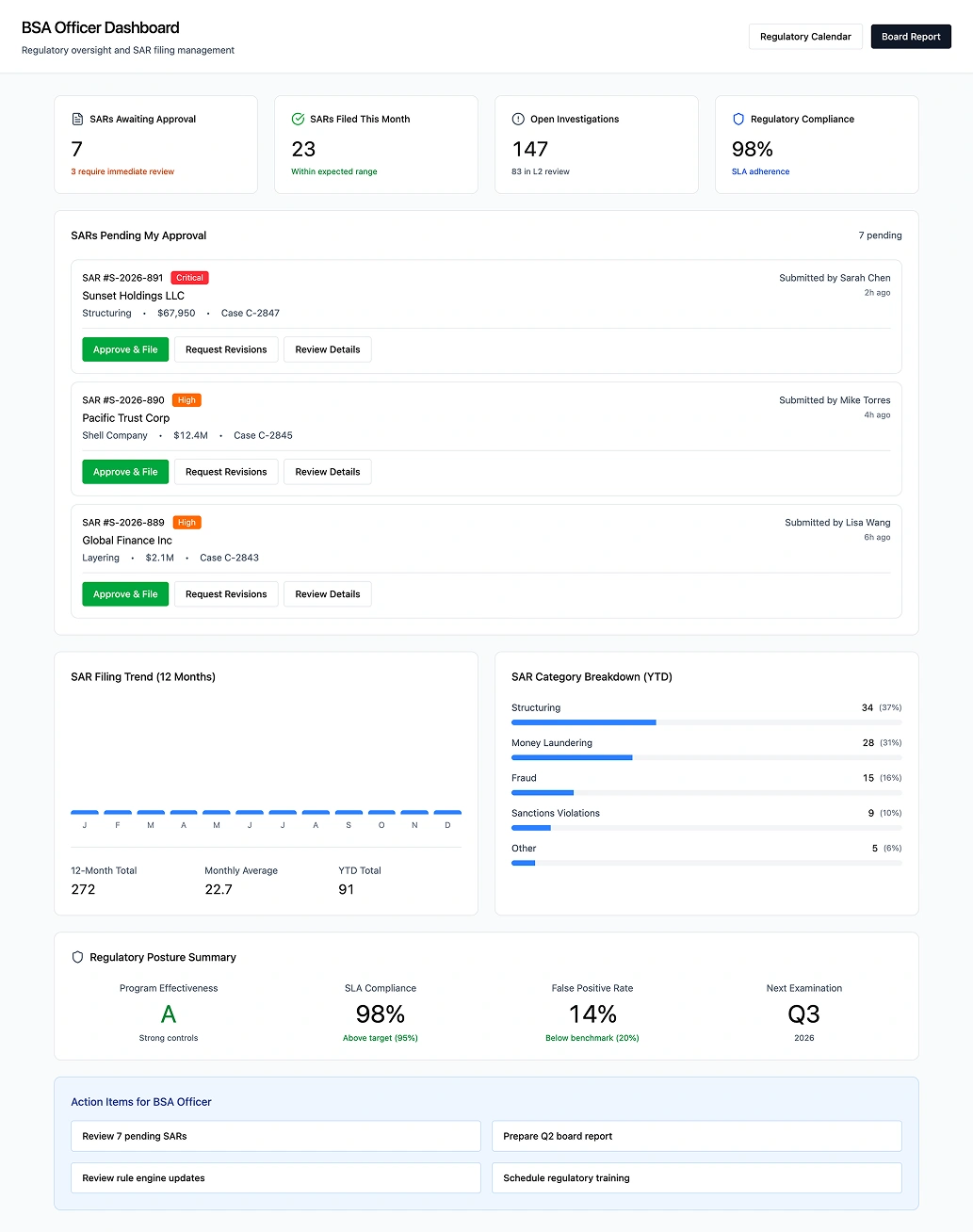
BSA Officer Dashboard — Program-Level Compliance Health and Regulatory Deadlines
The Details That Signal Production Readiness
Three supporting screens that round out the platform: sanctions and PEP watchlist management, keyboard-driven command palette (Cmd+K), and system configuration for API integrations, user preferences, and data source management.
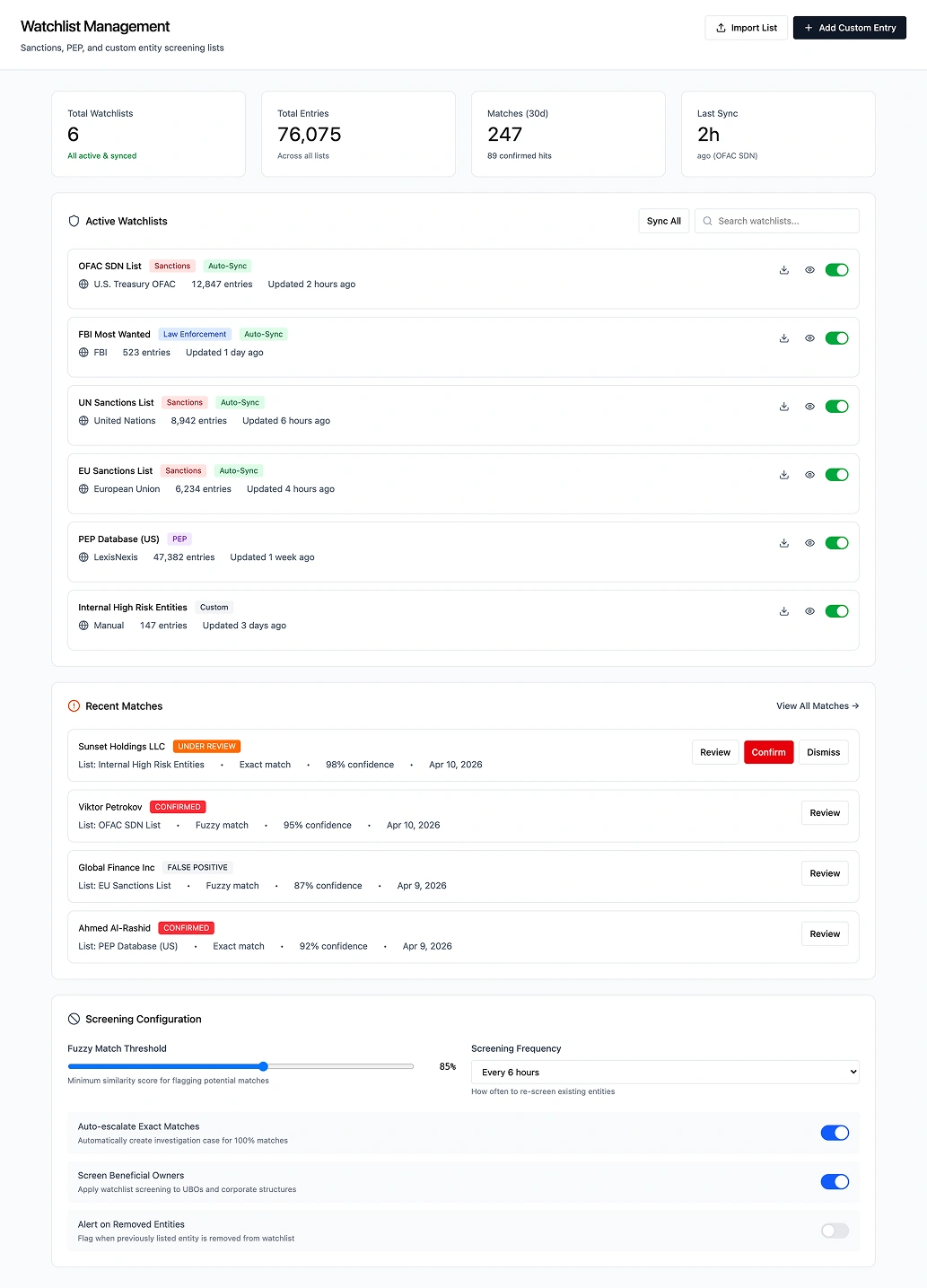
Watchlist Management — Sanctions, PEP, Adverse Media
Command Palette — Keyboard-Driven Navigation (Cmd+K)
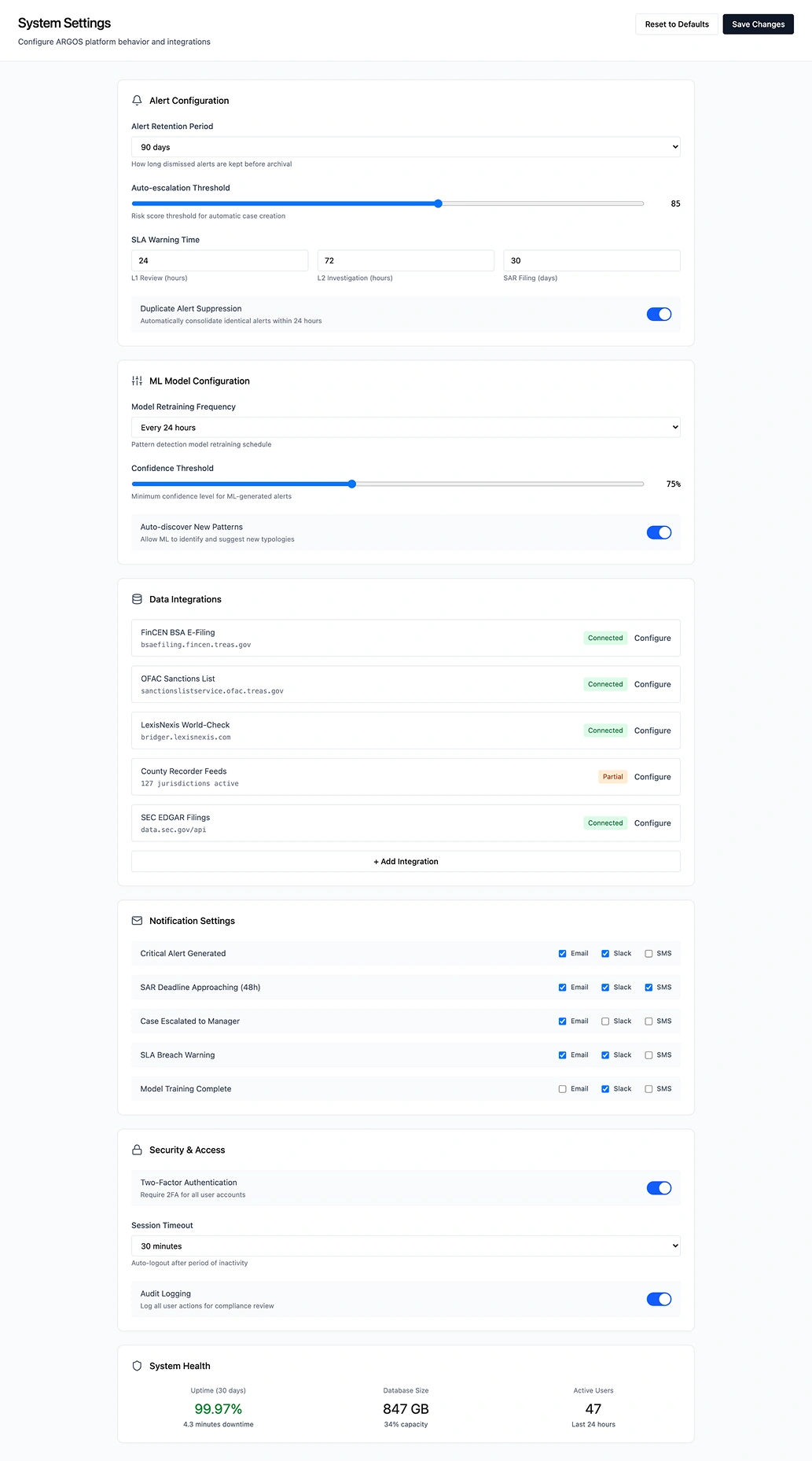
Settings — User Preferences, API Keys, Integration Configuration
Every Trade-Off, Documented
Design is choosing. These are the major architectural and interaction decisions that shaped Argos — each with the rejected alternative and the reasoning for the chosen approach.
Every Screen Traces Back to a Compliance Mandate
Argos design is anchored to regulatory requirements. This isn't decorative domain knowledge — it's the architecture. Every workflow, every data field, every approval step exists because a regulation requires it.
Bank Secrecy Act / AML
Transaction monitoring, Currency Transaction Report (CTR) filing, and SAR reporting. The BSA's five pillars (internal controls, BSA officer, training, independent testing, customer due diligence) are embedded in the team operations and BSA officer dashboard. Alert queue and investigation workspace directly support these obligations.
FinCEN SAR Requirements
30-day filing deadline (extendable once to 60 days). SAR filing workflow enforces this timeline with visible countdown, auto-escalation triggers, and multi-stage approval routing. The narrative builder follows FinCEN's structured format: Who, What, When, Where, Why, How.
FATF Mutual Evaluation
Financial Action Task Force recommendations on beneficial ownership transparency, sanctions screening, and cross-border reporting. Incorporated into the CAID (Cross-Asset Intelligence Dashboard) and GTO monitoring modules.
EU 6th Anti-Money Laundering Directive
Enhanced customer due diligence for high-risk entities, real estate transparency register requirements, and PEP screening obligations. The Real Estate module is built to 6AMLD beneficial ownership standards.
What Was Researched. What Was Assumed.
Transparency about what's real and what's hypothetical is a design decision in itself. Concept projects that pretend everything is validated lose credibility with senior reviewers. Here's the honest breakdown.
| Category | What Was Researched | Source |
|---|---|---|
| BSA/AML regulatory landscape | Filing requirements, enforcement actions, compliance program structure | FinCEN guidance, OCC bulletins, SEC enforcement actions |
| Transaction monitoring at scale | Rule engine architecture, false positive patterns, alert queue design | Nearly five years at ACY Securities: 150+ rules, 40+ jurisdictions |
| UHNW real estate compliance | Beneficial ownership structures, GTO requirements, cross-border deals | Christie's: $5M–$80M property transactions |
| Securities surveillance | Order book reconstruction, market abuse pattern detection | LogixTrader, Finlogix architectures; ACY trading infrastructure |
| Competitive landscape | Feature gaps, UI patterns, market positioning | Actimize (legacy), Lucinity (modern), Unit21 (API-first) |
| Assumption | Why It Matters | What Production Would Require |
|---|---|---|
| Real estate risk scoring | Model assumes access to property prices and ownership registries | Partnerships with data providers (CoreLogic, public registries) |
| Cross-asset entity matching | Assumes probabilistic UBO matching — name alone is not sufficient | Identity reconciliation engine (Dun & Bradstreet, graph databases) |
| AI confidence calibration | Co-Pilot confidence scores are placeholder values | Bayesian updating based on investigator accept/reject decisions |
| Latency assumptions | Alert queue sorting assumes rule engine evaluation < 500ms | Sub-100ms latency engineering for securities module specifically |
If Argos Were Shipped, These Are the KPIs
Concept projects that can't articulate their success metrics aren't thinking about outcomes. These are the six KPIs that would determine whether Argos is working — each with a specific target and measurement methodology.
Alert-to-Decision Time
From baseline 22 hours. Measured end-to-end: alert fired → investigator decision (dismiss/escalate/SAR). Tracked per role and rule category. The single most important operational metric.
False Positive Dismissal
For obvious false positives. Measured as time from alert queue view to dismissal action. Keyboard shortcuts are critical to hitting this target. If it takes longer than 2 minutes, the rule context isn't clear enough.
SAR Preparation Reduction
From 22 hours to 11 hours (legal review still required as human-in-the-loop). Auto-populated narratives and cross-asset linking save the bulk of data-gathering time.
NASA-TLX Cognitive Load
Post-task workload assessment quarterly. Argos should reduce mental effort, not increase it. If investigators are more cognitively loaded with the tool than without it, the design has failed.
AI Co-Pilot Acceptance Rate
Adoption of AI suggestions. Too low = Co-Pilot not trusted. Too high = might be automating judgment that should remain human. The sweet spot indicates useful augmentation without over-reliance.
Rule Maintenance Velocity
Time to deploy a rule change. No-code builder should enable compliance teams to iterate without engineering tickets. Currently most organisations wait 2–4 weeks for rule changes.
What Transferred. What Was New. What I'd Iterate.
The Most Ambitious Case Study I've Created
Argos represents nearly five years of compliance domain knowledge compressed into a unified platform design. It's not shipped — but every decision is defensible and grounded in real regulatory requirements, investigator workflows, and domain expert feedback. The cross-asset architecture is the product thesis: no competitor covers banking, securities, and real estate in a single investigation engine. That gap is real, and this design shows what filling it looks like.
| Category | Detail |
|---|---|
| What transferred from trading | Real-time data architecture (LogixTrader/Finlogix → securities module), keyboard-driven UI patterns (trading hotkeys → triage shortcuts), data density and visual hierarchy management |
| What was new | Narrative-driven investigation UI (trading shows numbers; compliance needs stories), regulatory compliance as design constraint (every screen must be audit-friendly), cross-domain unification (reconciling three asset-class data models) |
| What I'd iterate | Entity resolution UI (UBO matching is probabilistic — needs investigator-guided matching interface), AI confidence calibration (needs Bayesian updating from investigator feedback), mobile responsiveness (compliance teams need on-call access), third-party data integration patterns |
The Experience That Built Argos
Argos draws directly from my prior fintech and institutional experience. Each project contributed specific domain knowledge and design patterns.
ACY Securities
Nearly five years of compliance architecture. 150+ regulatory components, KYC flows, audit trails. The domain knowledge foundation for Argos — everything about how compliance workflows operate at scale.
TradeX Institutional
Unified trading platform. Real-time settlement, institutional workflows, regulatory reporting. Informed the securities module architecture and the real-time data patterns in the command center.
Christie's International
UHNW client experience for $5M–$80M properties. Cross-border ownership structures, high-value asset compliance. The real estate module's entire design language comes from this experience.
Where Argos Goes Next.
Surveillance for the AI-vs-AI Era.
Argos v1 above is built around the cross-asset compliance gap of the last decade — three asset classes, four user roles, the SAR lifecycle from alert through filing. That gap is real and still under-served. But the threat landscape has shifted: by 2026, unethical private AI farms can synthesise tens of thousands of fake transaction sequences and weave them through CFD wrappers, TRS structures, and multi-layer property holdings — at a velocity and statistical cleanliness no human launderer could produce. The traditional AML rule engine cannot see this. Four modules below are how I'd extend Argos into that environment.
Behavioral Entropy · Detecting AI-Generated Transaction Patterns
Human-driven transactions carry imperfection — rounding errors, hesitation lags, clustering around payday and business hours, irregular sub-amounts. Generative AI fraud patterns are statistically too clean: uniform velocity, near-perfect first-digit distribution, no behavioural fingerprint. The Entropy Engine surfaces an anomaly score to L2 investigators as a sidebar augmentation, not embedded automation — the same AI-trust discipline as Argos v1's challenge 03. Anchored to Benford's Law (first-digit distribution as fraud detection baseline), 2024–2025 FinCEN advisories on AI-generated synthetic identity fraud, and academic work on generative pattern detection over transaction graphs.
Instrument Decryption · CFD / TRS / Synthetic Asset Unwrapping
Argos v1 resolves entities — who is who across banking, securities, real estate. v2 deconstructs instruments — what is this wrapper actually doing economically. CFDs, total return swaps, structured notes, synthetic asset packages: each layer obscures the underlying exposure and the ultimate beneficial owner. The Decryption surface unwraps the layers, attributes economic exposure back to the UBO, and feeds that linkage into Argos v1's cross-asset correlation engine. Anchored to ISDA Master Agreement 2002 / 2021, CFTC Part 23 swap reporting, and EU EMIR derivative transaction reporting requirements.
SOC Team Incident Response · Honeypot Trigger Triage
Most AML systems are passive — they wait for alerts to fire. v2 explores what happens when the surveillance team uses active deception: honeypot grey transactions designed to attract automated AI fraud farms. The design surface here is not the honeypot infrastructure itself (that's a security engineering problem, not a product design problem) — it's the SOC analyst triage queue when a honeypot fires. Who tripped it, what pattern matched, what's the chain of evidence, escalate to L2 or dismiss as false positive. Same UX discipline as Argos v1's L1 alert triage, applied to a different data input. Anchored to NIST Cybersecurity Framework CSF 2.0, MITRE ATT&CK financial sector mapping, and FinCEN information-sharing guidance under USA PATRIOT Act §314(b).
Anomaly Index · Suspicion Scoring Under the EU AI Act
Argos v1 has rule-based risk scores per alert. v2 unifies these into a single Anomaly Index per entity — 0–100, but with three explicit bands: 0–30 normal, 31–69 review-ready, 70–100 escalate. Every score carries a visible reasoning chain (which rules fired, which behavioural patterns matched, which graph edges contributed weight). EU AI Act 2024 Annex III classifies AML scoring as a high-risk AI system; the transparency obligations under Article 13 mean every score must be explainable to the institution's BSA officer and, if challenged, to the regulator. Naming it "Anomaly Index" not "Truth Score" is deliberate — we don't claim to know ground truth. We claim to measure distance from known-normal patterns, with the score as input to human judgment, never replacement of it.
Three concept demos · how the v2 modules feel in the hand
The four modules above describe the framework. The three demos below let you actually interact with the design ideas — entropy detection, instrument unwrapping, and anomaly score reasoning. SOC triage UX is not separately demoed here because the discipline mirrors the L1 alert triage already in the v1 prototype above. None of these are production data — synthetic fixtures, deterministic seeding for reproducibility.
Behavioral Entropy · Pattern Comparison
Drag the threshold to tag batches with low entropy as AI-generated fingerprint. Benford's Law first-digit distribution shown below — human transactions cluster around the expected log curve, AI-generated batches do not.
Instrument Decryption · Wrapper Unwinding
Click the synthetic position to peel back four layers of wrapper structure and attribute economic exposure back to the ultimate beneficial owner. Click again to re-wrap.
-
L1
CFD Wrapper London · ISDA 2002 Master
Equity contract for difference, $50M notional, FTSE-100 basket exposure, daily margin to prime broker. No physical settlement — cash-settled net of dividend pass-through.
-
L2
Total Return Swap Cayman SPV · ISDA Schedule
CFD economic exposure swapped to a Cayman Islands special purpose vehicle. Counterparty: SPV B-class. Reference: ISDA Master Agreement 2021 update, CFTC Part 23.
-
L3
Holding Entity Delaware LLC · 2022
SPV controlled by a Delaware-incorporated single-member LLC. Sole-member structure, no business operations, US tax-transparent flow-through to upstream owner.
-
L4
UBO Trail BVI shell → Cyprus trust → individual
Delaware LLC owned by BVI nominee company; BVI shares held by Cyprus discretionary trust; settlor and protector identified through public filings. Beneficial owner attributed to a single individual.
Anomaly Index · Reasoning Chain Per Score
Each entity carries a 0–100 score with three explicit bands. Click any row to see the reasoning chain — which rules fired, which patterns matched, and the weight each contributed. Drag the threshold to reclassify in real time. Naming this an Anomaly Index, not a Truth Score, is deliberate (EU AI Act Article 13 transparency).
Live Demo · AML Link Analysis Graph
The graph that turns transactions into a story
Financial crime investigators don't catch money laundering by reading transaction tables — they catch it by seeing patterns. This force-directed graph surfaces the network behind a suspicious cluster: entities, accounts, shell companies, and the transactions connecting them. The red cluster is already visible before the investigator reads a single number.
Drag nodes to explore · Hover for details · Click to select · All data simulated · Built with D3.js v7
Argos is a concept study, not a shipped product — no live transaction feed, no real SAR filed, no detection-rate claim. The regulatory register it draws on (methodology limits, post-launch honesty, accessibility measurement, stakeholder political skill) is documented once, in full, on the case studies where it actually happened: Finlogix, ACY Securities, and ACY Connect.
Portfolio thread
Where Argos sits in the larger web
Argos sits at the intersection of three portfolio threads. Each thread carries Argos forward through related case studies — the FATF / BSA primitives below are the same patterns running underneath the institutional concept work.
Thread
AML / Financial Crimes Investigation
Alert triage, investigator workspace, SAR filing — three asset classes under one investigation engine.
- Argos — Cross-Asset Financial Crimes Platform 40+ screens, 4 user roles (L1/L2 Analyst · Investigator · Compliance Officer), AI co-pilot with explainable confidence scoring Concept · FATF · BSA · FinCEN · banking + securities + real-estate modules
- Double-Blind Fiduciary Protocol Hash-sealed adversarial-AI governance — applicable to the L2 investigator AI co-pilot pattern Concept · SEC 17a-4 retention · SR 11-7 model risk · audit-defensible
- Hire — regulatory cluster FATF · FinCEN · OFAC · BSA literacy demonstrated across Argos + production work Career signal · 6 jurisdictions named in interview-ready cluster
Thread
Regulatory Routing & Translation
How upstream regulation translates into UI primitives — disclosure banners, audit hooks, suitability gates.
- Argos compliance scaffolding 120+ compliance-specific components — disclosure cards, SAR review queue, sanctions screening primitives Concept · 6th AMLD · OCC bulletins · 30-day SAR deadline UX
- ACY Securities Ecosystem 150-component design system absorbing 8 regulatory rewrites without a rebuild cycle Shipped · 4 yrs · 40+ jurisdictions · production reference for the Argos pattern
- Praxis Prime — F2B Prime Brokerage CSDR settlement-discipline penalty UI · T+1 affirmation cut-off · same regulatory grammar Concept · FIX 4.4 · SWIFT MT54x · SEC Rule 15c6-2
- Batch Authorisation · Threshold Tiering Threshold tiering as UI No eng cost · tier(batch) = max(aggregate, highest line) · concept
Thread
Cross-Asset Architecture · Banking + Securities + Real Estate
One investigation engine spanning three asset classes — the same beneficial owner can move money through all three.
- Argos cross-asset correlation engine Shared 70% core + asset-specific 30% modules · entity resolution across banking, securities, real estate Concept · single SAR narrative across three asset classes
- ACY Connect — Institutional FIX API B2B FIX 4.4 surface for prime-broker integration — same regulatory anchoring Shipped · 12+ institutional clients · 5-user taxonomy
- Christie's — UHNW Editorial Platform UHNW real-estate buyer audience — production context for the real-estate compliance module Shipped · $5M–$80M client tier · 260-year brand discipline