
ACY Securities · Live copy-trading · ASIC-regulated

TradingCup

Designing trust for retail copy-trading.

A platform where 10,000+ retail followers back algorithmic strategy providers. I was sole product designer for the whole surface — provider cards, pre-allocation disclosure, follower risk controls, leaderboard staging, brand. The thesis: the first loss is the design problem, not the sign-up screen.

Live
In production at ACY
10K+
Active followers
187K+
Search clicks · 12 mo
0
ASIC findings · 2 yr
Platform · live Connects to ACY Securities
0
Signals
$0M
Invested funds
$0K
Total performance fees
$0K
Total subscription fees
🏆 Season leaderboard · MMR risk-adjusted ranking
1
Vector Quant
Multi-asset · 3y1m · low risk
+33.0%
Copy
2
Adrian Giralde
Xauusd Swing · 1y2m · low risk
+41.4%
Copy
3
Kaede Honjou
Gold Conqueror · 1y10m · med risk
+58.9%
Copy

The real product

Not a mockup. Live at ACY Securities.

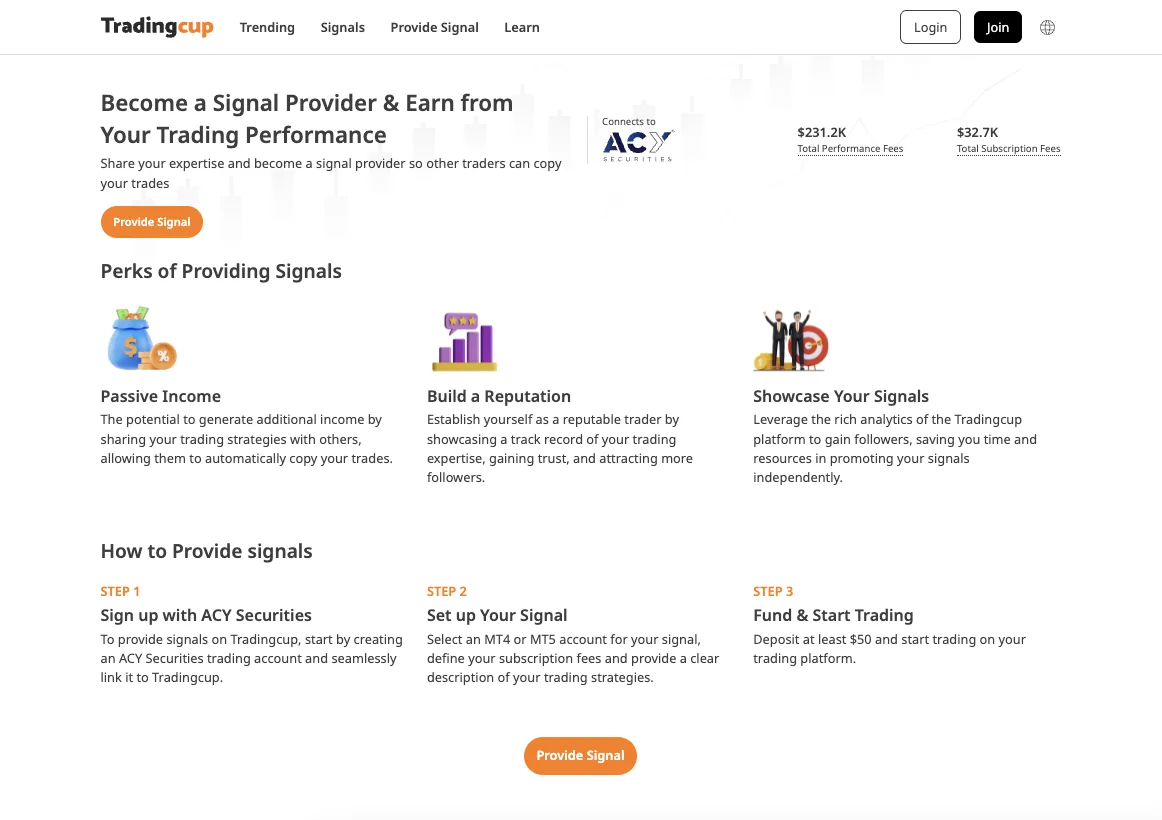
Copy the strategies of the best traders — the home surface pairs a copier and a signal provider, backed by a leaderboard connecting 3,883 signals and $84.6M in invested funds.

tradingcup.com/en
TradingCup home — Save time with copy trading, follow best Forex traders, copier and signal provider
Production · tradingcup.com
Home · copier ↔ provider Leaderboard · MMR ranking Signals · free & premium Provide signal · earn fees Risk controls · follower-side

The contribution · at a glance

Sole product designer — the entire surface.

Provider evaluation cards, pre-allocation disclosure flow, follower-side risk controls, leaderboard staging, brand identity — designed backwards from the moment the relationship actually dies: the follower's first sustained loss. Every figure carries its source.

10K+Active followers on the platform.Platform-stated · design = scalability
187K+Organic search clicks over 12 months.Google Search Console
42.37%GA4 engagement rate · 30-day rolling.Google Analytics 4
0Design-related ASIC findings over two years.Internal regulatory audit
4Risk-first provider metrics — return ranks fourth, not first.Provider evaluation framework
Killed“Recommended” → “Risk-Adjusted” — scrapped at pixel-perfect for inducement risk, re-shipped clean.Corporations Act s.911A · Legal sign-off

Live production at ACY Securities. Outcome figures are platform-attributable, not design-attributable in isolation — design owned the surface that converted, retained, and stayed compliant.

Where this sits · scale 02 of 05

After ACY. Before Xanthos.

ACY proved compliant infrastructure can hold across 40+ regulated markets. TradingCup proved compliance is necessary but not sufficient — you also have to design for the psychology of a follower under loss. That insight carries directly into Xanthos, where the first bad quarter is the moment that makes or breaks a $28M advisory relationship.

01 · Infrastructure
ACY Securities
Compliant broker system across 40+ regulated markets.
02 · Retail social · here
TradingCup
Compliance + the psychology of loss, at retail scale.
03 · Private wealth
Xanthos PB
The first bad quarter in a $28M advisory relationship.

The problem

Three failures copy-trading inherits by default.

When a platform offers to “follow successful traders,” the design either prepares the follower for what will actually happen, or it doesn't. Most don't. Each failure below I watched users hit at session-recording level.

01
Failure 01

Return-only ranking misclassifies risk-takers as skill

A 312% return over three weeks of leveraged Bitcoin reads identical to 312% over four disciplined years. Followers can't tell which one repeats.

No taxonomyCategory error
02
Failure 02

First drawdown breaks the relationship before it starts

In session recordings, most followers who churned did so on their first sustained loss — not because it was large, but because nothing in sign-up prepared them for normal volatility.

PsychologyChurn root
03
Failure 03

“Recommended” is a regulated word, not a UX word

The first cut of “Recommended Providers” was killed by Legal at pixel-perfect stage — implied endorsement under ASIC inducement rules. Pivoted to “Risk-Adjusted Ranking,” shipped clean.

ASIC inducementDesign–Legal joint

Design thesis

The first loss is the design problem.

Most copy-trading platforms optimise the sign-up funnel. The actual relationship dies at the first sustained drawdown — not at registration. So I designed the whole surface backwards from that moment: every screen before it has to prepare the follower for it. Onboarding and resilience aren't two products — they are one. The follower who signs up but quits at week 11 was acquired and then lost, and the design owned both.

Before

Optimise sign-up

  • Maximise funnel conversion
  • Hide drawdown until after deposit
  • Return shown first, risk buried
After

Design for the loss

  • Pre-allocation disclosure
  • Drawdown shown before any capital decision
  • Trust hierarchy on every card — risk first

Follower risk dashboard: the drawdown chart is intentionally placed above the P&L total — the follower's first instinct should be to read risk before return.

Provider evaluation framework

Four metrics, ranked by what protects the follower.

The same four metrics, in the same order, on every surface — list, detail, search, comparison. The order is not alphabetical. It's risk-first. Return is fourth.

Metric 01

Maximum drawdown

Peak-to-trough loss. Surfaces first — it answers the only question that matters before deposit: how bad does this get on its worst day?

Surface first
Metric 02

Sharpe ratio

Excess return per unit of volatility. Tooltip translates it as “extra reward per dollar of risk” — it has to land in one read for non-CFA followers.

Progressive disclosure
Metric 03

Win rate & consistency

Percentage of profitable trades, paired with average win/loss to defuse the “high win-rate, one huge loss” decoy. The pairing is what makes it honest.

Paired with avg W/L
Metric 04

Time on platform

Months of verified history. 38 months survives at least one volatility regime; 6 months might just be luck. Verification badge unlocks at 24 months.

Regime survival

Live demo · provider evaluation system

Watch return-only lie — then watch risk-first correct it.

The counterintuitive finding: showing full risk data increased sign-ups. Users who saw the complete risk profile signed up at 31% higher rates than those who saw return only — a relative rate from internal sign-up-funnel cohort comparison, platform-measured, not an externally audited A/B. Toggle the ranking below — see how a 3-week, high-drawdown decoy tops Return-only and sinks under Risk-adjusted (MMR).

TradingCup · Leaderboard Live · refresh 4s
Sorted by Risk-adjusted MMR — profitability, drawdown, stability, risk-adjusted return and longevity. Return ranks 4th.
#Signal provider1Y curveReturnMax DDMMR
Copy mirrors the provider · follower risk controls applyAll data simulated · scores refresh every 4s
The decoy: “Rapid ROI” posts a huge headline return over a 3-week history with a deep drawdown. Return-only ranking crowns it #1. Risk-adjusted ranking — the one that ships — buries it, because three weeks can't survive a volatility regime and the drawdown tells the real story.

Pre-allocation flow

The disclosure screens before any capital decision.

Three screens between provider selection and deposit. Each one is an off-ramp, not an upsell. Drop-off here is a feature — followers who quit at disclosure are followers who'd have churned at week 11 anyway.

Step 01

Historical drawdown disclosure

A static chart of this provider's worst 6 drawdowns over the lookback window, with duration and recovery time labelled. This cohort retained at higher rates.

Retention ↑
Step 02

Acknowledgement, not a checkbox

A free-text field: “What's the largest loss I'm prepared to accept on this allocation?” The follower types a number — the system uses it to set their auto-pause threshold.

Sets auto-pause
Step 03

Conservative defaults, every time

Allocation cap defaults to 5% of equity. Copy ratio defaults to 1:1. Both are explicit choices to override — not the most aggressive default with a “lower it if you want” hint.

Safe by default

In-position controls

Three controls the provider cannot override.

Once a follower is copying, the design honours one principle: the follower's risk budget is the follower's, not the provider's. Three controls the lead trader can't turn off.

Control 01

Per-trade stop-loss

Follower-set hard stop on every copied trade, independent of the provider's. Defaults conservative; can be tightened, never loosened beyond the platform max.

Follower-owned
Control 02

Allocation cap

Maximum share of account equity any single provider can use. Default 5%. Hard ceiling — followers cannot override beyond 25% even with confirmation.

Hard ceiling 25%
Control 03

Auto-pause on threshold

When cumulative loss crosses the follower's stated tolerance (from the pre-allocation form), copying pauses automatically. Resume requires an explicit human action.

Explicit resume

Compliance pivot

When Legal kills your pixel-perfect feature, the redesign teaches you something.

“Recommended Providers” was scrapped at handoff for ASIC inducement risk. The replacement — “Risk-Adjusted Ranking” — survived a two-year audit cycle with zero design-related findings. The pivot itself is the case study.

Before · killed by Legal

“Recommended Providers”

  • Implied platform endorsement
  • ASIC Corporations Act s.911A inducement risk
  • 4 weeks of high-fidelity work scrapped
  • Brand exposure if shipped
After · approved & shipped

“Risk-Adjusted Ranking”

  • Algorithm-derived, transparent methodology
  • Disclosed in tooltip + footer
  • “Past performance does not predict future results” on every card
  • Two-year audit window · zero findings
Legal counsel sign-off on the redesigned Risk-Adjusted Ranking surface — disclaimer placement and label wording drafted jointly in Figma
Legal-counsel sign-off — disclaimer placement, label wording and tooltip copy jointly drafted with Legal in the Figma file. Legal now joins at wireframe stage on every regulated feature.

Outcomes · over the two years it ran

What the surface produced.

Platform-attributable, not design-attributable in isolation — design contribution is the surface that converted, retained, and stayed compliant. Each number carries its source.

187K+
Organic search clicks · 12-month period
Google Search Console
42.37%
GA4 engagement rate · 30-day rolling
Google Analytics 4
10K+
Active followers on platform
Platform-stated · design = scalability
0
Design-related ASIC findings · 2 yr
Internal regulatory audit

The counterintuitive finding that shaped the whole surface: users who saw the full risk profile signed up at 31% higher rates than those who saw return-only data. Showing risk built trust — and trust converted. Source: internal sign-up-funnel cohort comparison · relative rate.

Cross-functional

Sole designer — but the work was orchestrated.

Sole product designer for the entire surface. The work was not solo — it ran across PM, engineering (Sydney + Taipei), Legal, Compliance, and the trading desk.

Engineering

Sydney + Taipei async pipeline

Bilingual specs (English UI labels + Chinese rationale notes) eliminated the translation tax. Loom walkthroughs replaced the synchronous handoffs 4-timezone teams can't have.

Legal

Joint Figma file from wireframe

Legal counsel reviewed clickable prototypes — not static mockups — at every regulated feature. Disclaimer wording and label semantics drafted in the same file as the design.

Trading desk

Provider taxonomy validated by quants

The four-metric framework was cross-checked with ACY's prop trading desk. Quants vetoed two earlier drafts that buried drawdown behind return.

Constraints & reflection

What I compromised on — and what I'd do differently.

The pre-allocation flow reduced sign-up conversion. That was deliberate. Other constraints were less defensible — listing them is part of the work.

Constraint 01

Sign-up conversion fell — and that's the trade

The pre-allocation disclosure screen reduced funnel conversion; week-12 retention went up. The PM and I agreed the trade was worth it — the CFO needed convincing with cohort data.

Constraint 02

Mobile-first compromised by chart density

The provider card needs four metrics visible. On mobile it collapsed to tap-to-expand. Ideally the four would be glanceable on every viewport — they're not.

Reflection

What I'd do differently

More follower-side qualitative research before v1. The pre-allocation flow was right in retrospect, but I designed it from session recordings and intuition, not interviews. Senior work closes that gap.

Onboarding and resilience aren't two products. They are one.

Ed Chen · Senior Product Designer · TradingCup, ACY Securities

Explore further

Live in production. Two years, zero findings.

Portfolio threads

Where this case study sits in the larger web

Every problem we solve for clients has multiple valid approaches — different costs, different ROI, different risk profiles. These threads show how the approach on this page compares to others in the portfolio.

Thread

Retail → Institutional Translation

Taking consumer-grade UX expectations into regulated/professional contexts — or reverse-porting institutional discipline back to retail.

Thread

Editorial Voice in Finance

Luxury, editorial, and brand discipline applied to financial interfaces — where restraint itself is signal.