Ed Chen
Senior Product Designer · Regulated Finance
Institutional Finance · Compliance UX · Design Systems
I design financial products the way they get audited — line by line, backwards from the finding. Nearly five years in regulated finance, and it's still the rare craft where restraint is the point and every default carries a consequence.
Senior Product Designer at ACY Securities — a 150-person ASIC-regulated broker with $2B+ daily volume, promoted January 2026 after three-plus years operating at design-lead tier. I lead design across five product lines, maintaining a 150-component system that absorbed eight regulatory rewrites without a rebuild cycle. As ACY’s sole designer I also built the investor and fundraising decks with the CFO and PwC, so my product decisions stay anchored in the unit economics a board actually questions.

How I Ended Up Here
From Editorial Craft to Regulated Design
My MFA was in digital design. The instinct was toward editorial craft — beautiful layouts, typographic restraint, things you could point to. Christie's gave me that. Nine months designing for $80M property clients taught me something unexpected: the most important design decisions weren't visual. They were about trust. Which information went first. What the client saw when uncertainty was high.
When ACY Securities asked me to redesign a trading platform audited by regulators, the same instinct applied — just with higher stakes. A misplaced risk warning isn't a design flaw. It's a compliance violation. That clarity — that every decision has a real consequence — is what kept me in this domain.
The Documentation Habit
I document the why for every meaningful decision — the trade-offs, the alternative I rejected, the regulatory clause that drove the placement. Six months later, when Legal asks why a disclosure sits in row two and not row one, the answer needs to be reconstructable from a file, not from my memory.
Three layers I architect
Compliance Infrastructure
Design systems where regulatory requirements are component properties. 150 components that absorbed eight regulatory rewrites at the token layer.
Execution Surfaces
High-frequency terminals where milliseconds matter and errors cost money. Keyboard-first, density-optimised, zero cognitive overhead.
Trust Interfaces
UHNW client portals and KYC onboarding. Where typography and disclosure lines are proxies for institutional reliability.
The same token-first governance now runs as two sibling systems: the institutional system, anchored to financial regulation, and an independent consumer system — 190 categories, zero dark patterns by construction, anchored to Apple HIG, Material 3, WCAG 2.2, GDPR, COPPA and FTC rules. Same discipline, two rulebooks — the proof it isn’t fintech-locked. The catalogue is new in 2026, but its patterns already run in my own live consumer products — Duo-Shou, PawsRoam and WizAgents.
How I actually work in 2026
I distilled my own product judgment into an “Ed Agent” — pre-loaded with my design-system rules, regulatory priors, and the bar I hold work to. Around it run nine specialist agents — review, refine, planning, risk & governance, regulation, performance, data (Databricks + Hotjar, read-only and permission-scoped), development, and QA. They ingest, analyse, and triage; I keep the design judgment and the sign-off. Leverage, not autonomy — it is how one designer plus two reports sustained seven product lines.
When a feature touches KYC records, trades, or client behaviour, the whole stack runs in-network — two NVIDIA DGX Spark over ConnectX and EXO-clustered Mac Studios deploying, serving, and LoRA-fine-tuning open-weight models (gpt-oss-120b, Qwen3.5, Gemma). Served and fine-tuned, not pre-trained. Prompts, data, and telemetry never leave the building.
Two levers, stacked. eds-mcp hands agents a targeted slice instead of whole files (~85–90% fewer tokens); each task routes to the cheapest sufficient model, terse and structured. As DesignOps cost governance — I own the company’s Figma, Adobe and OpenAI/Codex admin and budget — that is an estimated ~60–80% lower AI spend on my own workloads. Reasoning stays where correctness depends on it; regulated logic is never run terse.
See the full request → PM → design → dev → QA → launch operating model →
Four Things I Won't Compromise On
The mindset under the metrics: I read the regulation before I open Figma, design so an auditor can follow the logic line by line, treat the system — not the screen — as the deliverable, and let AI carry the legwork while the judgment and the sign-off stay mine.
Ambiguity Is the Bug
A confusing risk disclosure is a compliance finding waiting to happen. I design on the assumption someone external will audit it line by line.
Rationale Survival
The test is whether someone joining 18 months later can reconstruct the logic from the documentation without messaging me.
System Over Bottleneck
The system exists so engineering teams can ship without queuing for my Figma file. The measure is whether it keeps working when I'm on a flight.
Done Means Live
Figma is a proposal. Production is the work. I stay through QA, regulatory review, and the first week of live traffic.
Most of my work isn't visible from a portfolio homepage. It's in the rationale behind a margin dialog default, the disclosure that survived three rounds of Legal review, the component still shipping correctly two years after I last touched it. That's where design value in regulated finance actually accrues.
How the work translates downstream
Most design hires bring craft. I bring craft plus nearly five years of reading regulation, running audits, and building inside a system that gets reviewed by one. At ACY, regulatory rewrites were absorbed at the token layer — what used to cost three to four engineering weeks now costs three to five days, which the business keeps as gross margin instead of paying out in re-engineering. The design voice carries weight in the compliance room because it arrives with the regulation already read, not asking someone to summarize it.
The AI work here is working demos, not slides — Intent Canvas, Double-Blind, TradeX, and Macro Signal each run in the browser, because I would rather show AI on a surface you can click than describe it on one. The logic underneath stays constant: read the regulation first, design backward from audit readiness, build components that survive three team rotations and a regulatory rewrite, and stay through QA and the first week of live traffic.
Experience
Senior Product Designer at a 150-person ASIC-regulated broker — 100K+ active traders, 40+ jurisdictions, five product lines. I built the governance infrastructure (design system, component audit trails, compliance review workflows) that lets engineering teams ship autonomously while maintaining regulatory accuracy across every market we operate in.
- Built a 150+ component design system across web, iOS, Android, and institutional products — engineering implementation time dropped ~33%; component misuse dropped from ~30% to under 8% (based on quarterly code review audits of component usage across 3 engineering teams)
- Redesigned the 47-field KYC/AML onboarding; new-user sign-up drop-off improved from 73% to 45% (GA4 funnel, Q2→Q3 2022) after a three-week negotiation with Legal and leadership — all ASIC requirements kept, audit trail added
- Encoded ASIC disclosure rules, FCA risk warning standards, MiFID II best-execution reporting, and Dodd-Frank OTC transparency requirements into component properties. Eight regulatory revisions absorbed at the token layer between 2022–2026 (including ASIC RG 268 rev. 2023 and MiFID II Art. 27 amendments) with no component-level rework and zero QA regression
- Designed LogixTrader: a keyboard-first web trading terminal used by 20K+ traders. Applied research findings from a paired usability study (n=15 traders) that informed the order entry redesign — consolidated a 6-step flow to 2 steps, reducing placement time from 8.2s to 2.9s. Same research framework applied independently across the Finlogix platform.
- Designed the developer experience for ACY Connect — documentation architecture, credential flows, onboarding IA — alongside the Tech Lead and QA, who owned protocol correctness. Institutional FIX 4.4 API portal for 12+ clients; support tickets dropped 67%, integration time went from 3 weeks to 1 week
- Designed the corporate identity for the ACYLogix Group — logos for ACY Group, ACY Securities, ACY Capital, ACY Wealth, ACY Advisory, ACY Connect, Zerologix, Zerologix Taiwan, Logixel, and ACYLogix itself (roughly 90% of the marks on the group org chart). What started as a product-design role quietly expanded into owning the visual identity of an eight-entity financial services group.
- Led consumer mobile app design (iOS + Android) for 100K+ users across 12 countries — multilingual UX (AR/EN/VN/TH with full RTL support), consumer onboarding that cut KYC drop-off, and progressive disclosure for first-time traders. Post-2024 restructure, design lead across all five product lines (web, iOS, Android, institutional APIs, compliance tooling) — scaled output with AI-assisted workflows on low-risk work (copy, asset resizing, scaffolding), with manual QA on every compliance surface.
Want the ten-year narrative — chapters, mistakes, lessons learned? Read the full Career Journey →
0-to-1 B2B2C pet services marketplace connecting grooming, boarding, and veterinary providers to urban pet owners across Japan. Seven months from first Figma file to live MVP, on top of Tokyo field research across 2024–2025.
- Lead designer and developer: product architecture, iOS & Android app, and React Native frontend
- Map-centric discovery interface with venue-level filtering and venue recommendations based on proximity and pet profile
- PawsSafe Network: 24/7 connection between pet owners and certified emergency care providers
- Stack: React Native · Firebase · Google Maps API
A LINE bot “second-hand strategist” for the Japanese resale market — photo-to-valuation with calibrated AI confidence, sell-timing alerts, and channel routing. No commission, no custody of money.
- Solo design, brand, and build; live on LINE with a LIFF web view
- Three-tier honesty model and no-commission alignment — the consumer expression of my designed-honesty and fiduciary discipline
Hired as a Web Application Developer for Christie's International Real Estate editorial platform — serving UHNW clients ($5M–$80M property buyers) across NYC, London, Tokyo, Hong Kong, and Taipei. With no dedicated designer or product manager, the role expanded to cover design direction, UX decisions, and full-stack implementation across five global offices. The audience expects institutional-grade polish; the brand demands 260 years of earned restraint (Christie's was founded in 1766).
- Redesigned the CIRE blog from scratch; +20% page views (GA, post-launch comparison Q4 2021 → Q1 2022, same content volume), 60% fewer database queries (47→18 per page) — performance matters when your audience judges credibility by load time
- Built the company's first Figma-to-production workflow; design-to-deploy dropped from 2 weeks to 3 days across five international offices
- Integrated Salesforce CRM workflows and standardised content operations — ensuring consistent brand voice across all markets
- The core lesson from Christie's: restraint is the luxury. Every design decision was measured against whether it preserved or diluted two centuries of institutional trust
Independent design-and-build contracts alongside full-time work — landing pages, e-commerce, and front-end builds, each designed and shipped to production solo. Recognizable brands plus a long tail of independent clients.
- Selected clients: IBM, GDC 2019 (EVA promo site), LA Auto Show, Sourcing at MAGIC, and independent brands
- Designed and coded each deliverable end-to-end — the front-end-shipping discipline that runs through everything since
- The reference that can't be requested: several of these relationships are repeat engagements spanning nearly 8 years — clients and former colleagues, across trading, marketing, manufacturing, and luxury real estate, choosing to hire me again after they no longer had any reason to
Graduate study in digital design — editorial craft, typographic systems, interaction design. The editorial sensibility from this program is what Christie's originally hired for, and what underpins the visual restraint in every financial interface I've built since.
Skills & Capabilities
Independent design & front-end · 2016–2020
Before and alongside the institutional work, a run of independent contracts — each one designed and shipped to production front-end, solo. Same through-line as everything else here: a designer who builds what he designs.






Landing pages & front-end builds — IBM, LA Auto Show, Sourcing at MAGIC, a GDC 2019 promo site (EVA), and independent brands. Designed and coded, 2016–2020.
Found before the first message is sent
Recruiters and AI search engines find this work
without an introduction. The discoverability is engineered, not luck — JSON-LD on every page, an
llms.txt / ai-profile.json machine-readable layer, and semantic structure so both
Google and AI answer engines resolve the work. The same GEO + technical-SEO discipline I would bring to a
product.
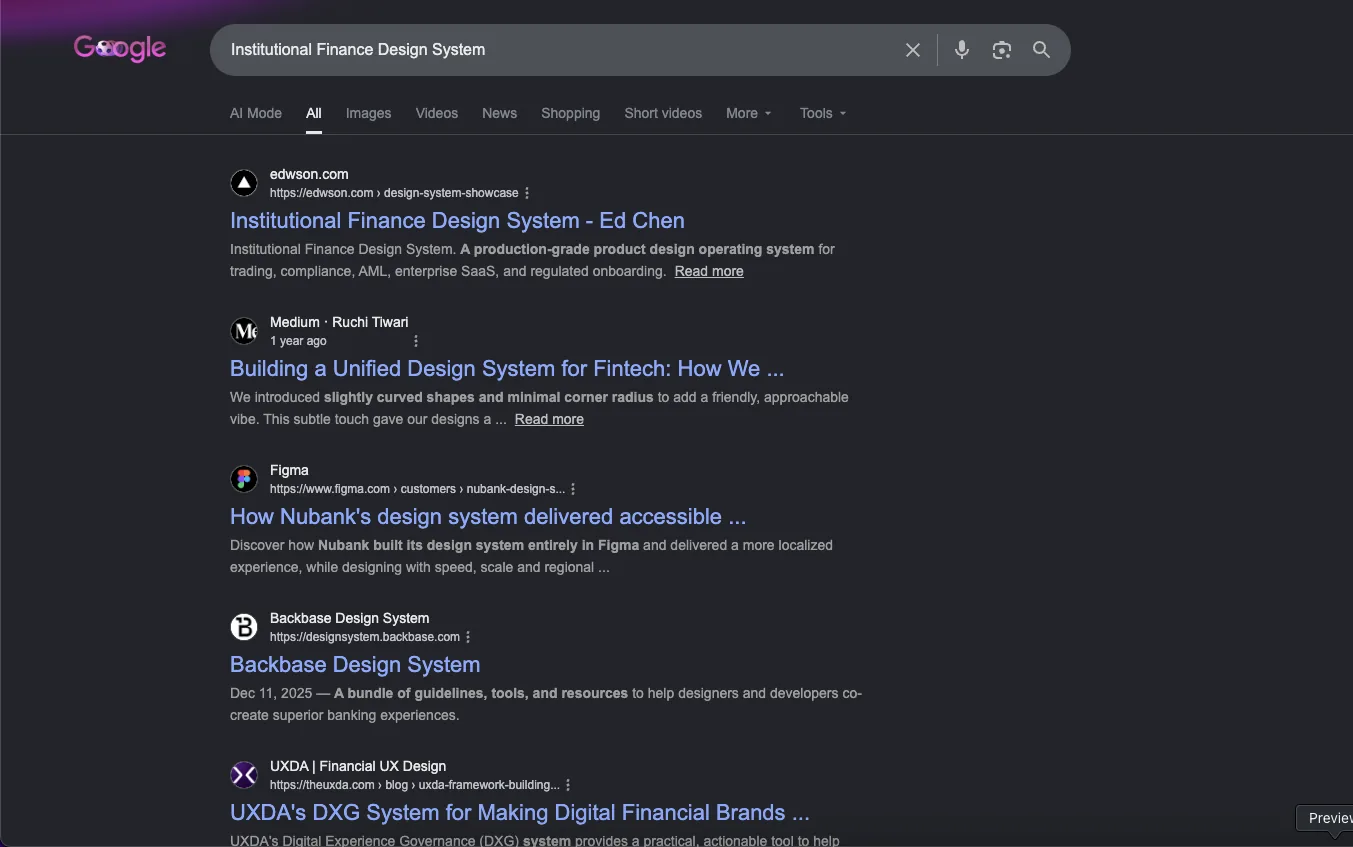
“Institutional Finance Design System” → #1, above Figma’s Nubank case study, Backbase, and UXDA.
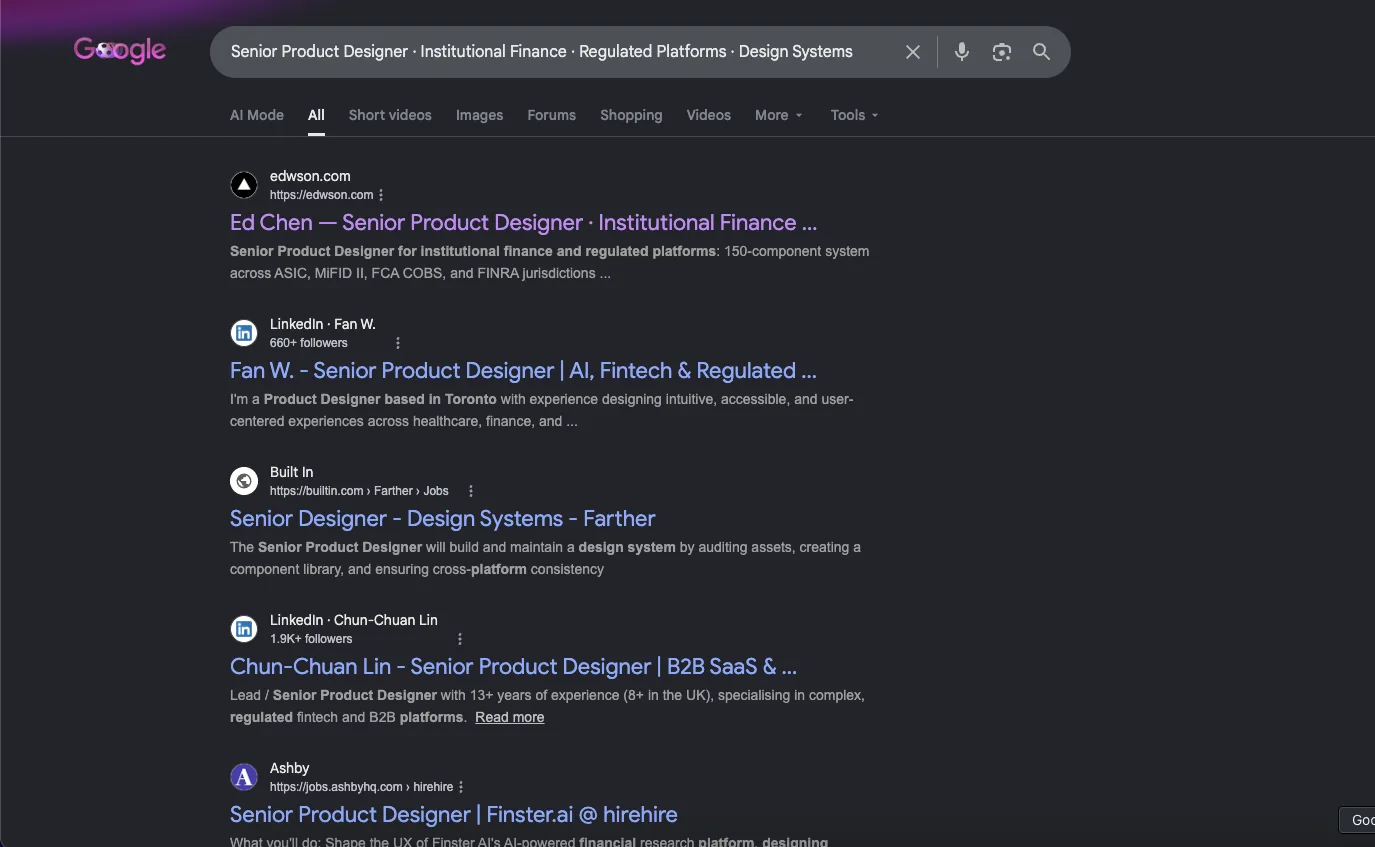
“Senior Product Designer · Institutional Finance” → #1, above LinkedIn profiles — the exact query a recruiter types.
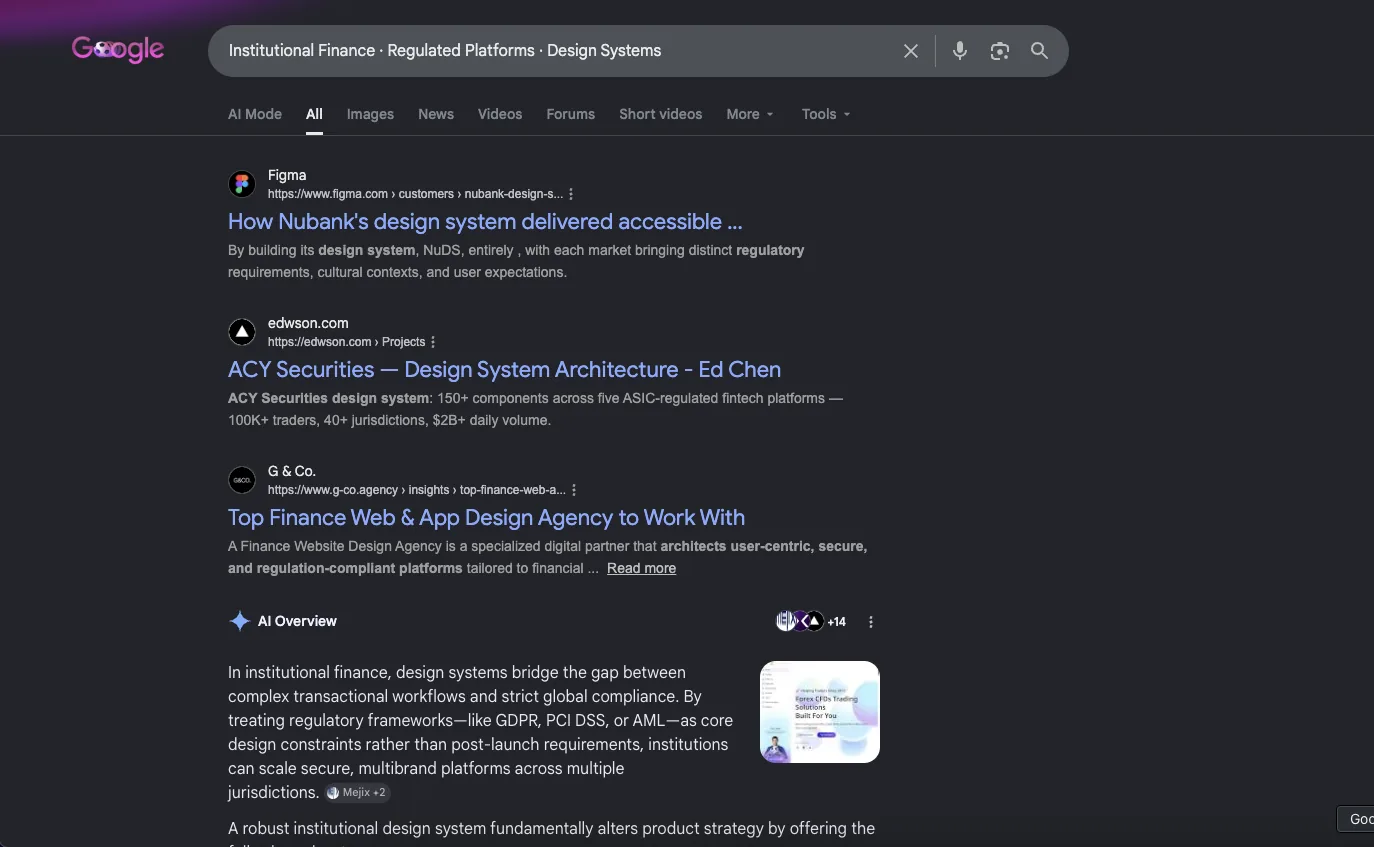
Google’s AI Overview surfaces the ACY Securities platform I designed — AI answer engines cite the work, not just the portfolio.
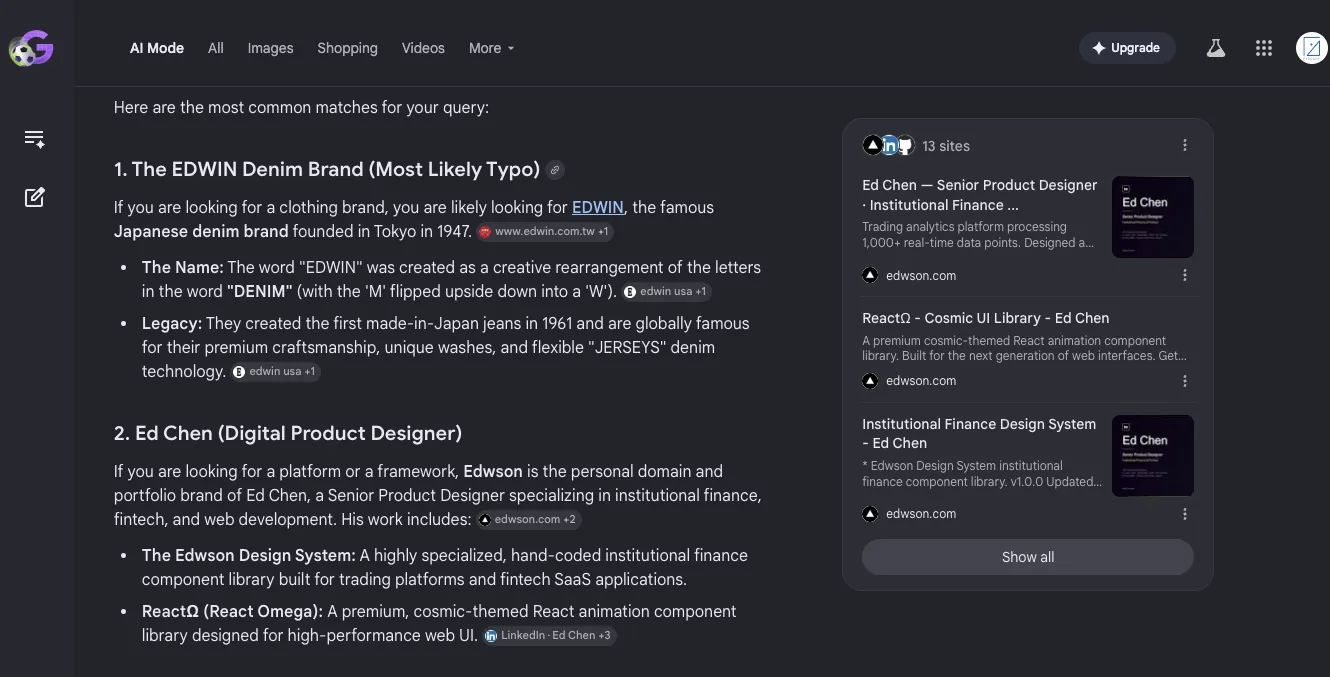
Google’s AI Mode names the work as a distinct entity — #2 after the 78-year-old EDWIN denim brand — and sources its answer almost entirely from edwson.com.
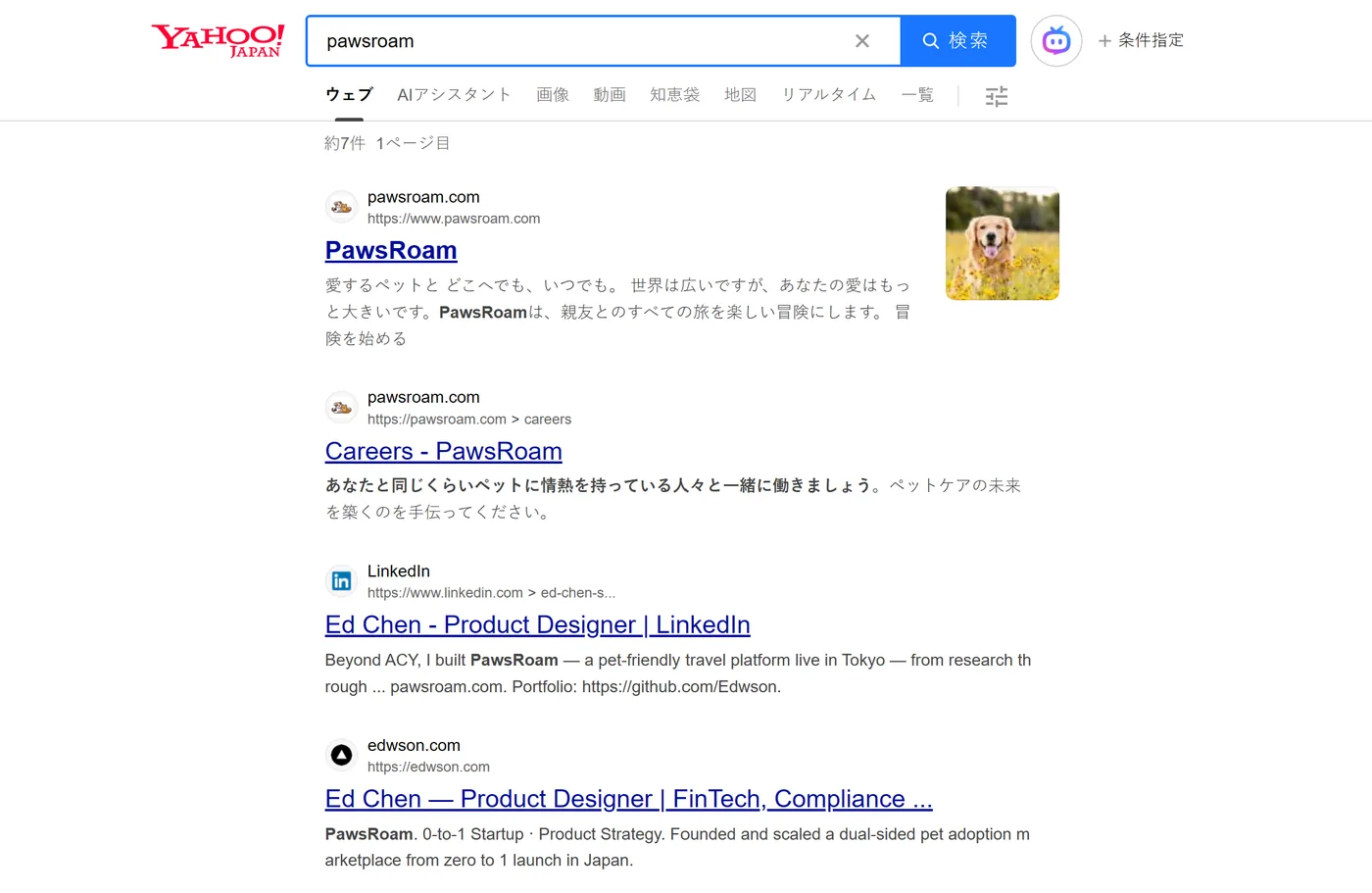
Yahoo Japan — the first page resolves almost entirely to my own work. In my target Tokyo market, the results return a product I built and shipped there (#1, plus its careers page), my LinkedIn, and the edwson.com portfolio — on Japan’s #2 search engine, not just Google.
Live snapshots, June 2026. Search results are personalized and shift over time — these are a moment, not a permanent ranking claim.
Six threads, one portfolio
The case studies on this site aren't isolated.
They sit on six threads — recurring problem classes formalised in /threads.json, where each project demonstrates a
different solution
profile under different cost, ROI, and risk constraints. Pick any case study, scroll to the bottom, and
follow the threads to see how the same class of problem was solved elsewhere.
- Regulatory Routing & Disclosure How upstream regulation and macro prints become downstream product defaults.
- Concentration, Risk & Agents Portfolio-level math primitives rendered into UI defaults and AI-assisted decisions.
- Retail → Institutional Translation Consumer-grade UX into regulated contexts — or reverse-porting institutional discipline to retail.
- Editorial Voice in Finance Luxury and editorial discipline in financial interfaces — where restraint is signal.
- Evidence & Verification Discipline How design claims get proven with data — A/B, pooled-SD, cohort, the rigor behind every number quoted.
- Fiduciary AI & Sign-off Discipline AI surfaces options, humans hold the commit. Every AI suggestion carries an explicit consent surface and an audit hook — no autonomous execution where regulation requires a human signature.
The discipline that runs underneath every project on this page.
The six threads above are the recurring problem classes across the portfolio. What holds them together sits in four field notes at the bottom — where every claim carries its source or named instrument, and its limits.
What the disclosure register says. Four field notes carry the burden of proof:
· Finlogix methodology — turns Cohen’s d = 2.47 from a marketing claim into a science claim with named limits.
· Post-launch iteration — an 18-month ASIC RG 268 arc with a v1 failure mode and one honest negative result.
· Accessibility audit — six named limits a certified conformance letter would close.
· Political skill — the user who did not want the software, and what earned adoption.
What each note carries: what is measured, what isn’t, what limits apply, and what would change running the work today.
- Finlogix Cohen’s d = 2.47 disclosure
- n = 15 paired within-subjects design
- Seven limits named
- Eight-direction replication plan
- RG 268 disclosure surface, 18 months
- v1 modal → v2 strip → v3 inline
- Muscle-memory dismissal failure named
- Honest negative result on AUM lift
- 12 token contrast pairs measured
- ARIA + keyboard patterns documented
- Six limits named
- Six-component replication plan with cost estimates
- ACY Connect, 12 institutional clients
- One IT director who didn’t want to migrate
- Three credible objections named
- Three verification surfaces that earned adoption
Education
Recognition
Let's Talk
If you're hiring for a senior product design role inside an institution where the work gets reviewed — by clients, regulators, or auditors — I'd rather hear from you directly than be filtered through a generic recruiting pipeline. The fastest path is email; LinkedIn works too. I read everything that lands in either inbox.