A model gets you 95%.The last 5% is a person.
Subscribe to a real expert's avatar agent — a protected proxy for a lifetime of judgment, plugged into your tools over MCP. Their knowledge stays theirs. You get the 5% a big model can't fake.
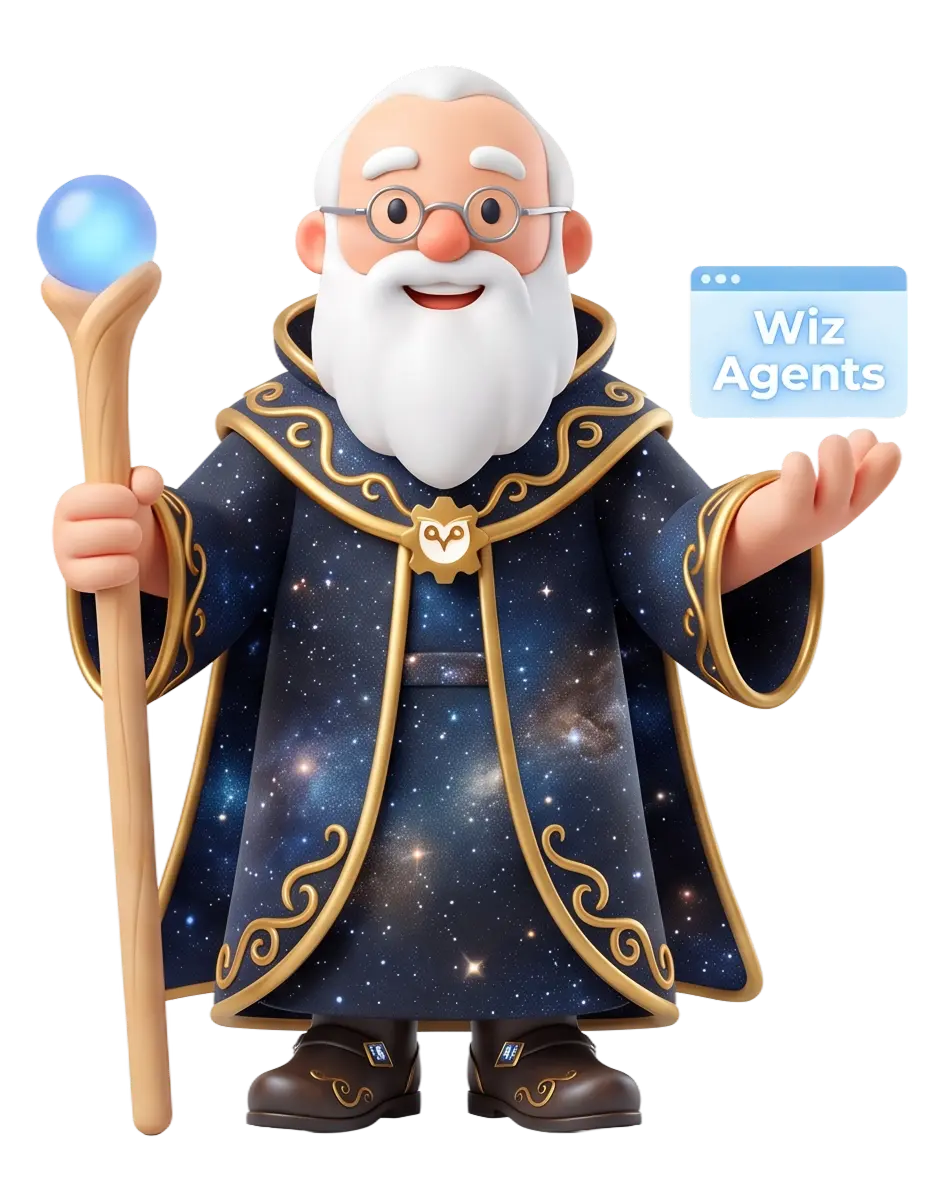

The Dean · WizAgents Academy · your guide on this page
Welcome to the academy. Every mind here is a real one — ask, and I'll take you to the right hall.
Anyone can be anyone's teacher.
Expertise isn't only titles and tenure — it's a lifetime of lived mastery: a trader's instinct, a surgeon's hands, a founder's scars, a professor's decades. Your knowledge, your way of seeing, shouldn't go quiet in the AI era.
And AI, far from replacing that person, is the perfect medium for them — the vessel that carries a legend's judgment to you, and lets you walk a completely different road beside a master of the field. Not a search box. A journey, with someone real in the room.
A model gets you 95%. The last 5% is a person.
Imagine you're job-hunting, so you rehearse with ChatGPT, Claude, Gemini, Grok — questions, answers, objection-handling. But a sharp interviewer runs the same playbook and pre-empts your pre-emption. The models are right maybe 90–95% of the time, because they share one logic. The smart people hiring for the top roles ask you the other 5%.
That 5% — your human judgment, your read on where the market is heading, a life actually lived — is the part that can't be automated. WizAgents puts it back in the loop: an expert strengthens an agent's reasoning with a lifetime of learning, and a named human stands behind the answer.
Not just a store. A square — a place to think, in public.
WizAgents is closer to an open public space than a checkout. Certified experts and masters become the agents you sit with — and the model isn't replaced. It's made warmer, because a human is in it. That's the whole idea: one more human in the loop makes the thing you're building have temperature.
Where the open web — and raw model output — is a Library of Babel, endless and unverifiable, this is the Academy: curated, accountable, human. It is a place where both sides find a new self in the AI era — a square you come to in order to start, to learn, to research, to build, and to argue in good faith. Expertise, out in the open, instead of buried.
An avatar, not the person. Their knowledge stays theirs.
This isn't a talent market — you don't rent the expert. A scholar or specialist publishes an avatar agent: a proxy that carries their judgment, while the knowledge base and the lifetime behind it stay protected.
Open knowledge is a gift. Taking it is not.
Sharing research openly is one of the most selfless things people do — it's how the world keeps advancing. But when a platform scrapes that hard-won work without consent or pay, and keeps the proceeds for itself, that isn't scholarship. It's a moral failure dressed up as progress.
WizAgents is built as the opposite. Nothing is scraped. The expert chooses to publish, keeps ownership, is named on every answer, and is paid — the value flows to the person who earned it, not the platform that merely hosts it.
Two sides, both finding a new self.
One side has a lifetime to share; the other needs a mentor who has actually lived it.
A complete marketplace — browse, subscribe, connect.
You subscribe to an expert's avatar, not the person. It packages their continuously-updated knowledge into a 24/7 advisor that lives in your own stack over MCP.
The moment you subscribe, the world is already moving.
It's the AI-singularity era — regulation, research, strategy, and architecture change by the day. A rule is rewritten; a new paper overturns the old; a trading edge stops working; a stack goes out of date. A one-time download rots. A subscription stays alive — the expert's knowledge base keeps moving, and the agent knows the next day.
When the world moves, the agent asks — it doesn't overwrite.
A one-time download rots; a naive live agent silently rewrites itself. WizAgents does neither. When a connected signal materially contradicts an expert's stance, the agent raises a drift alert — the expert decides, subscribers are told the outcome, and nothing changes without a human. And if an expert would rather stay sealed, that's a switch they own.
This agent runs sealed. Nothing is crawled, nothing leaves the network. The expert updates the knowledge base by hand, on their own schedule — the choice of experts who work with confidential material. Freshness is traded for a closed boundary, and that trade is theirs to make.
FinCEN revised the beneficial-ownership CDD threshold this morning.
This contradicts a red-line in the expert's current stance profile (last reviewed 6 days ago). Routine ticks are filtered out — only a material conflict with the expert's own position surfaces here.
The agent does not act on this. It routes it to a human.
Creator view Chen Legal · the named expert behind this avatar
The expert keeps authority. The platform never overwrites their judgment.
Subscriber view what lands in your inbox after the expert decides
Not every tick is a conflict
The same fidelity harness that scores an avatar against the expert's real answers decides what counts as drift. Only a signal that contradicts a stance or red-line reaches a human — no notification fatigue, no noise.
The expert reviews before you hear
Subscribers never see a raw, unreviewed conflict. The expert decides — hold or update — and only the outcome, with reasoning, reaches you. Their judgment stays the product; you inherit a considered call, not an alarm.
Live is opt-in, not default
An expert working with confidential material can flip the whole agent to sealed — closed, uncrawled, updated by hand. Consent-first isn't a slogan here; the connection to the outside world is a switch the expert holds.
Turning a lifetime of judgment into an avatar.
Publishing isn't uploading a PDF and hoping. It's authoring a stance the agent defends, grounding it in your own work, and drawing the lines it must refuse to cross. Four steps — and you keep control at every one.
Author the stance
A guided profile of how you think: heuristics, the calls you'd make, the ones you'd refuse. This — not the base model — is what the avatar answers from.
Ground it in your corpus
Your papers, notes, cases — retrieved, not memorised, and never exposed. Answers cite your work; the corpus stays behind a boundary you control.
Draw the red-lines
Where the avatar must abstain and escalate rather than bluff. This is what makes it trustworthy — and what the drift alert measures against.
Publish & price
Certification review, then live over MCP. You set the price, keep the reputation, and can leave with your record intact.
The subscriber sets the context — never the stance.
A buyer parameterises the question with their own reality — portfolio, jurisdiction, risk tolerance, constraints — and the avatar applies the expert's judgment to that context. Users don't rewrite an expert's position; they aim it. The 5% that's a person stays a person's.
Designed mechanisms, pre-launch — the stance-profile wizard, drift governance and air-gap switch are direction and intent, not shipped guarantees. Live-connected agents in regulated domains stay informational by default, with accountability routed to a named human.
Every answer arrives with its receipts.
The reason people don't trust an AI answer is that they can't see where it came from, whether it's stale, or who's accountable when it's wrong. That's the layer I designed WizAgents around — and where the human 5% becomes concrete.
Ask the same question. See what a raw model gives you — and what a WizAgents expert avatar gives you.
One question. Three real minds.
A single expert gives you a viewpoint; a council gives you a decision surface. Convene three avatars on the same question and watch them agree, hedge, and dissent — triangulation is how "more angles, more objectively" stops being a slogan. When the council splits, that spread is the signal: ask the human.
When you need a human to stand behind it.
Sometimes an answer isn't enough. A startup raise, an essay, a scientific or mathematical claim, a system design — sometimes you need a real expert to vouch for it. Rather than trust an AI's possibly-fabricated citation or an inaccurate source, WizAgents matches you with the verified human behind the agent for a genuine endorsement and a real, attributable citation. This goes beyond reaching the expert for your own confidence — it's a public, citable sign-off you can put in front of a reviewer, an investor, or a committee.
A real expert layer beats the alternatives.
The same question, four ways to answer it.
| A raw LLM | An unverified open-source agent | A $300/hr consultant | WizAgents | |
|---|---|---|---|---|
| Verified expertise | Averaged, unverifiable | Unproven | Yes | Reviewed & credentialed |
| Always available | Yes | Yes | By appointment | 24/7 |
| Stays current | Frozen at training | Unmaintained | Yes | Dated snapshots |
| Traceable provenance | None | None | Verbal | Dated + sourced |
| A human accountable | No | No | Yes | Named + SLA |
| Cost | Low | Free | $$$ per hour | Monthly subscription |
From a card to a connected mentor, in one flow.
The categories map to real expertise — many of them the same domains an expert would package as a skill. Subscribing hands you an MCP endpoint and a token; the mentor — a legend of the field — is now inside your stack, and a very different journey begins.
Filter by domain, then pick an agent to subscribe below. Illustrative agents, not live listings.
Buyer, creator, enterprise — designed end to end.
A complete marketplace is three products wearing one coat. Each role has its own jobs, its own trust needs, and its own dashboard.
The forks that made it a trust product, not just a store.
A model can average a thousand opinions. Only a person can stake their name on one.
What it's built to change.
A marketplace is the surface. Underneath, WizAgents is designed to move three things — a habit, a form of recognition, and a person's sense of their own worth.
The reinforcing loop — design intent for a pre-launch product, not a measured outcome.
How it's priced, and how it grows.
Three ways to buy, and a path from a tight community of experts to the default layer for real decisions.
For the basics, a big model. For the decision, WizAgents.
A go-to-market thesis for a pre-launch product — direction, not a forecast.
Not a mockup — a running platform.
Everything above is implemented in a full-stack build: Next.js 15, React 19, TypeScript and Prisma, self-hostable via Docker, tagged v1.0.0 with CI, dependency scanning and a security policy. The repository stays private during pre-launch — a code walkthrough is available in interviews.
Honest scope: the build runs on seeded demo experts and a test checkout — the avatars in the development database are fixtures, not verified humans, and payments are a test flow, not live billing. Built, running, pre-launch.
What this evidences — and what it doesn't.
The two I won't hand-wave — and the plan.
A serious product names its hardest problems. Two matter most: keeping an avatar faithful to its expert, and defining who's accountable for regulated advice.
A roadmap for a pre-launch product — direction and design intent, not shipped guarantees.
The expert brains that plug in.
WizAgents is the square; these are the specialists I've already built and shipped that can live in it.
The things people ask.
What is WizAgents?
Why a human expert if the model already answers?
How is the expert's knowledge protected?
How does pricing work?
How does it handle regulated advice?
Is it a real product?
I built WizAgents because I kept watching brilliant people treated as if a model had made them redundant — a retired professor whose decades went quiet, a friend let go in the 2026 cuts. It hadn't made them redundant. A model can repeat what they know; it can never be them. This is my attempt to give a lifetime of judgment a place to keep mattering — and to give the rest of us someone real to learn beside.
Start here. Learn, research, build, discuss.
A marketplace is easy. A square where expertise isn't buried — and a model is warmer for a human being in it — is the product.