The thing in your drawer is cash. Duo-Shou proves it.
A LINE bot that works like a second-hand strategist — 中古の軍師. Photograph something you no longer use; in five seconds it tells you what it's worth, when to sell, and where. It never touches your goods or your money, and takes no commission.
Everyone is sitting on idle cash. Nobody knows how much — or when it's leaking.
A used phone, a camera you upgraded from, a barely-touched appliance — they're not clutter, they're depreciating assets. But the moment you think about selling, three questions stop you cold: what's it worth, is now a good time, and where do I even sell it?
The valuation sites that exist hand you a number whether or not they actually know — they have no reason to admit uncertainty. And every marketplace wants you to list more, browse more, stay longer. None of them is on your side.
Duo-Shou is built to be the one thing that is: a strategist that only earns when you trust it, so it can afford to be honest — honest enough to say sell now and leave.
The same two disciplines as my institutional work — shipped as a consumer product.
I design regulated trading and wealth surfaces for a living. Duo-Shou looks nothing like them, but rests on the exact two convictions. That is the point: the discipline isn't a register I put on for institutions — it's how I design anything.
Designed honesty
A three-tier valuation that gives a number when the market is clear, a range when it isn't, and openly says "I can't find a reliable price" when it can't — the consumer form of the modelled-not-measured disclosure register behind my field notes. An estimate is only useful if it admits its own uncertainty.
Fiduciary alignment
No commission, no custody of money, revenue only from subscription — so the advice carries no conflict of interest. The same incentive logic as the Aureus Decision Room — and an incentive analogy to the fiduciary-alignment logic behind rules like SEC Reg BI, not a claim of regulatory equivalence — in a ¥720-a-month LINE bot.
Three jobs — and every one sits on the seller's side of the table.
No upsell to buy, no nudge to keep scrolling. いくら? · いつ売る? · どこで売る?
What's it worth いくら?
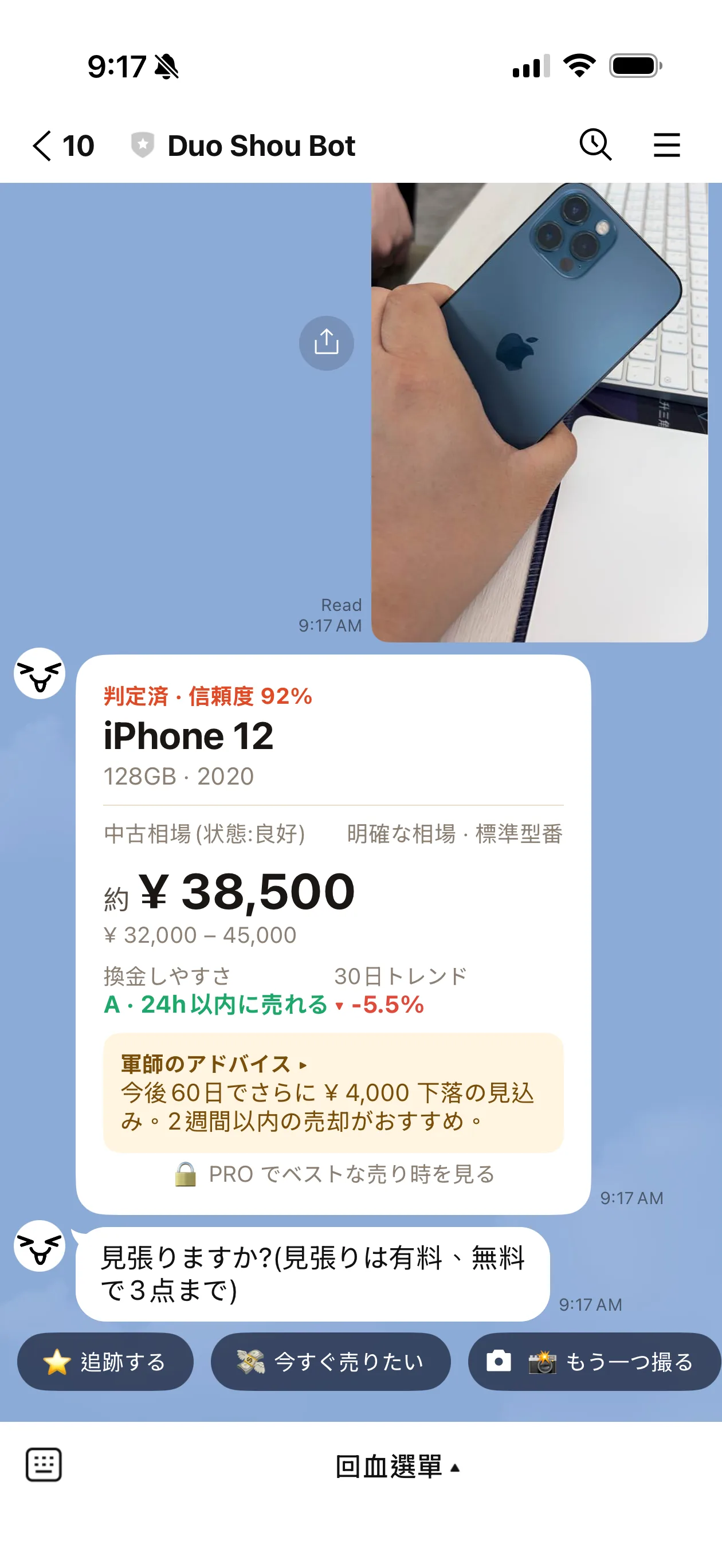
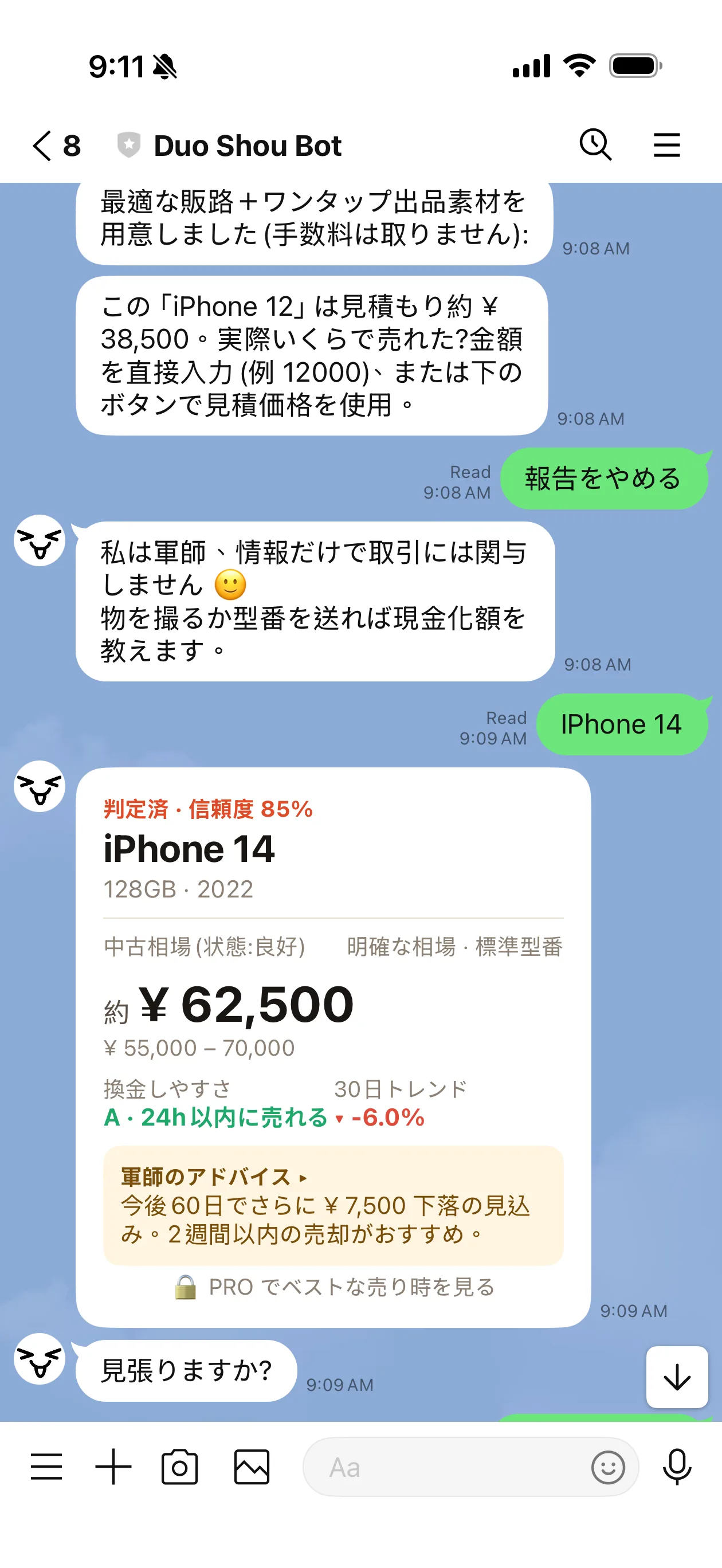
Send a photo or just type a model number. Recognition returns the item with a calibrated confidence score — 92% for a clean match, 85% for a less certain one — and a fair value as a number or a range. Typing a model is free, forever; photo recognition has a generous monthly allowance.
When to sell いつ売る?
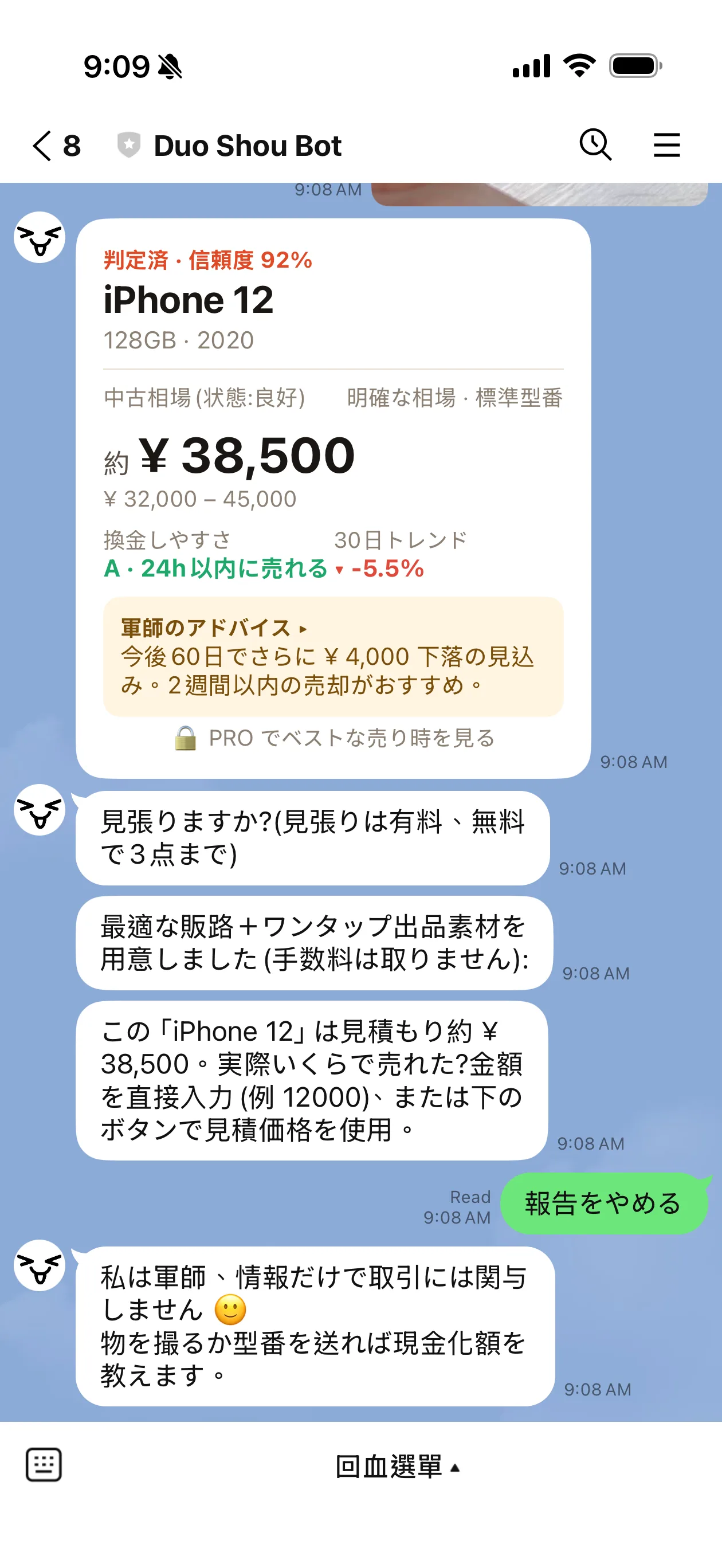
The killer feature. Duo-Shou watches the market and pushes you before a depreciation event — "the keynote is on the 12th; over the last five generations, old models dropped 8.4% in the week before." It frames the urgency as a loss countdown, then gets out of the way. The promise that makes it bearable: it only pings you when you are genuinely about to lose money.
Where to sell どこで売る?
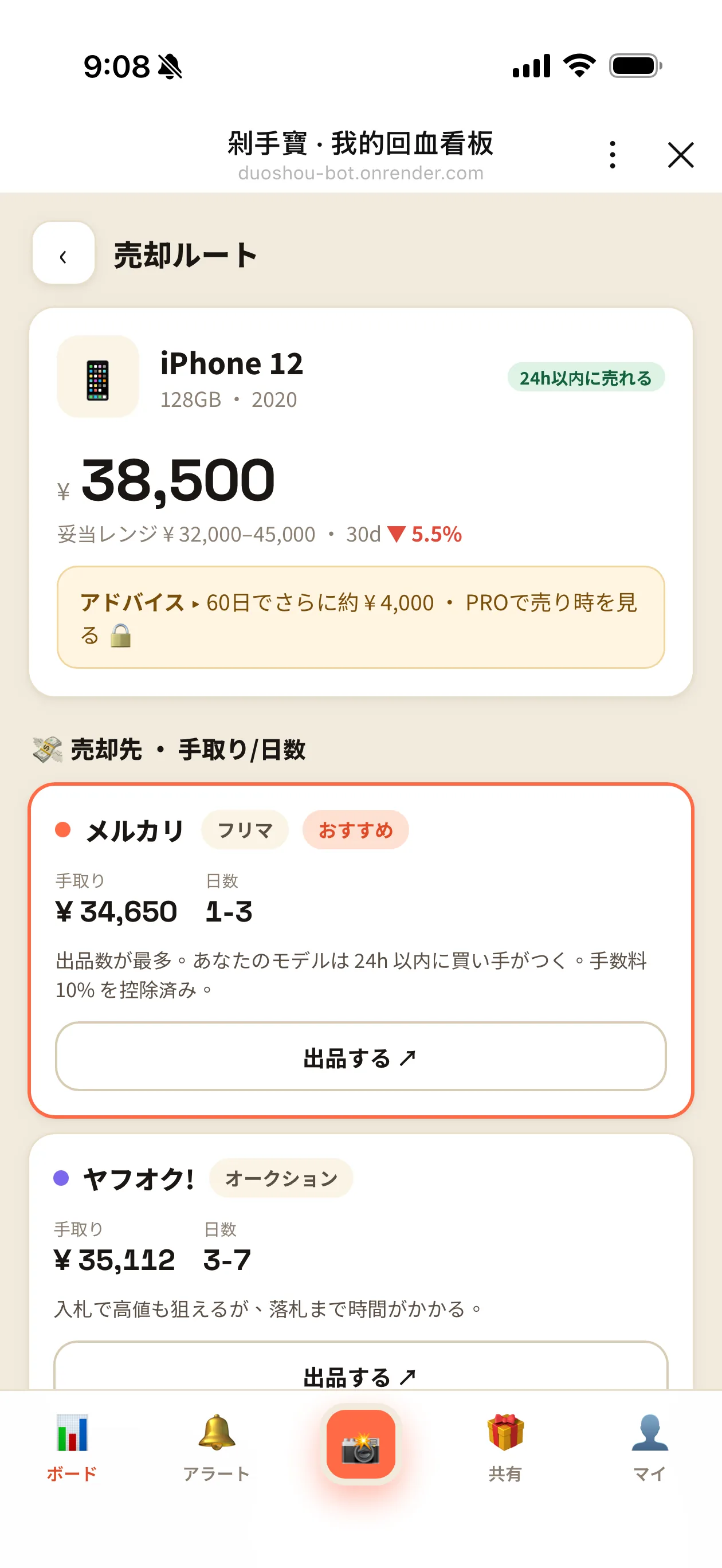
It compares each marketplace by net proceeds after fees and the days to sell, then names a pick. Crucially, the highest sticker price doesn't always win — the recommendation balances your money against your time and the odds of actually closing. Then it hands you ready-to-paste listing material and steps back; you complete the sale yourself.
Give a number when you can. Admit it when you can't.
Most valuation tools optimise for always returning a confident figure. Because Duo-Shou doesn't earn from the transaction, it has no incentive to manufacture a precision it doesn't have — so it grades its own certainty into three honest tiers.
The same conviction as the institutional disclosure notes, in a friendlier voice: an estimate that won't admit its own uncertainty is worse than no estimate. A bot that earns from the deal has every reason to hide that; one that earns only from your trust can afford to show it.
A strategist, not a channel. 軍師であって、販路ではない。
Marketplaces earn when you transact through them, so their "advice" is never neutral. Duo-Shou gives up that revenue on purpose, to keep the advice clean.
What it refuses to do
It doesn't hold your goods, your money, or your logistics, and takes no cut from any marketplace. No custody means no float to monetise and no settlement risk — and no reason to steer you toward the channel that pays it the most.
How it earns instead
One thing only: an optional ¥720 monthly subscription for continuous watching and sell-timing alerts, with a permanent free tier and a 7-day refund. Check for free; pay to be watched. The price of honesty is giving up the commission — so the model was designed never to need it.
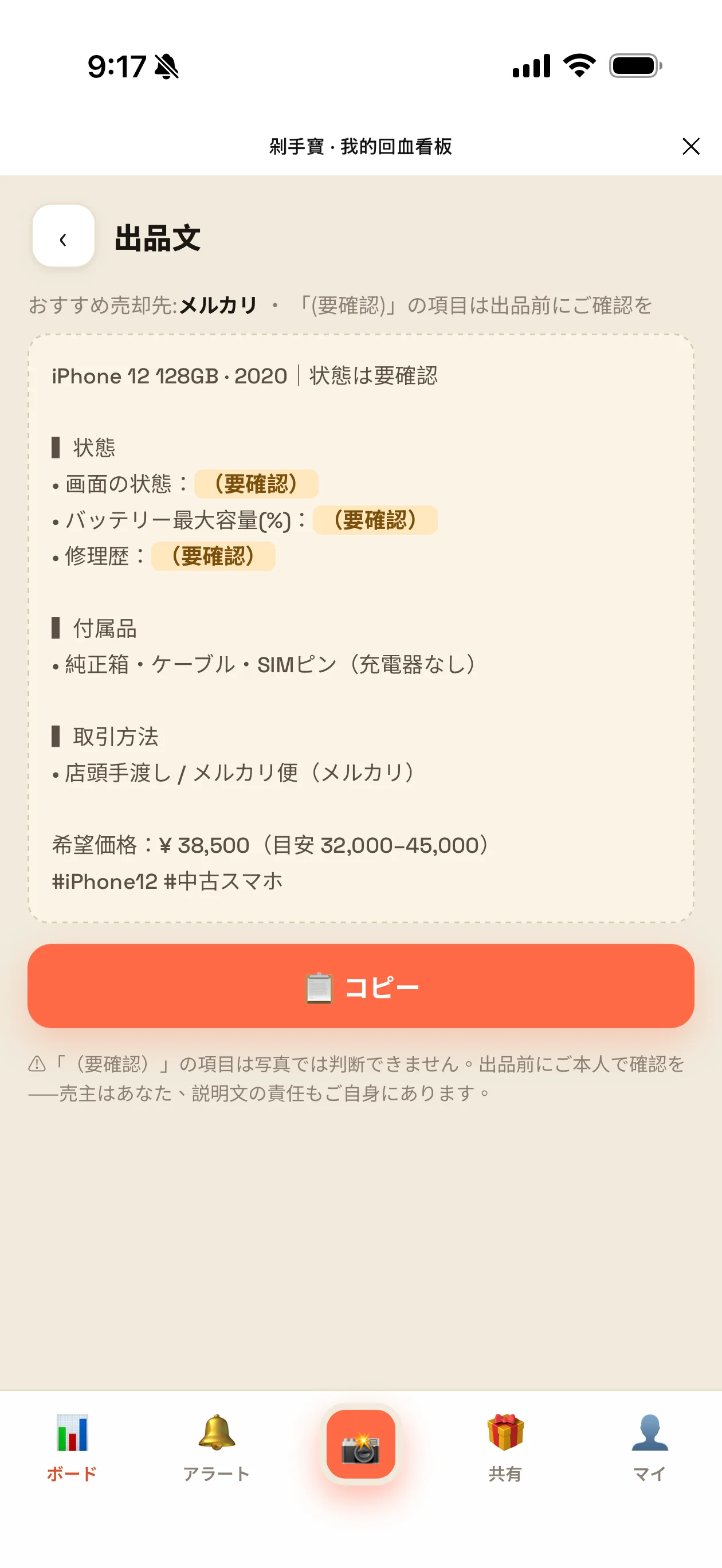
The AI drafts. The human owns it.
The bot generates the full listing — background-removed photos, copy, price — but every field it cannot verify from a photo is left as a highlighted fill-in token: screen condition, battery health, repair history.
The footnote is the whole philosophy in one line: these fields can't be judged from a photo — confirm them before you list; you are the seller, the description is your responsibility. The AI carries the tedious 80%; it never quietly invents the 20% only the owner can know — the same human-sign-off discipline I apply to AI in regulated finance.
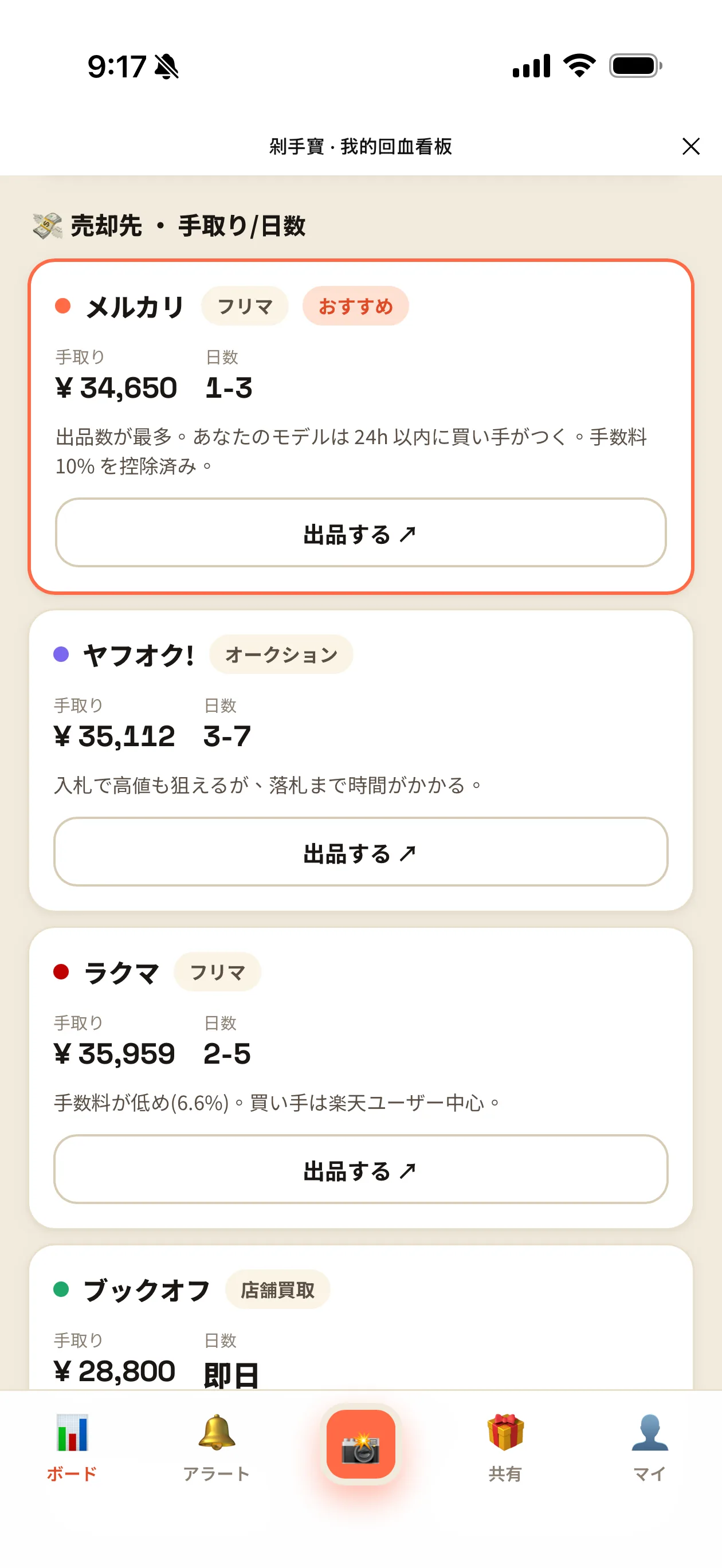
Built for where Japanese sellers actually are.
Designing for the Japanese resale market wasn't a language toggle. The currency, the price sources, and — most of all — the channels are specific to this market and its behaviour. The router knows them natively, with fees and liquidity modelled per platform.
What I deliberately didn't build.
The cuts are part of the design. Each of these would have made the product flashier and the advice less trustworthy.
Intelligence only — no float, no settlement, no escrow risk.
The human completes the sale; the bot never acts as you on a marketplace.
If the market is unclear, it says so, rather than inventing a confident figure.
It alerts you to leave at the high — the opposite of maximising time-in-app.
Data tunes its own valuation model only; aligned to ISO 27001 practice — not a certification claim; never sold.
COPPA-aware; refuses illegal or prohibited goods; respects 古物営業法 and local rules.
It's live. Go poke at it.
The real LINE bot
Add Duo-Shou as a friend and photograph something you don't use. Free to try.
duoshoubot.com
The product site — what it does, pricing, and the FAQ.
More case studies
The rest of the portfolio — institutional finance, design systems, AI.
Phase 1 Launch & Business Licensing
Currently applying for Japanese Antique Dealer Licenses (古物商許可證) and formal business registration. 100% self-funded founder build with zero VC dilution — built for organic profitability.
- Phase 1 Release Target January 2027
- Current Status Applying for Antique Dealer License (古物商許可證) & Business Registration
- Funding Model 100% Bootstrapped / Self-Funded · Zero VC Dilution